Today we will discuss about the Top 10 Largest Insurance Companies in the World (2026 Updated Rankings) with PDF, PPT and Infographic and Discover the top 10 largest insurance companies in the world based on the latest 2026 data from AM Best and S&P Global. Complete guide covering Allianz, Berkshire Hathaway, China Life, Ping An, Prudential, AXA, MetLife, Legal & General, Manulife, and Generali – with total assets, net premiums written, history, and expert analysis.
The Giants That Quietly Underpin the Global Economy
There is a good chance that at some point today, you have been financially protected by a company you have never thought about. The car you drove to work, the house you slept in, the life insurance policy that guards your family’s financial future, the health plan that covers your medical bills – all of it traces back, through chains of risk and reinsurance, to a handful of enormous financial institutions that most people could not name if asked. These are the world’s largest insurance companies, and they are among the most powerful economic forces on Earth.
Insurance, stripped to its essence, is a promise. You pay a premium today, and in exchange, a company promises to protect you from a financial loss tomorrow. That seems simple. But behind that promise sits an almost incomprehensibly complex machinery of capital, investment, actuarial science, and risk management. The world’s largest insurance companies hold total assets measured in the hundreds of billions – and in several cases, more than one trillion dollars. They are among the biggest investors in government bonds, corporate debt, real estate, and equities anywhere in the world. When they deploy capital, markets move. When they reassess risk – as they are doing right now with climate change – entire industries must adapt.
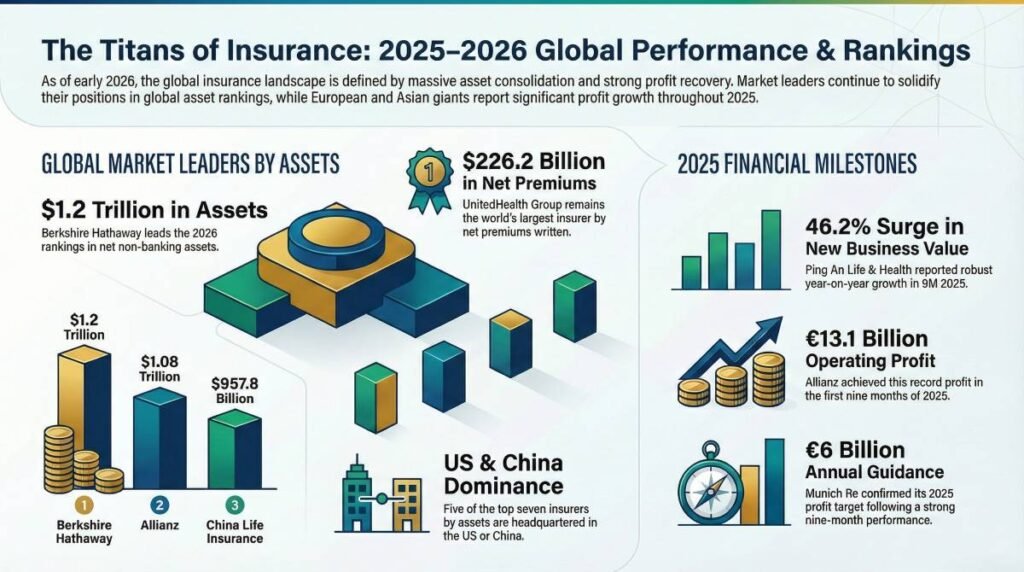
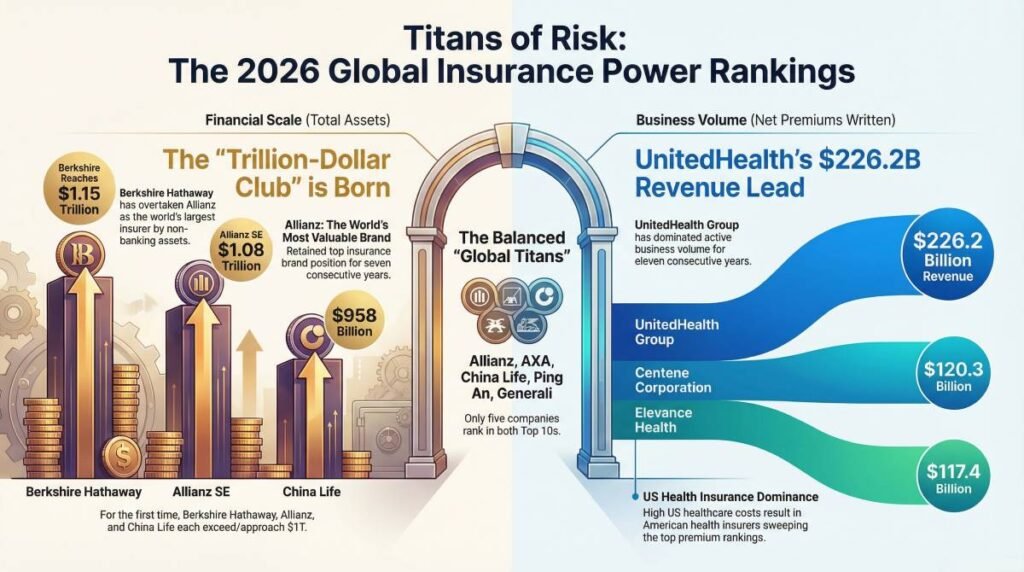
The 2026 rankings, based on the latest industry reports from AM Best and S&P Global, have brought a significant shift at the very top of the table. Berkshire Hathaway has overtaken Allianz SE to claim the number one position by non-banking assets, reaching an extraordinary $1.15 trillion. Allianz, however, holds firm at $1.08 trillion and retains its position as the world’s most valuable insurance brand for the seventh consecutive year. And for the first time in history, three companies – Berkshire Hathaway, Allianz, and China Life – simultaneously hold more than one trillion dollars in assets, forming what analysts have called the ‘Trillion-Dollar Club.’
This guide covers all ten of the world’s largest insurance companies based on the most current 2026 data, examining their history, their business models, their financial scale, and the trends reshaping each one. We also cover the separate ranking by net premiums written – the measure of active business volume – which tells a very different story, dominated overwhelmingly by American health insurance giants. Whether you are a finance professional, a student, an investor, or a curious reader, this is the most up-to-date and comprehensive guide to the world’s largest insurance companies available.
Understanding the Two Ways to Rank Insurance Companies
Before we get into the rankings, it is worth spending a moment on methodology, because the question ‘which is the world’s largest insurance company?’ genuinely has two very different answers depending on how you measure it.
By Total Assets – The Measure of Financial Scale
Total assets represent everything a company owns – its investment portfolio of bonds, equities, and real estate, its cash, its reinsurance receivables, and all other items on the balance sheet. For insurance companies, which hold large pools of capital to back their long-term policy obligations, total assets are the most comprehensive measure of overall financial size and power. A company with $1 trillion in assets is managing a sum of money that equals or exceeds the entire GDP of most countries on Earth. This metric reflects a company’s capacity to honour its commitments, its influence in financial markets, and the depth of its economic footprint. According to 2024-2026 data from AM Best, the total assets rankings are led by Allianz SE, Berkshire Hathaway, and China Life Insurance.
By Net Premiums Written – The Measure of Business Volume
Net premiums written (NPW) is the total value of insurance premiums collected in a given year, net of amounts ceded to reinsurers. This metric measures active business volume – how much insurance a company is actually selling and collecting on right now. By this measure, the rankings look dramatically different. UnitedHealth Group leads with $226.2 billion in NPW and has dominated this metric for eleven consecutive years, driven by its enormous health insurance business. Centene Corporation, Elevance Health (formerly Anthem), and Kaiser Permanente – all US health insurers – also rank among the top ten by premiums. These companies may have smaller asset bases than the European and Asian life insurance giants, but they are writing vastly more active business in revenue terms.
The right metric to use depends on what you want to understand. For financial strength and long-term stability, total assets is the superior measure. For understanding current business dominance and market share, net premiums written is more informative. This guide covers both, beginning with the total assets ranking since it is the most widely used and financially meaningful measure of insurance company size.
Top 10 Largest Insurance Companies in the World 2026 .PPTX | PPT SLIDES
Top 10 Largest Insurance Companies by Total Assets (2026)
Source: AM Best 2026 Report, S&P Global, Google Latest AI Data. All figures in US dollars as of latest available annual reports.
#1. Allianz SE – Germany
Total Assets: $1.08 Trillion | Headquarters: Munich, Germany | Founded: 1890
Allianz SE holds the number one position in the 2026 total assets ranking with $1.08 trillion – and retains this distinction as the world’s most valuable insurance brand for the seventh consecutive year, according to industry rankings published in late 2025. That combination of financial scale and brand value is no accident. It is the product of 135 years of disciplined growth, a genuinely global operating footprint spanning more than 70 countries, and a consistent commitment to financial strength that has made Allianz one of the most trusted names in global financial services.
Founded in Munich in 1890 by Carl von Thieme and Wilhelm von Finck to provide accident and transport insurance to businesses in Germany’s rapidly industrialising economy, Allianz grew steadily through the 20th century by expanding internationally at a pace that was unusual for a German company of its era. It was writing policies in South America and Asia before the First World War. It survived two world wars, multiple economic crises, and the complete transformation of the global financial system. Each time, it emerged with its financial strength intact and its global network expanded.
Today, Allianz serves over 125 million customers worldwide across its insurance and asset management businesses. In property and casualty insurance, Allianz Commercial is one of the world’s leading underwriters of complex industrial, marine, aviation, and construction risks. In life and health, it serves individuals, families, and pension funds across every major market. Its asset management arm is one of the most powerful in the world: PIMCO – the world’s largest active fixed income investment manager – manages approximately $1.8 trillion for institutional clients, while Allianz Global Investors oversees a further $500 billion or more. Together, these investment management businesses make Allianz not just an insurer but a dominant force in global capital markets.
Allianz’s financial strength ratings – consistently among the highest in the global insurance industry from AM Best, S&P, and Moody’s – reflect its exceptional capital position and disciplined risk management. Its solvency ratios routinely exceed regulatory requirements by a significant margin, a fact that matters enormously to the pension funds, corporations, and institutional clients that rely on Allianz to honour commitments extending decades into the future. The 2026 rankings confirm what has been clear for many years: Allianz is the benchmark against which all other global insurers are measured.
#2. Berkshire Hathaway – United States
Total Assets: $1.07 Trillion (Non-Banking Assets: $1.15 Trillion) | Headquarters: Omaha, Nebraska, USA | Founded: 1839 (Insurance operations from 1967)
Berkshire Hathaway has made headlines in the 2026 rankings for a very specific reason: it has overtaken Allianz to become the world’s largest insurer by non-banking assets, reaching $1.15 trillion. This distinction matters because Berkshire’s asset base includes significant holdings in financial companies – most importantly its major stake in Bank of America and other financial sector investments – that some analysts prefer to exclude when comparing pure insurance balance sheets. However measured, Berkshire sits firmly in the Trillion-Dollar Club and represents one of the most unusual and instructive business models in the history of global insurance.
The genius of Berkshire Hathaway under Warren Buffett is built entirely on a concept he calls ‘float.’ When insurance companies collect premiums, they hold that money between collection and claims payment – sometimes for years, sometimes for decades in the case of long-tail liability policies. This pool of money is the float. For most insurance companies, float is a liability to be managed cautiously. For Buffett, it has been the greatest investment vehicle in history – free capital that he has invested for more than 50 years in equities, bonds, and entire businesses, compounding at exceptional rates without paying a cent of interest on it. Berkshire’s current float exceeds $160 billion, and the company has historically achieved an underwriting profit – meaning the float has cost Buffett nothing. The returns on that free capital are what has built Berkshire’s trillion-dollar empire.
Berkshire’s insurance operations span three major platforms. GEICO is one of the largest automobile insurers in the United States, serving more than 28 million vehicles with a direct-to-consumer model that eliminates agent commissions and passes the savings to policyholders. Berkshire Hathaway Reinsurance Group handles some of the world’s largest and most complex reinsurance contracts. General Re, acquired in 1998 for approximately $22 billion, provides international reinsurance capabilities across property, casualty, and life lines. Together, these operations generate the tens of billions in annual premium income that feeds Berkshire’s float and funds its investment activities.
What separates Berkshire from every other company in this ranking is the investment philosophy layered on top of the insurance operations. While most insurers invest their float in short-duration bonds to match their liability profiles, Buffett invests Berkshire’s float in a concentrated portfolio of long-term equity holdings – major positions in Apple, Bank of America, Coca-Cola, American Express, Chevron, and dozens of others – treating them as permanent investments rather than tradeable securities. This approach has produced investment returns that have compounded at rates far above industry norms over five decades. Berkshire Hathaway is not merely the world’s largest insurer. It is a masterclass in what the insurance float, properly managed by a genuinely exceptional investor, can become.
#3. China Life Insurance – China
Total Assets: $958 Billion | Headquarters: Beijing, China | Founded: 1949
China Life Insurance is the third member of the Trillion-Dollar Club – though at $958 billion it sits just below the trillion threshold – and is the largest life insurer in China, a market that has grown from virtually nothing in 1980 to the world’s second-largest insurance market in less than 50 years. China Life’s story is inseparable from the story of China’s economic transformation, and understanding what this company does and why it matters requires understanding just how fundamentally Chinese society has changed in living memory.
China Life traces its origins to the People’s Insurance Company of China, established in 1949 immediately after the founding of the People’s Republic. For the first three decades of communist governance, formal insurance was largely irrelevant to most Chinese citizens – the socialist work unit system provided housing, employment, healthcare, and retirement through the state. But when Deng Xiaoping launched economic reforms in 1978 and the work unit system began to dissolve, hundreds of millions of Chinese families suddenly found themselves without the financial safety net they had relied on for a generation. Life insurance, health insurance, and savings products filled this gap – and China Life, restructured as a joint stock company in 1999 and listed in Hong Kong, New York, and Shanghai in 2003 and 2004, became the primary vehicle through which Chinese families accessed financial protection for the first time.
The scale of China Life’s operations is almost impossible to grasp intuitively. It serves over 680 million customers – more people than the entire population of Europe – through a distribution network of over one million licensed sales agents and tens of thousands of bancassurance distribution points. Its investment portfolio, one of the largest in Asia, spans Chinese government bonds, equities, infrastructure, and real estate. For hundreds of millions of Chinese families, a China Life policy represents their primary financial safety net beyond the basic state pension system – a responsibility the company takes seriously and that the Chinese government monitors closely.
At $958 billion in total assets, China Life has grown at a pace that reflects the extraordinary velocity of Chinese economic development. The challenges ahead are significant: an ageing population is simultaneously increasing demand for retirement and healthcare products while reducing the working-age premium base; digital insurtech competitors are disrupting traditional distribution channels; and regulatory scrutiny of the financial sector has intensified. But China Life’s scale, its state backing, its unparalleled distribution network, and the continued expansion of China’s middle class position it for continued growth toward and beyond the trillion-dollar threshold in coming years.
#4. Ping An Insurance – China
Total Assets: $848 Billion | Headquarters: Shenzhen, China | Founded: 1988
Ping An Insurance is the most technologically ambitious major insurance company in the world – a $848 billion institution that has invested more in artificial intelligence, fintech, and digital health than almost any other financial services company on Earth, and that is using that technology investment to redefine what an insurance company can be. Founded in 1988 in Shenzhen – a city that was essentially a fishing village before China’s economic reforms – Ping An has grown in less than 40 years from a small local insurer with a few hundred employees into one of the largest and most complex financial conglomerates on the planet.
Ping An’s name means ‘peace and security’ in Mandarin, and the company was born at precisely the moment that China’s economy was beginning to create the need for exactly those things. As state-provided security faded and private wealth accumulated, Ping An was there to offer the financial products that newly prosperous Chinese families needed. The company grew by building a massive agency force, developing bancassurance partnerships with major Chinese banks, and diversifying relentlessly – into banking (Ping An Bank), investment management (Ping An Asset Management), and technology.
It is Ping An’s technology strategy that has attracted the most international attention and that most distinguishes it from its peers. The company has filed more technology patents than almost any other financial institution in the world. Its AI-powered claims processing assesses vehicle damage from smartphone photographs in seconds, with no human involvement. Its facial recognition technology has transformed customer onboarding across its insurance and banking businesses. Its medical AI platform – deployed across a network of hospitals, clinics, and online consultation services – assists doctors in diagnosis and has made Ping An one of the largest healthcare services providers in China as well as one of its largest insurers.
Ping An’s Good Doctor platform, which provides online medical consultations and health management services to hundreds of millions of users, is particularly significant. It reflects Ping An’s conviction that the insurance company of the future will be not merely a provider of financial protection but a health management partner – a company that helps customers stay healthy and manage chronic conditions, rather than simply paying claims after illness strikes. This logic is both strategically sound and commercially compelling: healthier customers file fewer claims, and customers who receive genuine health value from their insurer are far more loyal. At $848 billion in total assets, Ping An is already enormous. Its technology investments suggest it is building to be something much more.
#5. Prudential Financial – United States
Total Assets: $721 Billion | Headquarters: Newark, New Jersey, USA | Founded: 1875
Prudential Financial is one of the oldest and most recognised financial brands in the United States – its Rock of Gibraltar logo has been a fixture of American advertising for more than a century – and at $721 billion in total assets it ranks as the fifth-largest insurance company in the world by this measure. More than a traditional insurer, Prudential has evolved into one of the world’s leading asset managers, retirement solutions providers, and international life insurance businesses, with operations spanning more than 40 countries.
The company was founded in Newark, New Jersey, in 1875 by John Fairfield Dryden with a social mission that was radical for its time: to make life insurance available to working-class Americans. Before Dryden, life insurance was essentially a luxury product accessible only to the wealthy. His innovation – ‘industrial life insurance’ sold door to door in working-class neighbourhoods at weekly premiums that ordinary families could afford – was both a genuine social service and a remarkably successful business model. Prudential agents walking their regular neighbourhood routes in the late 19th and early 20th century were among the first financial professionals to bring formal financial services to ordinary Americans, and the trust they built over decades is the foundation of Prudential’s brand recognition today.
The modern Prudential is dramatically more sophisticated than the one Dryden founded. Its asset management arm, PGIM, manages approximately $1.3 trillion in assets for institutional clients worldwide, making it one of the ten largest asset managers on Earth and one of the most important investors in global fixed income markets. In the United States, Prudential’s group insurance division provides employee benefits – life, disability, and dental coverage – to hundreds of thousands of employers and tens of millions of employees. Internationally, Prudential has built significant businesses in Japan, South Korea, Taiwan, India, and across Southeast Asia that have become important sources of earnings growth as the US life insurance market matures.
Prudential demutualized in 2001 – converting from policyholder ownership to a publicly traded company – in one of the largest IPOs in US history at the time. Since then, it has pursued a deliberate strategy of shifting toward higher-return, lower-capital-intensive businesses: asset management, international insurance in high-growth Asian markets, and institutional retirement solutions. PGIM has become the fastest-growing part of the business, attracting institutional clients worldwide with its expertise in fixed income, real estate, and alternative assets. At $721 billion in total assets, Prudential stands as one of the genuine titans of global financial services.
#6. AXA S.A. – France
Total Assets: $711 Billion | Headquarters: Paris, France | Founded: 1816
AXA is Europe’s second-largest insurance company by total assets in the 2026 rankings and one of the most globally diversified financial institutions on Earth. With operations in more than 50 countries, approximately 94 million customers worldwide, and a history stretching back to 1816, AXA is simultaneously a deeply French institution with roots in continental European financial culture and a genuinely global enterprise with major operations across North America, Asia, Africa, and the Middle East. At $711 billion in total assets, it is a company of extraordinary scale whose influence extends far beyond its balance sheet.
The modern AXA was substantially created through the vision and aggressive dealmaking of Claude Bébéar in the 1980s and 1990s. Bébéar saw, before most of his competitors, that the deregulation of global financial markets was creating an opportunity to build a truly international insurance and financial services group. He used the platform of a modest French regional insurer called Mutuelles Unies as the launching pad for an acquisition spree that transformed the company: The Equitable Life Assurance Society of the United States in 1992; UAP, then France’s largest insurer, in 1996, more than doubling AXA’s size overnight; Guardian Royal Exchange in the UK in 1999; Winterthur Group in Switzerland in 2006. Each acquisition brought new markets, capabilities, and customers that the organic efforts of decades could not have replicated.
AXA’s product range spans the full spectrum of insurance and financial services. Its property and casualty operations insure homes, vehicles, businesses, and agricultural operations across dozens of countries. Its life and savings business offers everything from basic term life to complex investment-linked savings products and pension solutions. Its international health insurance division, AXA Partners, is one of the world’s leading providers of medical insurance to multinational corporations and internationally mobile individuals. AXA Investment Managers, the group’s asset management arm, manages over $800 billion for institutional and retail clients globally – making AXA a major force in global capital markets as well as in insurance.
One of AXA’s most distinctive strategic commitments is its leadership on climate risk. The company has made formal commitments to exit fossil fuel investments, stop insuring coal mines and coal-fired power plants, and position itself as a leader in sustainable finance and green investment. This commitment reflects both genuine conviction about the direction of the global economy and the insurance industry’s very direct financial interest in climate change – a phenomenon that is already materially increasing the natural catastrophe losses that property insurers must pay. AXA’s climate leadership has enhanced its brand reputation, particularly in Europe, and positioned it as a partner of choice for the growing universe of organisations seeking to align their financial activities with sustainability goals.
#7. MetLife Inc. – United States
Total Assets: $688 Billion | Headquarters: New York, USA | Founded: 1868
MetLife is one of the most globally diversified American life insurance companies – a 157-year-old institution whose Snoopy mascot and iconic New York skyline presence have made it a fixture of American commercial life, while its international footprint spans more than 40 countries across five continents. At $688 billion in total assets in the 2026 rankings, MetLife ranks seventh globally and remains one of the most significant life insurance and financial services companies in the world.
Founded in New York in 1868 with the same social mission that animated Prudential – bringing life insurance to working-class Americans who had previously been shut out of the market – MetLife grew over the following century to become the largest life insurer in North America by the early 20th century. Its door-to-door industrial life insurance agents, covering their regular neighbourhood routes in cities and towns across America, built the brand recognition and trust that MetLife carries to this day. The company converted from mutual to publicly traded corporation in 2000, raising approximately $2.9 billion in one of the largest IPOs in US history and funding a decade of ambitious acquisition-led international expansion.
In 2010, MetLife made one of the most consequential acquisitions in modern insurance history: the purchase of American Life Insurance Company (ALICO) from AIG for approximately $16 billion. ALICO brought MetLife a major international life insurance platform spanning 50 countries, with particularly strong operations in Japan – which became MetLife’s most important international market – and across Latin America, Europe, the Middle East, and Asia. This acquisition transformed MetLife from a primarily domestic US insurer into a genuinely global life insurance company almost overnight.
A defining moment in MetLife’s recent history came in 2016 when it executed one of the most significant strategic decisions in the US insurance industry: spinning off its US retail life insurance and annuity operations – with over $240 billion in assets – into a separate publicly traded company called Brighthouse Financial. The motivation was regulatory: MetLife had been designated a Systemically Important Financial Institution, with significant associated capital requirements, and argued that shedding its most capital-intensive retail business would remove the justification for that designation. It eventually won that argument in court. The post-separation MetLife is leaner and more focused on its group benefits and international businesses – a strategic direction that reflects a deliberate choice to prioritise return on equity over absolute size.
#8. Legal & General Group – United Kingdom
Total Assets: $665 Billion | Headquarters: London, United Kingdom | Founded: 1836
Legal & General is one of the most significant and least globally recognised of all the world’s largest insurance companies – a 188-year-old British institution that most people outside the United Kingdom have never heard of, yet which manages assets comparable to AXA and MetLife and plays a critical role in funding infrastructure, housing, and long-term investment across the UK economy and beyond. Its $665 billion in total assets places it eighth in the 2026 global rankings, and its business model is in several respects more innovative than that of its more famous competitors.
Founded in London in 1836 as a life insurance company serving professional workers – lawyers, doctors, and clergymen in the early Victorian era – Legal & General grew steadily through the 19th and 20th centuries to become one of Britain’s largest and most trusted financial services companies. Today, the group operates across four main business lines: retail insurance and savings for individual consumers; institutional retirement, which manages pension risk for defined benefit pension schemes by entering into bulk annuity contracts with pension funds; investment management through Legal & General Investment Management (LGIM), one of the UK’s largest asset managers with over $1.4 trillion under management; and direct investments in infrastructure, housing, and urban regeneration through its capital division.
Legal & General’s pension risk transfer business deserves particular attention because it represents one of the most significant trends in British and global financial services. As defined benefit pension funds – once the bedrock of British workers’ retirement security – have matured and their sponsoring companies have sought to remove pension liabilities from their balance sheets, they have increasingly entered into bulk annuity transactions with insurers like Legal & General. Under these transactions, L&G takes on the obligation to pay members’ pensions in exchange for a transfer of assets. These transactions have made L&G one of the most important pension providers in the United Kingdom and have driven the growth in its asset base that places it among the world’s largest insurers.
What makes Legal & General’s investment model particularly distinctive is its commitment to what it calls ‘productive finance’ – the channelling of long-term institutional capital into infrastructure, affordable housing, urban regeneration, and clean energy. Through its capital division, L&G directly funds the construction of new homes, science parks, clean energy infrastructure, and other long-duration real assets that both generate the steady long-term returns needed to back its annuity and pension liabilities and create genuine economic and social value. This model – insurer as direct infrastructure financier rather than simply a buyer of traded financial instruments – is attracting attention globally as other long-term institutional investors look for ways to deploy capital productively while managing their liability durations.
#9. Manulife Financial – Canada
Total Assets: $661 Billion | Headquarters: Toronto, Canada | Founded: 1887
Manulife Financial is Canada’s largest insurance company and one of the most globally diversified financial institutions headquartered outside the United States or Europe. At $661 billion in total assets, it ranks ninth in the 2026 global rankings and operates under the Manulife brand in Canada and most international markets, and under the John Hancock brand in the United States – one of the most historically significant life insurance names in America. Manulife’s particular strength is its deep penetration of Asian insurance markets, which has become an increasingly important driver of its growth as North American markets mature.
Founded in Toronto in 1887 as The Manufacturers Life Insurance Company with Canada’s first Prime Minister, Sir John A. Macdonald, as its first president, Manulife grew through the 20th century as a traditional Canadian life insurer before beginning an ambitious international expansion. The pivotal transaction came in 2004, when Manulife merged with John Hancock Financial Services in a deal valued at approximately $11 billion – the largest transaction in Canadian insurance history at the time and one that gave Manulife a major US platform with the iconic John Hancock brand, which carries particular recognition in Boston and New England where its flagship skyscraper dominates the skyline.
But it is Manulife’s Asian operations that have generated the most excitement among investors and analysts in recent years. The company has built significant businesses in Hong Kong, Japan, Singapore, Malaysia, Vietnam, Indonesia, the Philippines, and Cambodia – markets at very different stages of insurance market development but sharing the common characteristic of rapidly growing middle classes with increasing demand for financial protection and savings products. Asia now contributes more than half of Manulife’s core earnings and is the company’s primary growth engine. Its Hong Kong business, in particular, has benefited from strong demand from mainland Chinese customers seeking to purchase savings and protection products offshore.
Manulife has also been an industry leader in integrating wellness and health management with its life and health insurance products. Its Vitality-linked insurance programme – which rewards policyholders with premium discounts and other benefits for meeting health and activity targets – was among the first major implementations of behavioural insurance at scale in North America. The commercial logic is compelling: healthier customers file fewer claims, and the engagement generated by wellness programmes significantly improves customer retention. This approach has been influential in the broader industry and reflects Manulife’s reputation as one of the more innovative major life insurers globally.
#10. Assicurazioni Generali – Italy
Total Assets: $664 Billion | Headquarters: Trieste, Italy | Founded: 1831
Assicurazioni Generali – almost universally known simply as Generali – is one of the oldest and most storied insurance companies in the world. Founded in Trieste in 1831 at a time when that city was the principal port of the Austro-Hungarian Empire and one of the most cosmopolitan financial centres in Europe, Generali has been at the heart of European insurance for nearly two centuries. At $664 billion in total assets in the 2026 rankings, it places tenth in the global table – and its combination of deep European heritage, genuinely international operations, and ambitious strategic vision make it one of the most interesting companies in the global insurance industry.
Generali’s history is a mirror of European history itself. The company was founded in a multinational empire, expanded across Europe in the 19th century, survived two world wars and the dramatic redrawing of European borders that accompanied them, rebuilt its business across the continent after the devastation of the Second World War, and has spent the past several decades positioning itself as a pan-European insurance champion in the era of European integration. It has been listed on the Milan Stock Exchange since 1938 and is one of the most important components of the Italian financial system. The legendary literary insurance agent Franz Kafka worked for an insurance company in Prague that Generali had a relationship with – a fact the company has not let go unacknowledged.
Today, Generali operates in more than 50 countries and serves approximately 67 million customers worldwide. Its strongest markets are in Italy, France, Germany, Austria, Central and Eastern Europe, and Asia. In life insurance – which represents the larger portion of its business – Generali has built a leading position in several European markets with savings, protection, and pension products. In property and casualty, it operates across a similarly broad European footprint with personal lines, commercial, and specialty products. Its asset management operations, conducted through Generali Investments, manage approximately $600 billion in assets, making it one of the largest asset managers in Europe.
Generali has attracted significant attention in recent years for the strategic direction set under CEO Philippe Donnet, who has pursued a ‘Lifetime Partner’ strategy – positioning Generali not as a transactional product provider but as a long-term partner in customers’ financial and personal lives, providing advice, protection, and savings solutions across life stages. This strategy has involved significant investment in digital capabilities, direct-to-consumer distribution, and data analytics, and has been accompanied by a series of strategic acquisitions in Central and Eastern Europe and Asia that have expanded the company’s geographic reach. Whether Generali can execute this transformation at the scale required to maintain its position among the world’s largest insurers will be one of the more interesting strategic stories in European financial services over the next decade.
Top 10 Largest Insurance Companies by Net Premiums Written (2026)
Source: AM Best 2026 Report. Net Premiums Written (NPW) measures active insurance business volume – the total value of premiums collected minus amounts ceded to reinsurers. This ranking is dominated by US health insurance companies due to America’s extraordinarily high healthcare costs.
#1. UnitedHealth Group – USA | NPW: $226.2 Billion
UnitedHealth Group is the undisputed global leader in net premiums written and has held this position for eleven consecutive years. Its dominance reflects a single extraordinary fact: the United States spends more on healthcare per person than any other country in the world, and UnitedHealth Group – through its UnitedHealthcare insurance division and its Optum health services arm – sits at the centre of that spending. UnitedHealthcare alone insures approximately 50 million people in the United States through employer group plans, Medicare Advantage plans, Medicaid managed care, and individual insurance products. Its $226.2 billion in NPW is almost double that of its nearest competitor and more than the entire insurance premium volume of most individual countries.
#2. Centene Corporation – USA | NPW: $120.3 Billion
Centene is a major managed care organisation specialising in government-sponsored healthcare programmes – primarily Medicaid (healthcare for low-income Americans) and Medicare (healthcare for seniors and disabled individuals). It has grown explosively in the past decade through acquisitions and organic expansion of its government programme footprint. Centene serves approximately 28 million members across 50 US states and several international markets. Its $120.3 billion in net premiums written makes it the second-largest insurance company in the world by this measure, though its focus on lower-margin government programmes means its profitability profile is very different from that of the asset-heavy life insurers at the top of the total assets ranking.
#3. Elevance Health – USA | NPW: $117.4 Billion
Elevance Health, formerly known as Anthem, is one of the largest health insurance companies in the United States and the largest Blue Cross Blue Shield licensee. It serves approximately 47 million members through its commercial health insurance, Medicare, and Medicaid businesses. The company rebranded from Anthem to Elevance Health in 2022 to reflect its evolving strategy of expanding beyond traditional insurance into broader health services and care management. At $117.4 billion in NPW, Elevance ranks third globally by this measure and is one of the defining institutions of the US managed care industry.
#4. China Life Insurance – China | NPW: $115.1 Billion
China Life Insurance is the only non-American company in the top six of the net premiums written ranking – a testament to the sheer scale of its operations in the world’s most populous country. At $115.1 billion in NPW, China Life writes more life insurance premiums than any company outside the United States. This figure also reflects the maturation of China’s insurance market: a decade ago, China Life’s premium volume was a fraction of this size. The rapid growth of Chinese insurance premiums is one of the most significant trends in global insurance and positions China Life for continued strength in the years ahead.
#5. Ping An Insurance – China | NPW: $114.7 Billion
Ping An Insurance’s $114.7 billion in net premiums written places it fifth globally by revenue and makes it the second-largest insurer in China by this measure, just behind China Life. The company writes premiums across its life and health insurance, property and casualty insurance, and pension management businesses, with life insurance representing the largest component. Ping An’s premium growth has been somewhat constrained in recent years by regulatory changes in China’s insurance market and by deliberate strategic decisions to focus on policy quality and profitability rather than raw volume growth. The company’s emphasis on its technology platform and digital distribution channels suggests it is positioning for efficient, data-driven growth rather than the agent-intensive volume expansion that characterised its earlier development.
#6. Kaiser Permanente – USA | NPW: $106.4 Billion
Kaiser Permanente is unique among the world’s largest insurance companies in that it combines insurance and healthcare delivery in a single integrated model. Founded in California in the 1940s to provide healthcare to industrial workers, Kaiser Permanente operates as both a health insurance plan and a healthcare provider – owning and operating hospitals, medical offices, and pharmacies, and employing its own physicians. This integrated model gives it the ability to manage care quality and cost in ways that pure insurance companies cannot. At $106.4 billion in NPW, Kaiser Permanente is the sixth-largest insurer in the world by premiums and the largest not-for-profit integrated health system in the United States.
#7. AXA S.A. – France | NPW: $95.7 Billion
AXA is the only European company in the top seven of the net premiums written ranking and the highest-ranked non-US, non-Chinese company by this measure. Its $95.7 billion in NPW reflects the breadth of its global operations across life, health, and property and casualty insurance in more than 50 countries. AXA’s geographic diversification – spread across Europe, North America, Asia, and the Middle East – means its premium volume is far less concentrated than the US health insurance companies above it in the ranking, and its earnings are supported by a more balanced mix of product types and geographies.
#8. Allianz SE – Germany | NPW: $88.9 Billion
Allianz’s $88.9 billion in net premiums written places it eighth globally by this measure – a contrast with its top position in the total assets ranking that reflects its heavy weighting toward life insurance and asset management businesses, which generate significant investment income and balance sheet scale without necessarily producing the highest premium volumes. Allianz consistently ranks in the top five of the net premiums written list for both property and casualty insurance and for life insurance when considered separately, which confirms its genuine breadth as one of the few truly diversified global insurance groups.
#9. PICC (People’s Insurance Co. of China) – China | NPW: $84.5 Billion
PICC, the People’s Insurance Company of China, is China’s largest property and casualty insurance company and one of the most important financial institutions in the Chinese economy. Founded in 1949 as the state insurer responsible for all property and liability insurance in China, PICC has evolved through multiple restructurings into a publicly listed company with significant operations across property and casualty, life, and health insurance. Its $84.5 billion in NPW reflects China’s enormous motor vehicle market – PICC is the dominant auto insurer in China – and its leading position in commercial and industrial insurance across the Chinese economy.
#10. Assicurazioni Generali – Italy | NPW: $80.3 Billion
Assicurazioni Generali appears in both the total assets and net premiums written top ten – one of only four companies to do so, alongside Allianz, AXA, and China Life. Its $80.3 billion in NPW reflects its pan-European distribution network and its leading positions in multiple European markets across life, health, and property and casualty insurance. Generali’s presence in both rankings confirms its status as one of the few genuinely balanced global insurers – with both the financial scale and the active business volume to compete in the top tier of the global industry.
Also read: Top 10 Renewable and Non-Renewable Sources of Energy PPT PDF
2026 Key Takeaways: What the New Rankings Tell Us
The Trillion-Dollar Club Is Born
For the first time in insurance history, three companies simultaneously hold more than one trillion dollars in total assets: Berkshire Hathaway at $1.15 trillion (non-banking), Allianz at $1.08 trillion, and China Life approaching the threshold at $958 billion. This milestone reflects the extraordinary scale that the largest insurance companies have now reached – a scale that gives them influence in financial markets comparable to the world’s largest banks and sovereign wealth funds. As these companies continue to grow their investment portfolios, the possibility of China Life and potentially Ping An joining the Trillion-Dollar Club within the next few years is very real.
The US-China Duopoly
American and Chinese companies account for approximately 70 percent of the top rankings by both total assets and net premiums written. The United States dominates the premiums written ranking through its health insurance giants. China dominates the asset rankings through its enormous life insurance balance sheets. This US-China duopoly in global insurance reflects the two countries’ status as the world’s two largest economies and the depth of financial development in both countries – though the routes to that development have been very different. The US health insurance dominance reflects a private-sector-led healthcare financing system unique among developed nations. China’s asset dominance reflects the accumulation of long-term savings through life insurance in the world’s most populous country.
Allianz Retains the Brand Crown
Despite ceding the top total assets position to Berkshire Hathaway in the non-banking measurement, Allianz SE was named the world’s most valuable insurance brand for the seventh consecutive year in late 2025. Brand value in financial services reflects trust, recognition, and the premium pricing that a strong brand enables – and Allianz’s ability to sustain this position year after year demonstrates that financial scale and brand strength are not the same thing. A trusted brand is one of the most durable competitive advantages in insurance, and Allianz has built one that spans more than 70 countries.
Legal & General and Manulife Join the Global Top Ten
The 2026 rankings see Legal & General of the UK and Manulife of Canada both appearing firmly in the global top ten – a reflection of the growing importance of pension risk transfer business in the UK case and Asian market growth in Manulife’s. Both companies represent geographies and business models that have historically been less prominent in global insurance rankings, and their presence confirms that the global insurance landscape is more diverse than the US-China axis might suggest.
The Forces Reshaping the Global Insurance Industry in 2026
Climate Change: The Industry’s Most Existential Challenge
No force is reshaping the global insurance industry more profoundly than climate change. The frequency and severity of natural catastrophes – hurricanes, floods, wildfires, droughts, and extreme heat events – have been rising consistently, and the trend is accelerating. Multiple major US property insurers have withdrawn from markets in California and Florida because they can no longer price wildfire and hurricane risk at levels that generate acceptable returns. European insurers face growing flood and drought losses across the continent. Asian insurers are managing increasing typhoon and monsoon risks. The industry is simultaneously the financial backstop for climate-related losses and one of the clearest market signals about where climate risk is becoming uninsurable – a signal that has profound implications for property values, mortgage markets, and the economics of living in high-risk locations.
Artificial Intelligence: Transforming Every Part of the Value Chain
Artificial intelligence is being deployed across every stage of the insurance value chain with rapidly growing sophistication. AI-powered underwriting platforms are pricing risk with greater precision and speed than traditional actuarial methods, using vast datasets including satellite imagery, IoT sensor data, and social patterns to assess risk in ways that were impossible a decade ago. AI claims processing – already deployed at scale by Ping An and several other leaders – is handling straightforward claims without human involvement, reducing processing times from days to minutes. Fraud detection algorithms are identifying suspicious patterns across millions of claims with accuracy that human teams cannot match. And generative AI is beginning to transform customer service, product design, and distribution in ways that are still being explored.
The Ageing Demographics Dividend
Ageing populations in developed economies are one of the most powerful structural forces driving demand for insurance products. In Japan, Europe, and the United States, the proportion of the population aged 65 and over is rising steadily – and this demographic shift creates enormous demand for retirement income products, long-term care insurance, annuities, and health insurance for older individuals. The companies best positioned to serve this ageing customer base – through products that provide reliable income in retirement, protect against the financial devastation of long-term care needs, and manage the health risks of extended longevity – are likely to see sustained structural growth for decades to come.
Asian Market Growth: The Engine of the Future
The most powerful structural growth story in the global insurance industry is the continued expansion of Asian insurance markets. Rising household incomes across China, Southeast Asia, South Asia, and other Asian markets are translating into rapidly growing demand for life insurance, health insurance, and savings products. Insurance penetration – the ratio of premiums to GDP – remains significantly below Western levels across most of Asia, which means the potential for growth is enormous. The companies with established positions in these markets – AIA Group, Manulife’s Asian operations, Ping An, China Life, and others – are sitting on some of the most attractive structural growth opportunities available in global financial services.
Cyber Insurance: The Fastest Growing Major Line
Cyber insurance is the fastest growing major line of insurance in the world, driven by the explosive growth in ransomware attacks, data breaches, and business interruption incidents caused by cyber events. As businesses of every size and sector have become increasingly dependent on digital infrastructure, the financial consequences of cyber incidents have grown from inconveniences to existential threats. A major ransomware attack can shut down operations for weeks, destroy customer relationships, trigger regulatory fines, and generate litigation lasting years. The insurance industry is racing to build the underwriting expertise, data resources, and modelling capabilities needed to price and manage cyber risk profitably – and the companies that succeed in this effort stand to benefit from one of the most compelling growth opportunities in modern insurance.
Comparison Table: Top 10 by Total Assets vs. Net Premiums Written
The following summary shows how the rankings compare across both metrics, highlighting the companies that appear in both lists.
By Total Assets (Size) | By Net Premiums Written (Revenue)
- 1. Allianz SE (Germany) – $1.08T | 1. UnitedHealth Group (USA) – $226.2B
- 2. Berkshire Hathaway (USA) – $1.07T | 2. Centene Corporation (USA) – $120.3B
- 3. China Life (China) – $958B | 3. Elevance Health (USA) – $117.4B
- 4. Ping An Insurance (China) – $848B | 4. China Life Insurance (China) – $115.1B
- 5. Prudential Financial (USA) – $721B | 5. Ping An Insurance (China) – $114.7B
- 6. AXA S.A. (France) – $711B | 6. Kaiser Permanente (USA) – $106.4B
- 7. MetLife Inc. (USA) – $688B | 7. AXA S.A. (France) – $95.7B
- 8. Legal & General (UK) – $665B | 8. Allianz SE (Germany) – $88.9B
- 9. Manulife Financial (Canada) – $661B | 9. PICC (China) – $84.5B
- 10. Assicurazioni Generali (Italy) – $664B | 10. Assicurazioni Generali (Italy) – $80.3B
Companies appearing in BOTH rankings: China Life Insurance, Ping An Insurance, AXA S.A., Allianz SE, and Assicurazioni Generali. These five companies represent the most genuinely balanced global insurance businesses – with both the financial depth and the active business volume to rank among the world leaders by either measure.
Frequently Asked Questions
Which is the largest insurance company in the world in 2026?
By total assets, Allianz SE of Germany leads the 2026 rankings with $1.08 trillion in assets and has been named the world’s most valuable insurance brand for the seventh consecutive year. However, Berkshire Hathaway has overtaken Allianz to become the world’s largest insurer by non-banking assets, reaching $1.15 trillion. The distinction depends on whether Berkshire’s significant financial sector holdings are included in the comparison. By net premiums written – the measure of active business volume – UnitedHealth Group of the United States is the undisputed leader with $226.2 billion, a position it has held for eleven consecutive years.
What is the Trillion-Dollar Club in insurance?
The Trillion-Dollar Club refers to the three insurance companies that, for the first time in history, simultaneously hold more than one trillion dollars in total assets in 2026: Berkshire Hathaway with $1.15 trillion in non-banking assets, Allianz SE with $1.08 trillion, and China Life Insurance approaching the threshold at $958 billion. This milestone reflects the extraordinary scale that the global insurance industry has reached and the growing importance of insurance companies as investors and financial intermediaries in the global economy.
Why do American health insurers rank so high by premiums but not by assets?
American health insurance companies – UnitedHealth Group, Centene, Elevance Health, Kaiser Permanente – rank very highly by net premiums written because the United States spends more on healthcare per person than any other country, and health insurance premiums reflect that extraordinary cost. However, they do not rank as highly by total assets because health insurance policies are typically short-duration – covering a year at a time – which means these companies do not accumulate the vast multi-decade investment portfolios that life insurers, annuity providers, and pension managers build up over time. Life insurance and pension products generate long-term liabilities that require long-term investment portfolios to match – and it is these portfolios that drive the total assets of the European and Asian companies that dominate the size ranking.
Is Berkshire Hathaway really an insurance company?
Berkshire Hathaway is technically a diversified holding company with major operations in insurance, energy, railroads, manufacturing, retail, and technology investments. However, insurance is its foundational business and the source of the investment float – currently exceeding $160 billion – that Warren Buffett deploys across the group’s vast investment portfolio. Berkshire consistently classifies itself and is classified by financial data providers as an insurance company, and its insurance operations – GEICO, Berkshire Hathaway Reinsurance, and General Re – generate the capital that makes the entire enterprise possible. The insurance float is the engine; everything else is what the engine powers.
How is Legal & General from the UK so large?
Legal & General’s $665 billion in total assets reflects primarily its enormous pension risk transfer business. Over the past decade, UK defined benefit pension schemes have been transferring their obligations to insurers like Legal & General through ‘bulk annuity’ transactions in which L&G takes on the obligation to pay members’ pensions in exchange for a transfer of assets. These transactions have made L&G one of the UK’s largest and most important pension providers and have driven dramatic growth in its balance sheet. Its asset management division, LGIM, managing over $1.4 trillion, adds further to its financial footprint. Legal & General is less well known globally than AXA or Allianz but is a financial institution of comparable significance within the UK economy.
Which country has the most insurance companies in the global top 10?
The United States has the most companies in the top 10 by total assets, with Berkshire Hathaway (2nd), Prudential Financial (5th), and MetLife (7th) all appearing. China has two – China Life (3rd) and Ping An (4th). Europe contributes four companies: Allianz from Germany (1st), AXA from France (6th), Legal & General from the UK (8th), and Assicurazioni Generali from Italy (10th). Canada contributes one – Manulife Financial (9th). US and Chinese companies together account for approximately 70 percent of the combined assets of the top 10.
Conclusion: Scale, Trust, and the Future of Global Insurance
The 2026 rankings of the world’s largest insurance companies tell a story that is simultaneously about financial scale, global geography, demographic change, and technological transformation. The creation of the Trillion-Dollar Club – three companies with assets exceeding one trillion dollars each – marks a milestone that would have seemed extraordinary even a decade ago. The dominance of American health insurers in the premiums ranking reflects the specific pathologies of the US healthcare system as much as the strength of those companies. The rise of Chinese insurers to the top of global asset rankings reflects one of the most dramatic economic transformations in human history. And the presence of Legal & General and Manulife in the global top ten reflects business model innovations – pension risk transfer, Asian market development – that are reshaping what insurance companies do and how they create value.
What unites all ten companies, despite their vast differences in geography, business model, and strategic focus, is the fundamental business they are in: making and keeping financial promises. Insurance is, at its heart, a promise to pay – to be there when disaster strikes, when illness comes, when the paycheck stops, when the fire starts, when the market crashes. The companies that keep those promises most reliably, most efficiently, and most intelligently, over the longest periods of time, are the ones that earn the trust of the hundreds of millions of customers who depend on them.
In a world of increasing uncertainty – from climate change to cyber threats, from demographic disruption to geopolitical instability – the companies with the financial strength, the analytical sophistication, the distribution reach, and the technological capability to manage these risks and serve these customers are likely to grow in importance rather than diminish. The ten companies in this guide are, collectively, among the most consequential financial institutions on Earth. Understanding them is understanding a significant part of how the modern global economy actually works.
Data Sources: AM Best 2026 Report, S&P Global Ratings 2026, Company Annual Reports 2026, Insurance Business Magazine, Reinsurance News.