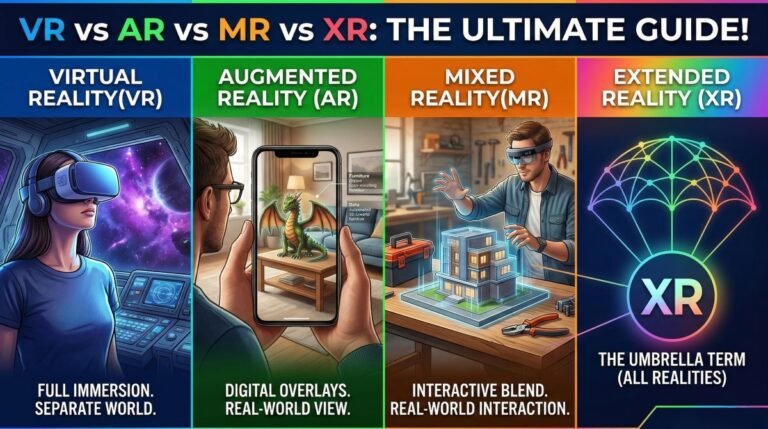
Today we will discuss about the Virtual Reality Augmented Reality and Mixed Reality PPT, PDF, Virtual Reality, Augmented Reality, Extended Reality and Mixed Reality: The Complete Guide and AR vs VR vs MR vs XR – Explained with Examples, Applications, Differences, and the Future of Immersive Technology so, Welcome to the Age of Immersive Reality, If you have ever worn a headset that transported you to a completely different world, pointed your phone at a table and watched a virtual dinosaur walk across it, or used a Microsoft HoloLens to see digital instructions overlaid on a real machine you were repairing, you have already experienced the three most transformative technologies of the 21st century: Virtual Reality (VR), Augmented Reality (AR), and Mixed Reality (MR).
Together, these technologies fall under the umbrella term Extended Reality, or XR. AR, VR, MR, and XR technology is no longer science fiction or the exclusive domain of large research laboratories. It is in classrooms, hospitals, military training facilities, retail stores, architecture firms, and, increasingly, in the pockets and living rooms of everyday people.
Yet despite the enormous buzz surrounding these technologies, a surprisingly large number of people remain genuinely confused about what makes them different from one another. What exactly is the difference between augmented reality and virtual reality? How does mixed reality fit in? And where does extended reality sit in all of this?
This comprehensive guide answers all of those questions and more. It is written to serve students looking for augmented reality and virtual reality notes, professionals researching AR VR applications, educators seeking a brief overview of virtual reality, augmented reality, and mixed reality in education, and enthusiasts who simply want to understand these technologies deeply. Whether you are downloading this as a PDF, using it as study notes, or reading it as a course reference, this article covers everything from foundational concepts to cutting-edge applications in 2025-2026.
AR vs VR vs MR vs XR: Quick Reference at a Glance
Before diving into the details, here is a quick comparison table showing the difference between augmented reality, virtual reality, and mixed reality at a glance:
| Technology | Full Immersion? | Real World Visible? | Digital Interaction? | Common Example |
| VR (Virtual Reality) | Yes – 100% | No – blocked out | Yes (virtual only) | Meta Quest 3, PlayStation VR2 |
| AR (Augmented Reality) | No – partial | Yes – fully | Limited (overlay only) | Pokemon Go, Snapchat filters, Google Maps AR |
| MR (Mixed Reality) | Partial | Yes – fully | Yes (anchored to real world) | Microsoft HoloLens 2, Magic Leap 2 |
| XR (Extended Reality) | Umbrella term | Varies | Varies | All of the above combined |
Virtual Reality Augmented Reality and Mixed Reality PPT SLIDES (.PPTX)
Section #1: What Is Virtual Reality (VR)?
Virtual Reality, or VR, is an immersive technology that completely replaces your real-world surroundings with a computer-generated, three-dimensional environment. When you put on a VR headset, everything you see, and increasingly everything you hear, touch, and even smell, is artificial. The real world around you disappears entirely. You are, in the truest sense of the phrase, transported somewhere else.
The history of virtual reality is longer than most people realize. The concept was explored as far back as the 1960s with Morton Heilig’s Sensorama machine (1962) and Ivan Sutherland’s head-mounted display (1968), often called the Sword of Damocles. Commercial VR products emerged in the early 1990s but were expensive, uncomfortable, and graphically primitive. The modern era of consumer VR began in earnest in 2012 with the Oculus Rift Kickstarter campaign, and today’s headsets, including the Meta Quest 3, PlayStation VR2, Apple Vision Pro, and Valve Index, are capable of delivering profoundly convincing virtual experiences.
How Virtual Reality Works
At its core, VR works by presenting two slightly different images, one to each eye, creating the illusion of depth and three-dimensional space. This principle, known as stereoscopic 3D, combined with head-tracking technology that adjusts the image in real time as you move your head, creates what researchers call presence, the compelling sensation of actually being somewhere else. Modern VR systems track not just head movement (3 degrees of freedom, or 3DoF) but the full position and orientation of your body in space (6 degrees of freedom, or 6DoF), allowing you to physically lean, crouch, and move through virtual environments.
- Key components of a VR system:
- Head-Mounted Display (HMD): The headset itself, housing the screens or lenses
- Motion tracking sensors: Inside-out tracking (camera-based) or outside-in (external sensor-based)
- Controllers: Hand-held devices for interacting with the virtual environment
- Processing unit: Either built into the headset (standalone) or connected to a PC/console
- Audio system: Spatial 3D audio that shifts direction as you move
Virtual Reality Examples in Real Life
Here are some of the most compelling real-world virtual reality VR and augmented reality AR experiences currently in use:
- Gaming and Entertainment: The most widely known VR application. Games like Half-Life: Alyx, Beat Saber, and Resident Evil Village VR Mode offer deeply immersive gaming experiences impossible on flat screens.
- Military Training: The U.S. Army uses the Synthetic Training Environment (STE), a massive VR platform for combat simulation, vehicle operation, and mission rehearsal without the cost or risk of live exercises.
- Medical Education: Medical students use VR to practice surgical procedures on virtual patients. Companies like Osso VR and Touch Surgery have demonstrated that VR-trained surgeons perform procedures 230% faster with higher accuracy.
- Real Estate and Architecture: Architects use VR to walk clients through buildings before a single brick is laid. Platforms like Matterport allow virtual property tours that have transformed real estate marketing.
- Mental Health Therapy: VR is used for exposure therapy in treating phobias, PTSD, and anxiety disorders. Patients can confront fear-inducing scenarios in a fully controlled, safe environment.
- Virtual Travel: Applications like Google Earth VR allow users to visit any location on the planet in immersive 3D, opening up extraordinary experiences for people with mobility limitations.
Section #2: What Is Augmented Reality (AR)?
Augmented Reality, or AR, is a technology that overlays digital information, whether images, text, animations, or 3D models, onto the real world as you see it. Unlike VR, which replaces reality entirely, AR enhances or augments it. You remain fully aware of your physical environment; you just see additional digital layers on top of it.
The term augmented reality was first coined by Boeing researcher Tom Caudell in 1990 to describe a digital display system he developed to guide aircraft assembly workers. Since then, the technology has evolved from expensive industrial tools to applications that run on the smartphone in your pocket.
The most famous augmented reality application in history is Pokemon Go, launched in 2016 by Niantic. The game used your phone’s camera and GPS to place cartoon creatures in real-world locations, giving hundreds of millions of people their first meaningful AR experience. Today, AR is used in everything from Snapchat and Instagram filters to surgical navigation systems and battlefield head-up displays.
How Augmented Reality Works
Augmented reality works by using a camera (on a phone, tablet, smart glasses, or headset) to capture a live view of the real world. Software then analyzes this image, identifies surfaces, objects, or markers, and renders digital content that is precisely positioned and scaled to fit the real-world view. The combined image is then displayed back to the user in real time on the screen.
Modern AR systems use several key technologies to achieve this seamless overlay:
- Computer Vision: Algorithms that analyze camera feeds to understand the geometry and content of scenes
- SLAM (Simultaneous Localization and Mapping): Technology that maps the environment in real time while tracking the device’s position within it
- Depth Sensors: LiDAR scanners (like those in the iPhone Pro) that measure the exact distance to surfaces for precise digital object placement
- Marker-based tracking: AR triggered by specific visual codes or images (like QR codes)
- Markerless tracking: AR that works on any flat surface without requiring a special marker
Augmented Reality and Virtual Reality Applications: Where AR Shines
Augmented reality and virtual reality applications serve overlapping but distinct needs. Here are the most impactful real-world augmented reality examples:
- Retail Shopping: IKEA’s AR app lets customers place virtual furniture in their actual rooms before purchasing. Sephora’s AR mirror lets shoppers virtually try on makeup. These applications have been shown to reduce product returns by up to 40%.
- Navigation: Google Maps’ Live View uses AR to overlay directional arrows directly onto the real street in front of you, making navigation in complex city environments dramatically easier.
- Industrial Maintenance: Workers at companies like Airbus and Boeing use AR smart glasses to receive step-by-step visual instructions overlaid directly on the machinery they are assembling or repairing, reducing errors and training time.
- Medical Surgery: AR surgical navigation systems overlay scan data (CT, MRI) onto a patient’s body during operations, helping surgeons see exactly where to cut without making unnecessary incisions.
- Education: AR textbooks come alive when a student points their phone at a page. The human heart model jumps off the page in 3D. Historical monuments appear on a student’s desk. AR is revolutionizing how abstract concepts are taught.
- Military Heads-Up Displays: The U.S. Army’s Integrated Visual Augmentation System (IVAS), based on Microsoft HoloLens technology, overlays tactical information, maps, and enemy positions directly onto soldiers’ fields of view.
Section #3: What Is Mixed Reality (MR)?
Mixed Reality, or MR, is the most sophisticated and often most misunderstood of the three main immersive technologies. Mixed reality goes beyond simply overlaying digital content on the real world (as AR does). In true MR, digital objects are not merely placed on top of reality; they interact with and respond to the real world around them.
The foundational concept of mixed reality was defined by researchers Paul Milgram and Fumio Kishino in their landmark 1994 paper, which described the Reality-Virtuality Continuum. At one end sits pure reality (the unaltered physical world). At the other end sits pure virtuality (complete VR). Mixed reality occupies everything in between, where real and virtual elements coexist and interact. Some researchers use the terms augmented reality and mixed reality interchangeably; however, the key distinction is that MR involves real-time interaction between digital objects and the physical environment.
Mixed Reality Examples: What Makes It Different
The clearest way to understand the difference between AR and MR is through examples:
- AR Example: You point your phone at a table and a virtual coffee cup appears sitting on it. If you move the phone away, the cup disappears. The cup does not actually interact with anything; it simply floats over the image.
- MR Example: You put on a HoloLens and a virtual coffee cup appears sitting on the table. The system understands the table’s geometry. If you place a real book next to the virtual cup, the cup appears to sit behind the book. If you walk around the table, the cup stays in place from every angle. If you reach out and tap it, it responds. This is mixed reality: digital objects anchored to and interacting with the real world.
Real-world mixed reality examples include the Microsoft HoloLens 2 (used in industrial design, medical training, and military applications), Magic Leap 2 (used in enterprise and healthcare), Apple Vision Pro (which Apple calls a Spatial Computing device and which blends passthrough video of the real world with digital overlays in a highly interactive way), and Meta Quest 3’s Color Passthrough Mode.
Mixed reality vs augmented reality examples reveal this key distinction: in AR, digital and real objects do not know about each other. In MR, they do. A digital ball in AR falls through a real table. A digital ball in MR bounces off it.
Mixed Reality vs Virtual Reality: Key Distinctions
While VR transports you completely into a digital world and MR blends digital and real worlds together, the practical differences matter enormously for specific use cases:
- VR is better when: Total immersion is the goal, there is no need to see the real world, the experience requires a fully controlled environment (flight simulation, surgery rehearsal, phobia therapy).
- MR is better when: You need to interact with both real and digital objects simultaneously, collaboration with people in the real room is needed, the task requires real-world context (architectural design review, engineering assembly, remote assistance).
Section #4: Extended Reality (XR) – The Umbrella That Covers It All
Extended Reality, or XR, is the overarching term that encompasses all immersive technologies: Virtual Reality (VR), Augmented Reality (AR), Mixed Reality (MR), and any new hybrid forms that emerge in the future. AR, VR, MR, and XR technology represents the full spectrum of experiences that blend the physical and digital worlds to varying degrees.
Augmented reality vs virtual reality vs mixed reality vs extended reality can be summarized in a single sentence: XR is the category, MR is the most advanced blend, AR overlays, and VR replaces. Understanding this hierarchy helps cut through the confusion that surrounds these terms in news coverage, product marketing, and academic literature.
The XR industry is growing at an extraordinary pace. According to market research firm IDC, the global XR market was valued at approximately $29 billion in 2023 and is projected to exceed $100 billion by 2028, driven by enterprise adoption, the growth of spatial computing platforms, and the increasing affordability of consumer devices. AR vs VR vs mixed reality solutions are all growing, though at different rates and toward different markets.
Section #5: Difference Between AR and VR – Complete Comparison in Tabular Form
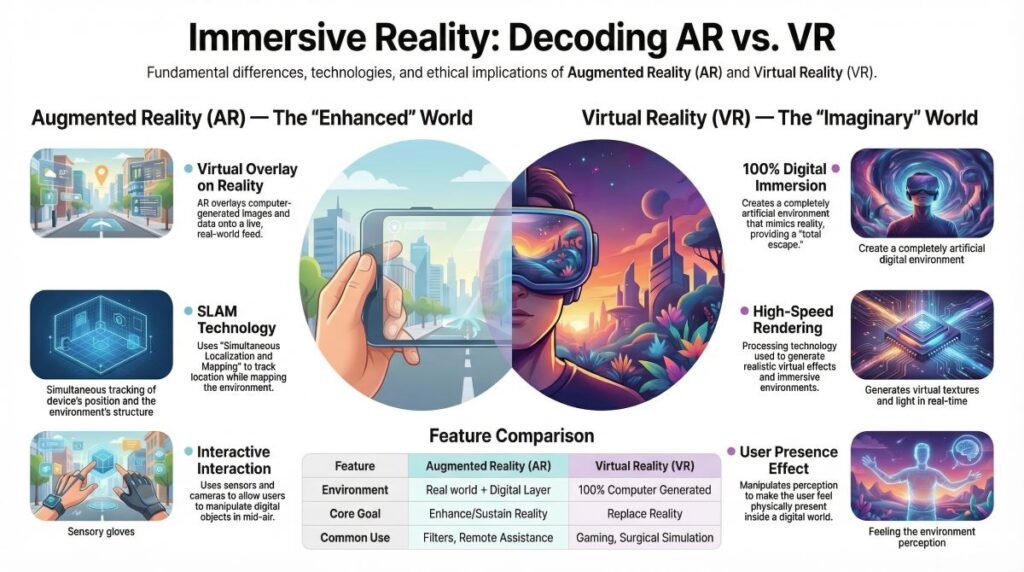
One of the most frequently searched queries related to this topic is the difference between augmented reality and virtual reality in tabular form. Here is a comprehensive table covering every major dimension of comparison:
| Comparison Point | Virtual Reality (VR) | Augmented Reality (AR) |
| Definition | Fully immersive, computer-generated environment replacing the real world | Digital overlays added on top of the real world, visible through a device |
| Real World Visible? | No. Real world is completely blocked | Yes. User sees the real world with digital additions |
| Level of Immersion | 100% virtual | Partial (digital on top of real) |
| Primary Hardware | Closed headset (Meta Quest, PSVR2, Valve Index) | Smartphone, tablet, transparent smart glasses |
| Internet Required? | Not always (standalone devices work offline) | Often needed for location-based AR apps |
| User Mobility | Limited; requires clear physical space, risk of collision | High; user can walk around freely while using AR |
| Cost | Higher hardware cost ($300-$3,500+) | Lower (runs on existing smartphones) |
| Key Use Cases | Gaming, simulation, therapy, military training, virtual tourism | Navigation, retail, surgery, education, industrial maintenance |
| Famous Examples | Meta Quest 3, PlayStation VR2, Apple Vision Pro (VR mode) | Pokemon Go, Google Maps Live View, IKEA Place, Snapchat filters |
| Key Limitation | Social isolation; motion sickness in some users; high cost | Limited field of view; digital objects can feel flat or disconnected |
| Processing Requirement | High (complex 3D rendering) | Moderate (real-time camera analysis) |
| Presence of Mixed Reality? | Not inherently; some VR systems add passthrough video (mixed mode) | AR is technically a subset of Mixed Reality on Milgram’s continuum |
Section #6: Virtual Reality, Augmented Reality, and Mixed Reality in Education – A Brief Overview
Perhaps no field has more to gain from immersive technology than education. Virtual reality, augmented reality, and mixed reality in education represent a fundamental shift in how knowledge is acquired, retained, and applied. Research consistently shows that experiential learning, actually doing or experiencing something rather than just reading or hearing about it, produces dramatically better outcomes. XR makes experiential learning possible at a scale never before achievable.
How VR is Transforming Education
Virtual reality VR and augmented reality AR experiences in educational settings allow students to visit ancient Rome, walk inside a human cell, witness historical events, conduct chemistry experiments in a virtual lab with no safety risk, and rehearse high-stakes skills (CPR, public speaking, surgical procedures) thousands of times without consequence. The learning retention rate for VR-based training has been measured at up to 75%, compared to just 5% for lecture-based learning (Edgar Dale’s Cone of Experience model).
Several universities and school systems around the world have implemented VR and AR curricula. Google Expeditions (now rebranded as Google Arts and Culture) provided virtual field trips to schools worldwide. The University of Maryland found that students learning in VR remembered information with 8.8% more accuracy than those who learned on a flat screen.
AR in the Classroom
Augmented reality in the classroom transforms static textbooks and materials into living, interactive experiences. Apps like Quiver (coloring pages that come to life in 3D), Merge Cube (a physical cube that renders AR objects when held), and Anatomy 4D (a 3D human body AR overlay) are already in classrooms around the world. These tools make abstract concepts in biology, physics, geometry, and history tangible and memorable in ways that no printed diagram can match.
MR in Professional Training and Higher Education
Mixed reality devices like the Microsoft HoloLens 2 are increasingly used in professional training programs at medical schools, engineering colleges, and military academies. Surgeons train on holographic patients. Engineers inspect virtual prototypes overlaid on physical workspaces. Soldiers rehearse missions in MR environments that blend real maps with virtual enemy positions. The advantage over both flat-screen simulation and pure VR is that MR preserves real-world context, which is critical when the skill being trained must ultimately be applied in a real physical environment.
Section #7: Augmented Reality and Virtual Reality in Web Technology
One of the most exciting developments in the XR space is the emergence of WebAR and WebVR, technologies that bring augmented reality and virtual reality in web technology directly to users’ browsers, with no app download required.
WebXR, the W3C standard that enables XR experiences in web browsers, allows developers to build AR and VR applications that run inside Chrome, Firefox, Safari, and other major browsers. A user simply opens a URL on their smartphone and immediately experiences an AR overlay of a product in their room, or dons a VR headset and enters a virtual showroom, all without installing any software.
AR and VR in Web Development: Tools and Frameworks
Several key tools and frameworks have made augmented reality and virtual reality development in web technology accessible to a wide range of developers:
- A-Frame: An open-source web framework built on top of Three.js for building VR experiences using HTML-like syntax. Created by Mozilla, it dramatically lowers the barrier to VR web development.
- Three.js: The most widely used JavaScript 3D library, providing the foundation for most WebGL-based 3D and VR experiences on the web.
- 8th Wall: A leading WebAR platform enabling markerless AR directly in mobile browsers. Used by major brands including PepsiCo, Porsche, and L’Oreal.
- Unity with WebGL export: The dominant game engine for VR and AR development, complete virtual reality and augmented reality development with Unity is a major skill area, with Unity supporting WebGL builds for browser-based 3D experiences.
- Babylon.js: Microsoft’s powerful open-source 3D engine with strong WebXR support, favored for enterprise web applications.
The business implications are significant. E-commerce platforms using WebAR for product visualization have reported conversion rate increases of 40-94%, according to Shopify’s internal data. A furniture company that deployed WebAR found that customers who used the AR product placement feature were 11 times more likely to make a purchase. Virtual reality and augmented reality are two examples of experiential marketing technologies that have proven, measurable commercial impact.
Section #8: AI Applications in Virtual Reality and Augmented Reality Experiences
Artificial intelligence and XR technology are converging rapidly, and the result is a new generation of immersive experiences that are more responsive, intelligent, and personalized than anything previously possible. AI applications in virtual reality and augmented reality experiences are transforming what these technologies can do.
- AI-Powered NPCs: In VR environments, non-player characters (NPCs) powered by large language models can now hold genuine, context-aware conversations, respond intelligently to unexpected inputs, and adapt their behavior based on the user’s actions. This is transforming VR training simulations, particularly for interpersonal skills like negotiation, conflict resolution, and customer service.
- AI Object Recognition in AR: Modern AR systems use AI-powered computer vision to identify real-world objects in real time and overlay contextually relevant information. Point your phone at a wine bottle and AI identifies the vintage and provides tasting notes. Look at a broken machine through an AR headset and AI diagnoses the fault and displays the repair procedure.
- AI Scene Understanding for MR: Mixed reality devices use AI to build detailed semantic maps of physical environments, understanding not just the geometry of a room but what objects are in it. This enables digital objects to interact with the real world with far greater sophistication.
- Generative AI in XR Content Creation: AI tools like Scenario, Luma AI, and various large-scale 3D generative models are dramatically reducing the cost and time required to create high-quality 3D assets for VR and AR applications. What once required a team of artists for months can now be generated in minutes.
- Personalized XR Experiences: AI analyzes user behavior within VR and AR environments to personalize experiences, adapt difficulty levels in training simulations, and identify moments where a learner is confused or disengaged, intervening with targeted support.
Section #9: Augmented Reality and Virtual Reality Applications Across Industries
Augmented reality and virtual reality applications now span virtually every major industry. Here is a sector-by-sector overview of the most impactful deployments as of 2025-2026:
Healthcare and Medicine
- Surgical training: VR platforms like Touch Surgery and Osso VR provide risk-free surgical rehearsal.
- AR surgical navigation: Systems like Augmedics’ xvision overlay spinal surgery guidance in real time.
- Pain management: VR distraction therapy reduces acute pain by 24-50% in clinical studies.
- Mental health: VR exposure therapy for PTSD, phobias, and social anxiety disorders.
- Medical education: AR anatomy models replace expensive physical cadavers for student learning.
Manufacturing and Engineering
- AR-guided assembly: Workers receive real-time step-by-step visual guidance through AR glasses.
- VR design review: Engineering teams collaborate in virtual 3D models of products before physical prototypes are built.
- Remote expert assistance: A technician in a field location wears AR glasses; a remote expert sees what they see and draws annotations directly onto their field of view.
- Quality inspection: AR systems automatically highlight defects and deviations from specifications on physical components.
Retail and E-Commerce
- Virtual try-on: AR makeup, glasses, clothing, and accessories try-on via smartphone camera.
- Product visualization: AR furniture and appliance placement in your actual room before purchasing.
- Virtual showrooms: VR stores allow shoppers to browse physical-quality 3D product displays from home.
- In-store navigation: AR overlays guide shoppers to product locations within large stores.
Defense and Military
- VR combat simulation: Realistic, risk-free training for complex combat scenarios.
- AR heads-up displays: Tactical data overlaid on soldiers’ fields of view via smart helmet visors.
- Mission rehearsal: VR walkthrough of actual terrain before entering a real operational environment.
- Maintenance training: AR guides technicians through complex maintenance procedures on military equipment.
Architecture and Real Estate
- VR building walkthroughs: Clients experience finished designs before construction begins.
- AR design overlays: Architects view digital building models superimposed on physical construction sites.
- Virtual property tours: Remote property buyers tour homes in VR, reducing unnecessary physical visits.
Section #10: AR vs VR vs MR vs XR – Full Comparison Table
| Feature | VR | AR | MR | XR |
| Real world visible? | No | Yes | Yes | Varies |
| Digital-physical interaction | Virtual only | Overlay only | Full interaction | Varies |
| Primary hardware | Closed HMD | Phone / glasses | Transparent HMD | All devices |
| Processing demand | Very High | Moderate | High | Varies |
| Cost to deploy | High | Low-Medium | Very High | Varies |
| Mass consumer adoption | Growing | Widespread | Early stage | Growing |
| Best for education? | Immersive learning | Interactive textbooks | Professional training | All levels |
| Best for enterprise? | Simulation training | Remote assist / retail | Design / surgery / military | Holistic deployment |
Section #11: Major AR, VR, and MR Hardware Devices in 2026
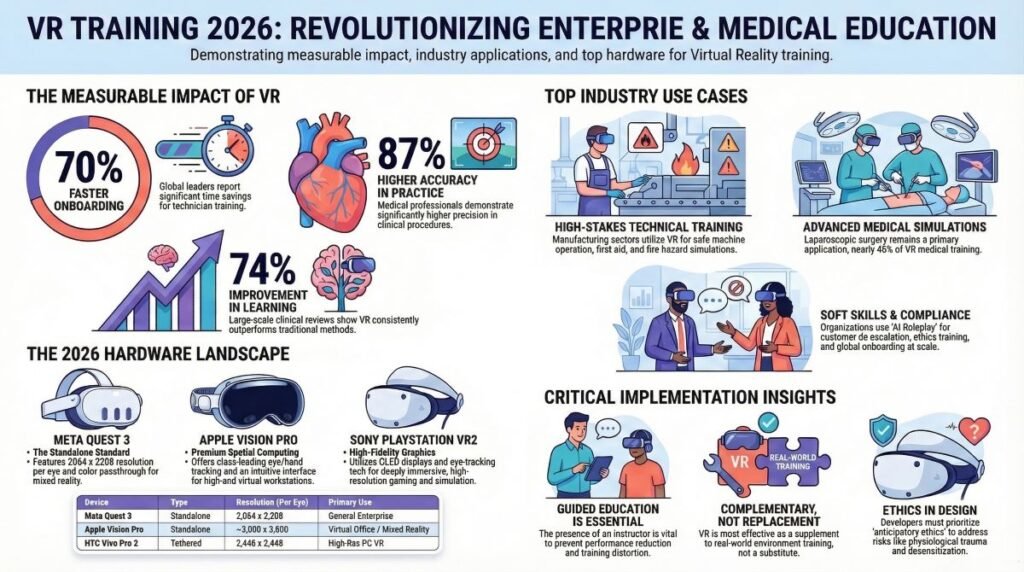
The hardware landscape for immersive technology has matured enormously in the past five years. Here is an overview of the most significant devices currently available or recently released:
VR Headsets
- Meta Quest 3: The most popular standalone VR headset. Runs on Snapdragon XR2 Gen 2, full-color passthrough for mixed reality mode. Price: approximately $499.
- Apple Vision Pro: Apple’s landmark spatial computing device. Ultra-high-resolution displays, eye and hand tracking, designed primarily for productivity and mixed reality. Price: $3,499.
- PlayStation VR2: Sony’s tethered VR headset for PS5. OLED displays, eye tracking, 4K resolution. Price: approximately $549.
- Valve Index: PC-connected VR for enthusiast gamers. Finger-tracking controllers, 144Hz refresh rate. Price: approximately $999.
AR and MR Headsets
- Microsoft HoloLens 2: Enterprise-grade MR headset. Holographic waveguide display, hand and eye tracking. Price: approximately $3,500. Primary markets: healthcare, manufacturing, military.
- Magic Leap 2: Enterprise MR designed specifically for healthcare and industrial use. Lighter and more comfortable than HoloLens 2. Price: approximately $3,299.
- Meta Ray-Ban Smart Glasses: Consumer AR glasses. No display overlay but with integrated camera and Meta AI voice assistant.
- Google Glass Enterprise Edition 2: Lightweight AR glasses for industrial use. Barcode scanning, remote expert assistance.
Section #12: Challenges and Limitations of AR, VR, and MR Technology
Despite the extraordinary promise of XR technology, significant challenges remain before these tools can achieve truly universal adoption:
- Motion Sickness (VR): Approximately 25-40% of VR users experience cybersickness or motion sickness, caused by a mismatch between visual motion and physical stillness. High refresh rates (90Hz+) and low latency (<20ms) are critical to minimizing this effect.
- Field of View Limitations (AR/MR): Current AR and MR headsets suffer from a relatively narrow field of view, meaning digital holograms only appear within a limited central region of your vision. Extending this to match natural human FOV (approximately 220 degrees) remains a major optical engineering challenge.
- Battery Life: Standalone VR headsets typically offer 2-3 hours of active use before requiring a recharge. AR smart glasses face even tighter power constraints given their smaller form factor.
- Social Acceptability: Wearing a large VR headset or even relatively discreet AR glasses in public settings remains socially awkward and is a barrier to adoption in everyday consumer contexts.
- Content Gap: The quality and quantity of compelling AR and MR content lags significantly behind VR. Most AR apps remain novelties rather than essential tools.
- Privacy Concerns: AR and MR devices with always-on cameras raise serious questions about surveillance, data collection, and facial recognition that remain unresolved both legally and socially.
- Cost: High-quality MR devices like the HoloLens 2 and Apple Vision Pro remain prohibitively expensive for most individual consumers and many small businesses.
Section #13: The Future of Virtual Reality, Augmented Reality, and Mixed Reality
The trajectory of XR technology points toward a future where the boundary between the physical and digital worlds becomes increasingly permeable. Several major developments will shape the next five to ten years:
- Smart Contact Lenses: Companies including Mojo Vision and Samsung are developing AR contact lenses that project digital information directly onto the retina. This would eliminate headsets entirely, making AR genuinely invisible and socially acceptable.
- Neural Interfaces: Elon Musk’s Neuralink and competitor companies like Synchron are developing brain-computer interfaces. In the long term, these could allow users to navigate and interact with VR and AR environments using thought alone.
- 6G and Edge Computing: The rollout of 6G wireless networks (expected in the early 2030s) and the expansion of edge computing infrastructure will enable cloud-rendered XR at a quality and latency that current wireless networks cannot support.
- Metaverse Infrastructure: While the metaverse hype of 2021-2023 has cooled, the underlying infrastructure, shared virtual spaces, persistent digital identities, spatial audio, and interoperable digital assets, is being quietly built by companies including Meta, Microsoft, NVIDIA, and Epic Games.
- Haptic Technology: Companies like HaptX and bHaptics are developing gloves and full-body haptic suits that provide physical sensation feedback in VR, adding the sense of touch to immersive experiences.
- Spatial Computing Mainstreaming: Apple’s framing of the Vision Pro as a spatial computing device rather than a headset signals an industry-wide shift toward thinking about XR as a fundamental new computing paradigm, not just a gaming or entertainment accessory.
Section #14: Virtual Reality and Augmented Reality Are Two Examples of Experiential Marketing
One of the most commercially significant insights about XR technology is that virtual reality and augmented reality are two examples of experiential marketing at its most powerful. Traditional marketing tells consumers about a product. Experiential marketing puts them inside the experience of owning or using it.
The results are striking. Neuroscience research conducted by Nielsen found that immersive VR advertising generates emotional engagement levels 27% higher than traditional TV advertising. AR product visualization in e-commerce, where a customer sees a sofa or a car in their actual space before purchasing, has been shown to reduce return rates by 22-40% and increase purchase intent by up to 65%.
Major brands that have deployed immersive experiential marketing include:
- IKEA: IKEA Place app, which lets customers AR-place full-size furniture in their homes.
- Gucci: Gucci’s virtual sneaker try-on AR app, a bestseller in mobile AR fashion applications.
- Jaguar Land Rover: VR dealership experiences that allow customers to configure and virtually drive any vehicle before it even enters production.
- Coca-Cola: VR experiences offered at major events that place consumers inside branded virtual worlds.
- TOMS Shoes: A pioneering VR campaign that transported customers to Peru to witness the impact of their purchase, widely credited as one of the first successful VR marketing campaigns.
Also read: What is Hepatitis PDF and PPT Download
(FAQ):
What is the difference between AR and VR with example?
VR replaces your entire field of view with a digital environment. Example: you put on a Meta Quest headset and find yourself standing on the surface of Mars. AR adds digital elements on top of your real-world view. Example: you open Pokemon Go on your phone and see a Pikachu sitting on your real kitchen table. The key difference between AR and VR with example is total versus partial substitution of reality.
Is AR and MR the same thing? (Also: Is AR and MR the same in chemistry?)
In the technology context, AR and MR are closely related but distinct. AR overlays digital content on the real world without those digital objects interacting with physical objects. MR creates digital objects that are spatially anchored to and can interact with the real world. Technically, MR is a more advanced and encompassing version of AR. In chemistry, AR and MR are entirely different terms: AR refers to the relative atomic mass symbol and MR refers to the relative molecular mass, and neither has any connection to augmented or mixed reality technology.
What are the best resources for learning AR and VR development?
For students and developers, the best starting points include: Unity’s official AR/VR learning pathways (complete virtual reality and augmented reality development with Unity is one of the most widely used educational frameworks), Unreal Engine’s XR documentation, Meta’s Presence Platform SDK, Apple’s RealityKit and ARKit documentation, and the book Augmented Reality: Principles and Practice by Dieter Schmalstieg. For academic study, the CCS333 augmented reality virtual reality lab manual used in many university programs provides excellent hands-on foundations.
What is the difference between virtual reality and augmented reality and mixed reality in one sentence each?
Virtual Reality: You enter a fully digital world where the real world around you no longer exists. Augmented Reality: You stay in the real world, but digital content is visually layered on top of it. Mixed Reality: You stay in the real world, and digital objects are anchored to and interact with physical reality as if they were truly present.
Which is better for education: AR, VR, or MR?
It depends on the learning objective. VR is best for full immersive simulations (surgery rehearsal, historical re-enactment, phobia therapy). AR is best for supplementing existing materials and making abstract concepts visual. MR is best for professional and technical training where digital guidance must coexist with real physical tasks. For most K-12 educational settings, AR is the most accessible and cost-effective solution. For university-level professional training, MR offers the deepest integration of digital instruction with real-world practice.
Conclusion: A World Where Real and Digital Are One
Virtual reality, augmented reality, and mixed reality are not three competing technologies racing toward the same finish line. They are three complementary tools, each with its own strengths, limitations, and ideal applications. VR excels at total immersion and presence. AR excels at accessibility, information overlay, and contextual enhancement of the real world. Mixed reality, the most sophisticated of the three, excels at creating seamless, intelligent interactions between the digital and physical worlds.
Together, these technologies and the extended reality ecosystem they form represent nothing less than the next great platform shift in computing. Just as the desktop PC shifted computing from specialists to everyone, and just as the smartphone shifted computing from desks to pockets, XR is shifting computing from screens to space itself, wrapping digital intelligence around the physical world we already inhabit.
Whether you are a student looking for augmented reality and virtual reality notes PDF, an educator exploring virtual reality augmented reality and mixed reality in education, a developer building with Unity, a marketer deploying experiential campaigns, or a business leader evaluating enterprise XR investment, the fundamental conclusion is the same: these technologies are not tomorrow’s story. They are today’s reality, and the time to understand and engage with them is now.
References & Disclaimer: Information in this article is drawn from publicly available academic publications, manufacturer specifications, industry analyst reports (IDC, Gartner, Statista), and peer-reviewed research current to early 2026. Market figures are estimates based on available public data. This article is written for educational and informational purposes only.