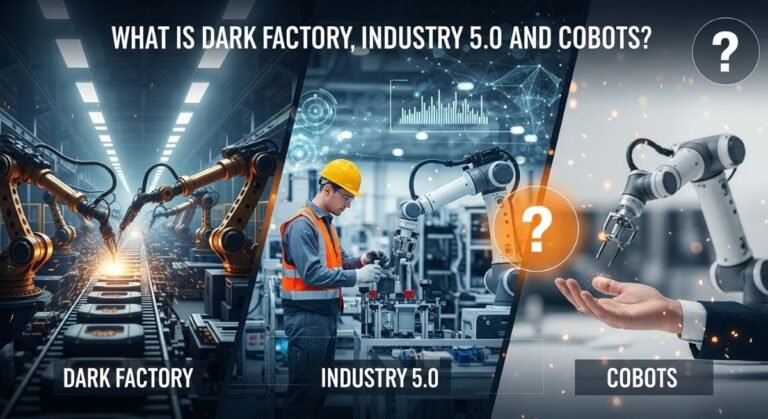
In this article we will know about What is Dark Factory Industry 5.0 and COBOTS? The Future of Manufacturing Explained with PPT, PDF and Infographic so, the manufacturing world is going through its most dramatic transformation in history. From fully automated dark factories running without a single light switch being flipped, to collaborative robots working hand-in-hand with humans, the way we make things is changing fast. If you have been searching for what a dark factory is, what Industry 5.0 means, or what cobots are used for, you are in the right place. This guide breaks it all down in simple, clear language – no jargon, no fluff.
What is Dark Factory Industry 5.0 and COBOTS? (PPTX)
What Is a Dark Factory?
A dark factory, also called a lights-out factory or lights-out manufacturing facility, is a fully automated production plant that operates without any human workers present on the factory floor. The name comes from the fact that, since no humans are working inside, there is no need to keep the lights on. The entire operation runs in complete darkness, driven by robots, AI-driven systems, and IoT (Internet of Things) devices.
In its simplest terms, a dark factory is the ultimate objective of automation – a factory run by robots and computerized systems with little to no human intervention. Machines receive instructions, perform tasks, do quality checks, and even handle maintenance alerts, all by themselves.
The Dark Factory Concept: How Did It Start?
The dark factory concept did not appear overnight. It grew steadily from the foundations laid during the earlier industrial revolutions. Industry 3.0 introduced computers and basic automation in the 1970s and 1980s. Industry 4.0 then brought connectivity, smart machines, and cyber-physical systems. Together, these phases created the technical groundwork needed to imagine a factory with zero human presence on the floor.
The concept began gaining serious attention in the early 2000s when manufacturers started realising that robots could perform repetitive, precision-heavy tasks faster and more accurately than humans. As sensor technology, machine learning, and real-time data processing improved, the vision of a fully automated, unmanned manufacturing facility became realistic.
Dark Factory Examples Around the World
Several leading companies have already brought the dark factory concept to life:
- Xiaomi Dark Factory: Xiaomi, the Chinese technology giant, operates one of the most talked-about dark factories in the world. Located in China, this facility produces smartphones and electronic components with minimal human presence. Automated guided vehicles move parts across the factory floor, robotic arms assemble devices, and AI systems handle quality inspection in real time.
- Siemens Dark Factory: Siemens runs one of the most advanced smart factories in Amberg, Germany. Often cited in discussions about lights-out manufacturing, the Siemens Amberg plant operates with an exceptionally high degree of automation – with machines communicating with each other and with central systems almost entirely on their own.
- FANUC Corporation in Japan: FANUC, the robotics company, runs factories where robots literally build other robots – with lights turned off for days at a time. This is often cited as one of the purest examples of a dark factory.
Dark Factory in China: A Global Leader in Lights-Out Manufacturing
China has positioned itself as a global leader in dark factory automation. The Chinese government’s ‘Made in China 2025’ initiative actively encouraged the adoption of robotics and smart manufacturing. Today, Chinese manufacturers across sectors like electronics, automotive, and textiles are investing heavily in dark factory technology. Beyond Xiaomi, companies in Guangdong, Shenzhen, and Chongqing have established lights-out manufacturing lines, replacing tens of thousands of human workers with automated systems.
Dark Factory in India: An Emerging Opportunity
Dark factory adoption in India is still in its early stages but growing rapidly. With the rise of smart manufacturing initiatives under ‘Make in India’ and increasing investments in Industry 4.0 technologies, Indian manufacturers in sectors like automobiles, pharmaceuticals, and electronics are starting to build partially automated facilities. Full lights-out factories in India remain rare at present, but the trend is clearly moving in that direction – especially as the cost of robotics continues to fall.
Dark Manufacturing vs Dark Factory: Is There a Difference?
The terms dark manufacturing and dark factory are often used interchangeably, but there is a subtle distinction. Dark manufacturing refers broadly to the process – the practice of manufacturing with minimal or no human workers on the floor. A dark factory is the physical facility where dark manufacturing takes place. Think of dark manufacturing as the strategy and the dark factory as the building where that strategy is executed.
Dark Factory AI: The Brain Behind the Operation
Artificial intelligence is what makes a true dark factory possible. Dark factory AI systems handle everything from production scheduling and predictive maintenance to real-time quality control and supply chain management. Computer vision systems powered by AI inspect products at speeds and accuracy levels no human could match. Machine learning algorithms continuously optimize production flows, detect anomalies, and reduce waste. Without AI, a dark factory would simply be a collection of machines – with it, it becomes a self-managing ecosystem.
What Is Industry 5.0? The Human-Centric Industrial Revolution
To understand Industry 5.0, you first need to understand where we have come from. Each industrial revolution has fundamentally changed how humans produce goods. Industry 1.0 brought steam power. Industry 2.0 introduced electricity and mass production. Industry 3.0, also known as the Digital Revolution, brought computers and automation into factories. Industry 4.0 connected everything – machines, devices, and data – into cyber-physical systems. Now, Industry 5.0 takes the next step.
Industry 5.0 in Simple Terms
In simple terms, Industry 5.0 is a humanized vision of technological transformation in industry. While Industry 4.0 was mostly about machines talking to machines, Industry 5.0 is about humans and machines working together in a smarter, more balanced way. It reflects a shift from a focus on economic value to a focus on societal value – and a shift in focus from worker welfare to genuine worker wellbeing.
Industry 5.0 Meaning: What Does It Really Stand For?
The meaning of Industry 5.0 goes beyond robots and automation. It is built on three core pillars:
- Human-Centric: Technology should serve human needs, not the other way around. Workers are partners in the production process, not just monitors of machines.
- Sustainable: Industry 5.0 prioritizes environmentally responsible production, focusing on resource efficiency, reduced carbon footprints, and long-term sustainability.
- Resilient: Factories and supply chains must be able to adapt quickly to disruptions – whether from pandemics, geopolitical events, or natural disasters.
Industry 4.0 vs 5.0: What Is the Key Difference?
The fundamental difference between Industry 4.0 vs 5.0 is the role of humans. Industry 4.0 was primarily focused on automation, connectivity, and efficiency – often at the expense of the human workforce. Machines replaced people in many roles. Industry 5.0, by contrast, does not seek to eliminate workers. Instead, it re-introduces the human element into the automated environment. The goal is collaboration, not replacement. Humans bring creativity, judgment, and empathy – things machines still cannot replicate. Industry 5.0 recognises this and builds systems that leverage both human and machine strengths.
Industry 5.0 Technologies: What Powers the Next Revolution?
Industry 5.0 integrates resilient, sustainable, and human-centric technologies, organizational concepts, and management principles to improve ecosystems and supply chains. Key Industry 5.0 technologies include:
- Cobots (Collaborative Robots): Designed to work safely alongside humans, sharing workspaces without cages or barriers.
- Artificial Intelligence and Machine Learning: For adaptive manufacturing, predictive maintenance, and real-time decision making.
- Digital Twins: Virtual replicas of physical factory systems that allow simulation, monitoring, and optimization without physical risk.
- Bionic Technologies: Exoskeletons and augmented reality tools that extend human capabilities in industrial environments.
- Edge Computing and IoT: Real-time data processing at the source, enabling faster and smarter factory floor decisions.
Industry 5.0 with Example: Real-World Application
A practical Industry 5.0 example: imagine a car assembly line where a cobot (collaborative robot) handles the heavy lifting – bolting an engine block that weighs 50 kilograms – while a human worker alongside it applies a custom hand-finished trim that requires tactile precision and aesthetic judgment. The robot does what it is best at (power, repetition, precision). The human does what they are best at (judgment, craft, quality sensing). Together, they outperform what either could achieve alone. This is Industry 5.0 in action.
What Is Industry 5.0 Primarily Focused On?
Industry 5.0 is primarily focused on three outcomes: putting people at the centre of industrial production, making manufacturing more environmentally sustainable, and building supply chains that are more resilient to shocks and disruptions. Where Industry 4.0 asked ‘how do we automate this?’, Industry 5.0 asks ‘how do we make this better for people and the planet while still being efficient?’
What About Industry 6.0?
Industry 6.0 is still largely a concept discussed in academic and futurist circles. While Industry 5.0 is only now being implemented by leading manufacturers, some researchers are already theorizing about what comes next. Industry 6.0 is expected to involve fully autonomous, self-evolving production systems, ultra-personalized manufacturing, and possibly human-machine integration at a neurological level. For now, however, the world is focused on making Industry 5.0 a reality.
What Are COBOTS? The Collaborative Robot Explained
Cobot Full Form: What Does COBOT Stand For?
The cobot full form is Collaborative Robot. The term was first coined in 1996 by professors J. Edward Colgate and Michael Peshkin at Northwestern University. A cobot is a robotic system specifically designed to interact physically and safely with humans in a shared workspace. Unlike traditional industrial robots that are sealed behind safety cages and barriers, cobots are built to work right beside you.
Cobot vs Robot: What Is the Difference?
The distinction in the cobot vs robot comparison comes down to safety, speed, and purpose. Traditional industrial robots are large, fast, powerful, and dangerous to humans if approached. They are designed for fully automated environments and cannot sense the presence of a human nearby. Cobots, on the other hand, are equipped with sensors, force-limiting technology, and vision systems that allow them to detect humans and stop or slow down immediately to avoid injury. Cobots are typically smaller, slower, and less powerful than industrial robots – but far more flexible, safe in shared spaces, and easier to reprogram for different tasks.
What Is Cobots Used For? Applications Across Industries
Cobots are used across a wide range of industries and tasks. Common cobot applications include:
- Cobot Welding: Cobots are widely used for welding tasks, especially in automotive manufacturing. Cobot welding combines machine precision with the ability to work alongside human operators who supervise or handle complex joins.
- Assembly: Cobots handle repetitive assembly tasks like screw driving, component placement, and gluing, freeing human workers for higher-value activities.
- Pick and Place: Moving items from one location to another – particularly in warehouse and packaging environments.
- Quality Inspection: Using machine vision, cobots inspect products for defects with precision and consistency beyond human capability.
- Material Handling: Loading and unloading machines, carrying heavy materials, and feeding production lines.
- Healthcare and Laboratories: Cobots assist in pharmaceutical manufacturing, lab sample handling, and even surgical assistance.
Cobots in Manufacturing: Why They Matter
Cobots in manufacturing are reshaping production lines globally. Small and medium-sized businesses, which could never afford large industrial robots, can now deploy cobots at a fraction of the cost. Cobots are quicker to deploy, easier to reprogram, and do not require specialist engineers to maintain. In the context of Industry 5.0, cobots are central – they are the physical embodiment of human-machine collaboration on the factory floor.
Cobot Technology: How Do Cobots Work?
Cobot technology relies on several key components. Force-torque sensors detect when a cobot’s arm encounters unexpected resistance – such as a human hand – and immediately limit force or stop movement entirely. Vision systems using cameras and depth sensors allow cobots to perceive and react to their environment. Modern cobots often use hand-guiding technology, which means a worker can physically move the robot’s arm through a task to ‘teach’ it a new motion, making cobot programming highly accessible even for people without engineering backgrounds.
Cobot AI: Making Cobots Smarter
The latest generation of cobots integrates artificial intelligence to go beyond pre-programmed movements. Cobot AI allows robots to learn from new situations, adapt to variations in parts or products, and make real-time decisions without human reprogramming. AI-powered cobots can identify the position of an object that has shifted on a conveyor, adjust their grip accordingly, and continue working – something traditional robots simply cannot do. This is a major leap forward in flexible automation.
Cobot Programming: Easier Than You Think
One of the biggest advantages of cobots is how straightforward cobot programming has become. Traditional industrial robot programming required specialist software engineers working with complex code. Modern cobots often feature graphical drag-and-drop interfaces, touchscreen pendants, and hand-guiding teach modes. A production line supervisor with no coding knowledge can typically program a cobot for a new task within hours. This dramatically reduces deployment costs and makes cobots accessible to businesses of all sizes.
Cobots Examples: Leading Products in the Market
The cobot market is growing fast, with several major players leading the sector:
- Universal Robots (UR): The Danish company Universal Robots is widely considered the pioneer of the modern cobot market. Their UR3, UR5, UR10, and UR20 models are used globally across virtually every industry.
- FANUC CRX Collaborative Robot: FANUC America offers the CRX series of cobots, described as robotic systems designed to interact physically and safely with humans in a shared workspace.
- ABB YuMi: ABB’s YuMi is a dual-arm cobot that works alongside humans in small-parts assembly tasks, notable for its compact size and human-like arm configuration.
- Cobot Proxie: Proxie is an AI-powered cobot platform gaining attention for its advanced machine learning integration and its ability to adapt to unstructured environments – an important step forward for cobot automation.
Cobot Price: How Much Does a Cobot Cost?
Cobot prices vary widely based on payload capacity, reach, and features. Entry-level cobots for light assembly tasks can start from around $20,000 to $30,000 USD. Mid-range cobots with higher payload capacities and integrated vision systems typically cost between $40,000 and $80,000 USD. High-end AI-powered models can exceed $100,000 USD. When factoring in the total cost of ownership, cobots often deliver an impressive return on investment within 12 to 24 months, particularly in high-volume production environments.
Cobot Company: Who Are the Major Players?
The cobot industry is dominated by a handful of major companies. Universal Robots (owned by Teradyne), FANUC, ABB, KUKA, Rethink Robotics, Doosan Robotics, and Techman Robot are among the most recognized names in the sector. Each cobot company offers different specializations – some focus on automotive welding applications, others on electronics assembly, and some on healthcare and laboratory environments. The market is expanding rapidly, with new entrants offering increasingly specialized and AI-driven solutions.
How Dark Factories, Industry 5.0, and Cobots All Connect
At first glance, dark factories and Industry 5.0 might seem contradictory. One removes humans entirely; the other puts them at the centre. But in reality, they represent two ends of a spectrum – and cobots are the bridge between them.
- Dark factories represent the maximum level of automation achievable in controlled, repetitive environments. They are ideal for high-volume, standardized production – think millions of smartphone screens or car parts produced identically, around the clock, without variation. In these settings, full automation makes economic and operational sense.
- Industry 5.0 represents the philosophy that guides how we deploy all of this technology. Not every factory should be dark. Not every job should be automated. The question is always: where does technology help, and where does the human touch still matter? Industry 5.0 answers that question with a framework built on human wellbeing, sustainability, and resilience.
- Cobots sit perfectly within this framework. They enable factories that are not fully dark – where humans and robots genuinely share the floor, each doing what they do best. Cobot automation allows manufacturers to increase efficiency without sacrificing jobs, adapt production quickly, and build the kind of human-machine partnership that defines Industry 5.0.
The Future of Manufacturing: What Comes Next?
The trajectory is clear. More factories will move toward lights-out operations for repetitive, high-volume production. At the same time, hybrid facilities – where humans and cobots work together – will become the norm for complex, customised, and high-value manufacturing. AI will continue to make both dark factories and cobots smarter, faster, and more adaptive.
The companies and countries that move fastest in adopting these technologies – whether it is China expanding its dark factory network, India embracing smart manufacturing, or European firms leading in sustainable Industry 5.0 practices – will define global manufacturing leadership in the coming decade.
For workers, the message of Industry 5.0 is important: this is not a story of humans being replaced by machines. It is a story of humans being freed from dangerous, repetitive, and physically damaging work – and empowered to focus on the tasks that require creativity, judgment, and care. The rise of cobots and dark factories, understood through the lens of Industry 5.0, is ultimately a story about building a better future for people.
Dark Factory vs Industry 5.0 vs Cobots: Complete Comparison Tables
Table 1: Quick Overview
| Feature | Dark Factory (Industry 4.0 Peak) | Industry 5.0 | Cobots (The Enablers) |
| Primary Focus | Automation & Efficiency | Human-Machine Synergy | Collaboration & Safety |
| Worker Role | Replaced or Remote | Collaborative Partner | Operator / Trainer |
| Robotics | Industrial (Isolated) | Cobots (Shared Space) | Shared Space with Humans |
| Goal | Mass Production | Mass Customization | Task Augmentation |
Table 2: Complete Detailed Comparison – Technical Facts, Operational Impact & Real-World Examples
| Feature | Dark Factory (Industry 4.0 Peak) | Industry 5.0 (Human-Centric) | Cobots (The Tech Enablers) |
| Core Philosophy | Automation & Isolation Lights-out efficiency with zero human interference. | Collaboration & Resilience Re-humanizing manufacturing to combine machine speed with human creativity. | Partnership Robots designed to assist, not replace, human workers. |
| Worker Role | Replaced / Remote Humans are supervisors monitoring from a distance; no presence on the floor. | Collaborator Humans work alongside robots, focusing on customization and critical thinking. | Operator Humans physically interact with the cobot to guide or teach it tasks. |
| Primary Goal | Mass Production High volume, identical products at the lowest possible cost. | Mass Personalization Tailored products for individual customers (e.g., custom prosthetics). | Augmentation Enhancing human capabilities (lifting heavy loads, precision assembly) safely. |
| Operational State | Lights-Out Manufacturing Designed for 24/7 autonomous production with zero on-site staff. | Synergistic Environment Re-integrates humans into the loop for creativity and ethics. | Shared Workspace Robots operate without safety cages alongside humans. |
| Robotics Type | Industrial Robots Large, heavy, caged off for safety. Hard to reprogram. | Collaborative Robots Lightweight, sensor-rich, and cage-free. | Cobots Built with force-limiting sensors to stop instantly upon contact. |
| Key Technologies | Digital Twins, AI Algorithms, AGVs/AMRs, ASRS | Generative AI, 6G, IoT, Human-Machine Collaboration (HMC) | Force-sensing, Vision Sensors, Lead-through Programming |
| Lighting / HVAC | Unnecessary Can operate in total darkness and without climate control to save energy. | Required Standard human-centric environment (light, heat, air) is needed. | Flexible Can operate in either environment, but usually deployed where people are. |
| Product Focus | Mass Production Standardized high-volume goods (e.g., electronic components). | Mass Customization High-value, personalized products (e.g., custom prosthetics). | Task Augmentation Handling the 3 Ds: Dull, Dirty, and Dangerous tasks. |
| Industry Facts | Unattended for up to 30 days Eliminates all lighting and HVAC costs. | Up to 62% waste reduction Through circular production models. | 30% annual growth expected Cobot market projected to grow 30% annually by 2030. |
| Key Benefit | Efficiency 24/7 continuous operation with zero fatigue or shifts. | Sustainability & Agility Reduces waste and adapts quickly to changing market needs. | Safety & Accessibility Easy to deploy and program without specialised coding skills. |
| Major Challenges | Rigidity & Cyber Risk Hard to change the production line once set; 3x more vulnerable to cyber attacks. | Retraining Costs High cost of retraining workforce and techno-panic regarding skill gaps. | Payload / Speed Limits Generally lift less weight and move slower than traditional industrial robots. |
| Weakness | Zero Flexibility Cannot adapt to custom orders; production line changes are costly and slow. | Speed Slower than dark factories because safety limits robot speed near humans. | Payload / Speed Generally lift less weight and move slower than traditional industrial robots. |
| Real-World Examples | FANUC (Japan) Operates robots that build other robots unattended for weeks. | Adidas Uses Industry 5.0 to save 11,500 tons of plastic through sustainable sneaker production. | Ford (Cologne Plant) Cobots sand vehicle contours in just 35 seconds. |
| Strategic Benefits | 30% downtime reduction Through predictive AI maintenance. | 17%–55% productivity boost Through human-robot synergy. | 72.5% hazard reduction Workplace hazards reduced in cobot-equipped facilities. |
Sources: Google search results, PREVIOUS KNOWLEDGE | Data compiled 2026
The “Dark” Reality: Why Industry 5.0 Is Reimagining the Future of Work
Imagine a manufacturing plant the size of several football fields, operating at peak capacity in a silence so profound you can hear the hum of data moving through cables. There is no chatter, no clatter of boots on concrete, and-most strikingly-not a single light bulb burning. To the uninitiated, this “Dark Factory” looks like a descent into a digital underworld; to the modern industrialist, it represents the pinnacle of friction-free efficiency. Why would giants like Adidas or Apple effectively turn off the lights? The answer isn’t a power failure or a minor cost-cutting measure. It is because the workers inside do not have eyes; they have sensors. As we pivot from the automated landscape of Industry 4.0 to the highly specialized, human-cobot synthesis of Industry 5.0, we are witnessing the “Architecture of Absence”-a total reimagining of what it means to go to work.
The Architecture of Absence: Inside the Dark Factory
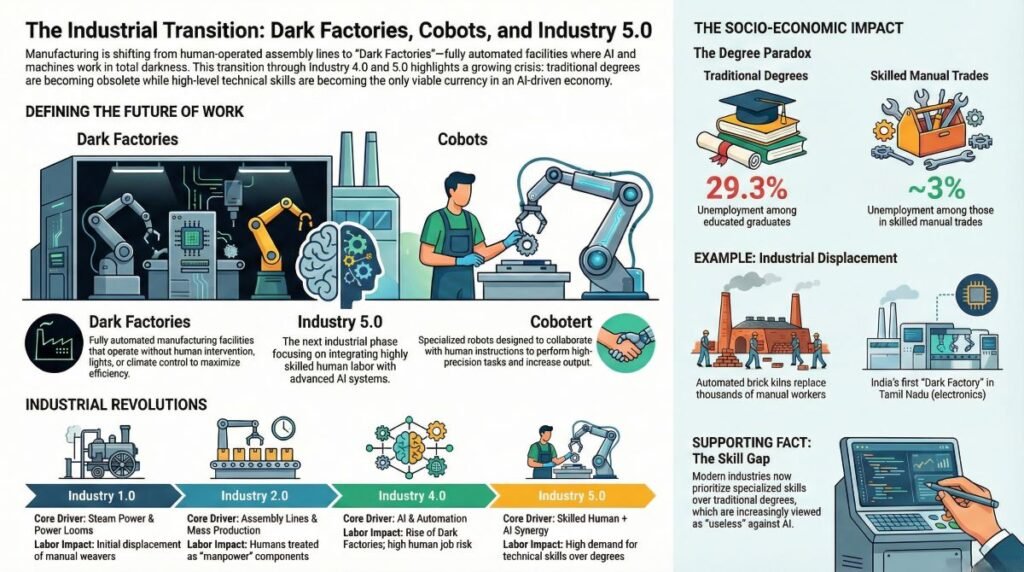
In India, this transition is no longer a futuristic theory. The country’s first dark factory is already operational in Tamil Nadu, where Tata Electronics assembles Apple iPhones. The term “dark” is purely functional: robots and AI-driven systems perceive their environment through infrared, LiDAR, and ultrasonic sensors that require no visible light.By removing the “human condition” from the factory floor, the structural requirements of production collapse. Traditional plants are built around human biological needs, requiring vast footprints for canteens, bathrooms, medical centers, first-aid doctors, and even dedicated breastfeeding rooms. Outside, the infrastructure must accommodate bus stops and transport hubs for thousands of employees.When you remove the need for humans to stand at an assembly line, the physical footprint of a facility can shrink from a massive complex to a tenth of its original size (x/10 km). These condensed, lightless warehouses operate 24/7 without shifts or fatigue, signaling a move toward an industrial model where the “factory” is simply a giant, autonomous machine.
The Education Paradox: 29.3% vs. 3%
As this automation accelerates, a startling and uncomfortable paradox has emerged in the Indian workforce. According to data from the Economic Survey and the International Labour Organization (ILO), the unemployment rate for educated graduates sits at a staggering 29.3%. In contrast, the unemployment rate for the “uneducated” or “illiterate” workforce is a mere 3%. This gap highlights a “Skill vs. Degree” crisis. While universities are busy “collecting degrees” and producing graduates who spend years in a vacuum-including the millions of UPSC and IAS aspirants who are technically unemployed but uncounted by official metrics-the industry is desperate for skills AI cannot yet master. A plumber who spends 12–15 years learning a trade often finds more financial stability and demand than a graduate with a generic degree who lacks industry experience. The late actor Sushant Singh Rajput, an engineer himself, once poignantly noted this approaching obsolescence: “What we are studying in schools and colleges will become useless after five years. AI is approaching us… degrees will become useless; marks will become useless. We should work on skills.”
The Brick Kiln Revolution: 1,000 Families vs. Three Supervisors
Nowhere is the ethical tension of this shift more visible than in the traditional sectors. Consider the automated brick factory near Delhi-the first of its kind. Historically, brickmaking was a family affair, involving thousands of husbands, wives, and children digging clay, hand-molding bricks, and manually flipping them to dry under the sun. The new automated process has replaced this entire ecosystem with a setup reminiscent of a high-tech roti-making machine:
- Mechanical Extraction: Machines dig and mix clay with water into a perfect semi-solid solution.
- Robotic Precision: A “brick-laying” machine molds and cuts the bricks with perfect precision.
- Electric Furnaces: Robots load the bricks onto a belt that passes through an electric furnace, replacing the old, carbon-heavy coal kilns.
- Autonomous Logistics: Robots then load the finished bricks onto trolleys that, much like those used in China, can navigate themselves to delivery points.The result is a devastating efficiency: a task that once required 1,000 workers to labor for 10 days can now be completed in 24 hours by just three human supervisors , producing 100,000 bricks in a single day.
Industry 5.0 and the “Soft Hit” of Cobots
To bridge this gap, the industry has introduced “Cobots”-Collaborative Robots. Designed to work alongside humans, Cobots are often framed as a way to enhance human efficiency rather than replace it. However, from an ethical standpoint, Cobots can be seen as a “soft hit”-a way to sugar-coat the pill of total automation. We are told this is Industry 5.0, a phase where “human manpower” is rebranded as “skilled labor.” But this rebranding faces a “Transition Wall.” Can our education system actually produce these highly skilled workers? There is deep skepticism when the very professors teaching these subjects often have zero industry experience and are more focused on publishing research papers than securing patents or fostering practical skills.
No One is Safe: The Upward Migration of Automation
The displacement is no longer confined to the “blue-collar” factory floor. It is moving rapidly into high-level service and white-collar roles:
- Chartered Accountants (CAs): Automated systems now outperform the human brain in speed and precision for tax and GST filing, traditionally the bread and butter of the profession.
- Call Centers: The human operator is being pushed to the “outer edge.” Customer support is now a three-layer system: first, website self-service; second, AI chatbots; and finally, a human who only handles the rarest, most complex frustrations after a long wait.
- Logistics: In China, the traditional truck crew-consisting of a driver, a helper, and a cleaner-is being replaced by driverless, GPS-guided trucks that can travel 600km a day without a rest stop.
The Transition Wall
We have journeyed from Industry 1.0’s steam-powered looms to Industry 5.0’s AI-driven Cobots. Each step has increased production speed while decreasing the necessity of the human element. We now stand at a “Transition Wall.” On one side is a society built on the traditional value of degrees and manual labor; on the other is a future where the “human” is either an elite specialist or entirely redundant. As the lights go out in factories from Tamil Nadu to Delhi, we must confront the reality that our current education system is preparing us for a world that no longer exists. In the age of the Dark Factory, the most pressing question remains: are you cultivating a skill that will keep the lights on for your career, or are you just collecting a degree that will leave you in the dark?
Also read: Top 10 Largest Insurance Companies in France 2026 (.PPTX)
Conclusion
Dark factories, Industry 5.0, and cobots are not separate trends – they are interconnected parts of the same fundamental shift in how the world produces goods. Dark factories and lights-out manufacturing show us what full automation looks like. Industry 5.0 shows us how to use technology in a way that serves people and the planet. And cobots are the technology making human-machine collaboration a practical, everyday reality on factory floors around the world.
Whether you are a business owner exploring cobot automation, a student researching the industrial revolution’s next chapter, or simply someone curious about the factories of the future – the most important thing to understand is this: the future of manufacturing is not about choosing between humans and machines. It is about combining them wisely.
(FAQ)
What is a dark factory in simple terms?
A dark factory is a fully automated manufacturing facility that operates without human workers on the floor. It is called ‘dark’ because, with no workers present, there is no need for lighting. Robots, AI, and IoT systems handle all production tasks.
What is Industry 5.0 primarily focused on?
Industry 5.0 is primarily focused on making manufacturing human-centric, sustainable, and resilient. It aims to ensure that advanced technology serves human wellbeing and societal goals, not just economic efficiency.
What is the full form of COBOT?
COBOT stands for Collaborative Robot. It refers to a robot designed to work alongside and safely interact with human workers in a shared workspace.
What is the difference between a cobot and a robot?
Traditional robots are powerful, fast, and must be caged away from humans for safety. Cobots are designed with safety sensors and force-limiting technology so they can work directly beside human workers without barriers. Cobots are slower and less powerful but far more flexible and safe.
Are dark factories good or bad for employment?
This is a complex question. Dark factories reduce the need for manual labour in repetitive tasks, which can displace certain types of jobs. However, they also create demand for higher-skilled roles in robotics maintenance, AI management, and system oversight. The Industry 5.0 framework acknowledges this challenge and emphasises that technology adoption should protect and improve human livelihoods, not just cut costs.