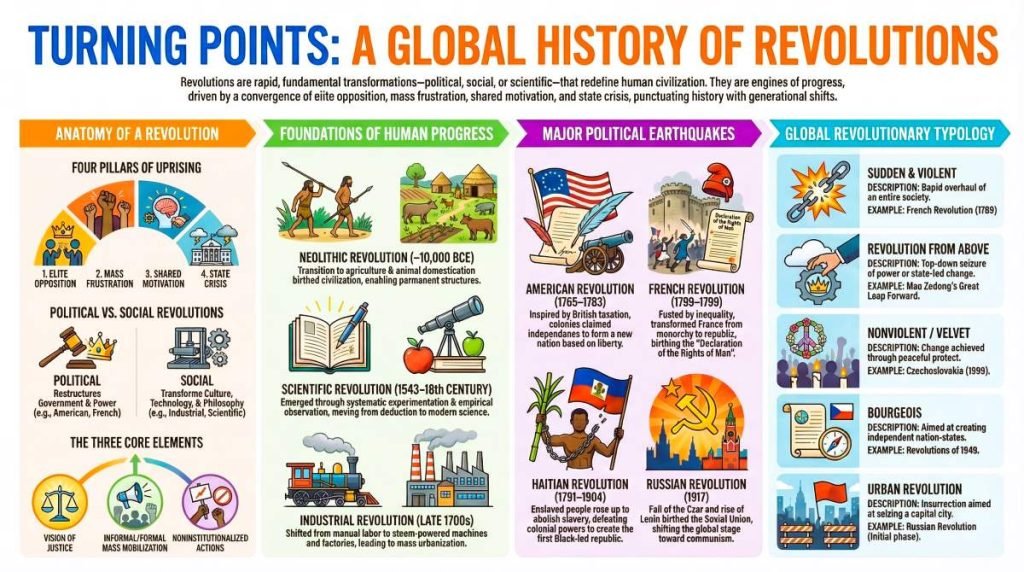
Today in this article we will discuss about Top 30 Most Important Revolutions in History All over the World with PPT, PDF and Infographics: Complete Guide to Humanity’s Greatest Uprisings so, Throughout human history, moments arrive when the accumulated weight of injustice, inequality, and oppression becomes too great to bear. In these explosive moments, ordinary people – farmers, workers, students, and soldiers – have risen against kings, emperors, dictators, and colonial masters to reshape the world forever.
Revolutions are not merely political events. They are seismic shifts in human civilization that redraw borders, topple dynasties, forge new nations, inspire continents, and permanently alter the relationship between rulers and the ruled. From the guillotines of Paris to the jungles of Cuba, from Tahrir Square to Tiananmen, these 30 revolutions represent the most dramatic and consequential political upheavals in human history.
This comprehensive, EEAT-compliant guide examines each revolution in depth – the causes, the key figures, the battles fought, the outcomes achieved, and the lasting legacy they left upon the world we live in today.
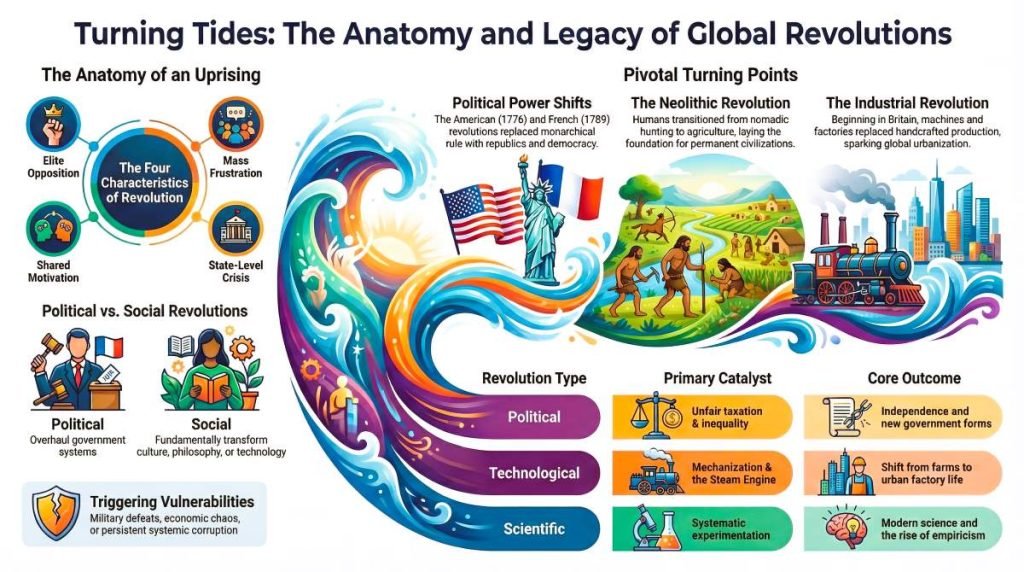
What Makes a Revolution “Important”?
Before exploring our list, it’s essential to understand how historians measure a revolution’s significance. The most impactful revolutions share several characteristics:
- Systemic Change – They fundamentally altered a nation’s political, social, or economic structure
- Global Influence – Their ideas and methods inspired movements in other countries
- Ideological Impact – They introduced or spread powerful new ideas about governance and human rights
- Long-Term Consequences – Their effects are still visible in today’s world
- Scale of Mobilization – They involved large numbers of people across society
For this article, revolutions are ranked #1 as most important, counting down to #30.
Top 30 Most Important Revolutions in History (World) | PPT SLIDES (.PPTX)
The 30 Most Important Revolutions in History
#1. The French Revolution (1789–1799)
Location: France
Key Figure: Maximilien Robespierre
Against: King Louis XVI
Outcome: End of monarchy, birth of republic, then Napoleon
The French Revolution stands as the single most influential political event in modern history. It didn’t just topple a king – it demolished an entire world order and planted the seeds of modern democracy, nationalism, and human rights across the globe.
The Causes: France in 1789 was a powder keg ready to explode. Three fundamental crises converged simultaneously. First, France was financially bankrupt – the treasury had been emptied by disastrous wars (including funding the American Revolution) and the extravagant spending of Versailles. Second, a catastrophic harvest in 1788 left millions of French peasants facing starvation while the aristocracy continued their lavish lifestyle. Third, Enlightenment ideas – spread through the writings of Voltaire, Rousseau, and Montesquieu – had convinced educated French citizens that the existing social order was not divinely ordained but a human construct that could and should be changed.
France was divided into three “Estates”: the clergy (First Estate), the nobility (Second Estate), and everyone else – 97% of the population (Third Estate). The Third Estate paid virtually all taxes while the privileged First and Second Estates paid almost none. This inequality had become politically intolerable.
The Revolution Unfolds: The revolution began not with violence but with a political crisis. When King Louis XVI convened the Estates-General to address the financial crisis, the Third Estate representatives demanded equal voting rights. When refused, they declared themselves a National Assembly in June 1789 – the first act of defiance. On July 14, 1789, Parisian crowds stormed the Bastille fortress, a symbol of royal tyranny, and the revolution became unstoppable.
The Declaration of the Rights of Man and Citizen, adopted August 26, 1789, proclaimed that “the principle of all sovereignty resides essentially in the nation” and guaranteed liberty, property, security, and resistance to oppression. It remains one of history’s most consequential documents.
The Reign of Terror: The revolution’s most violent phase (1793-1794) saw Maximilien Robespierre and the Committee of Public Safety execute over 16,000 people by guillotine – including King Louis XVI in January 1793 and Queen Marie Antoinette in October 1793. Ironically, Robespierre himself was guillotined in July 1794, ending the Terror.
Key Figures:
- King Louis XVI – The indecisive monarch whose inability to reform led to his execution
- Maximilien Robespierre – The idealistic lawyer who became the Terror’s architect
- Marie Antoinette – The Austrian queen whose extravagance became a symbol of royal excess
- Napoleon Bonaparte – The military genius who emerged from revolution to build an empire
Lasting Legacy: The French Revolution introduced the concepts of liberty, equality, and fraternity as political principles – values that now underpin virtually every democratic government on Earth. It abolished feudalism permanently, established the principle of national sovereignty, and inspired independence movements from Latin America to Africa and Asia. The metric system, civil law codes, and secular education all emerged from revolutionary France.
Fascinating Facts:
- The word “revolution” in its modern political sense was popularized by the French Revolution
- The guillotine was considered a humane execution method compared to previous methods
- The Marseillaise, composed in 1792, became France’s national anthem and a revolutionary anthem worldwide
- “Left” and “right” as political terms originated from seating arrangements in the National Assembly
- Napoleon’s Civil Code, based on revolutionary principles, still influences law in 40+ countries today
#2. The American Revolution (1775–1783)
Location: United States
Key Figure: George Washington
Against: King George III of Britain
Outcome: Birth of the United States of America
The American Revolution was the world’s first successful colonial independence movement and created the world’s first modern constitutional republic – a political experiment that fundamentally altered humanity’s understanding of government.
The Causes: British colonists in America had enjoyed significant self-governance for 150 years through their colonial assemblies. But after the expensive French and Indian War (1754-1763), Britain imposed new taxes – the Stamp Act, the Townshend Acts, the Tea Act – without colonial representation in Parliament. “No taxation without representation” became the rallying cry. But the deeper issue was philosophical: colonists steeped in Enlightenment thought increasingly believed that government derived its authority from the consent of the governed, not from divine right.
The Boston Massacre (1770) and Boston Tea Party (1773) escalated tensions until open conflict became inevitable.
The Revolution Unfolds: Fighting began at Lexington and Concord, Massachusetts, on April 19, 1775 – “the shot heard round the world.” The Continental Congress appointed George Washington commander of the Continental Army. On July 4, 1776, the Second Continental Congress adopted the Declaration of Independence, written primarily by Thomas Jefferson, proclaiming that “all men are created equal” and that governments derive their “just powers from the consent of the governed.”
The war was long and brutal. Washington’s army endured desperate conditions at Valley Forge (1777-1778), where 2,500 soldiers died of cold and disease. The French alliance (1778), secured partly by Benjamin Franklin’s diplomatic genius, proved decisive. The war ended with British surrender at Yorktown, Virginia, on October 19, 1781.
The Constitutional Achievement: The 1787 Constitutional Convention created a revolutionary system of government: a federal republic with separation of powers, checks and balances, an independent judiciary, and a Bill of Rights guaranteeing individual freedoms. This framework has endured for 235+ years and influenced constitutions worldwide.
Key Figures:
- George Washington – Commander-in-chief who held the army together through crisis
- Thomas Jefferson – Principal author of the Declaration of Independence
- Benjamin Franklin – Diplomat who secured French alliance
- Alexander Hamilton – Architect of the new nation’s financial system
- John Adams – Theorist of republican government
Lasting Legacy: The American Revolution proved that colonies could win independence from a European empire, inspiring independence movements across Latin America and eventually Africa and Asia. The Declaration of Independence’s language – particularly “all men are created equal” – became the touchstone for subsequent liberation movements including abolitionism and women’s suffrage. The U.S. Constitution’s framework of democratic governance has been emulated by over 100 nations.
Fascinating Facts:
- The Continental Army was often unpaid and poorly equipped, yet persevered for eight years
- France’s military and financial support was arguably the decisive factor in American victory
- Approximately 20% of colonists remained loyal to Britain (Loyalists); many fled to Canada
- The Boston Tea Party destroyed 342 chests of tea worth about $1.7 million in today’s money
- Washington crossed the Delaware River on Christmas night 1776 in a daring surprise attack
#3. The October Revolution (1917)
Location: Russia
Key Figure: Vladimir Lenin
Against: The Provisional Government and Tsar Nicholas II
Outcome: Birth of Soviet Union, communist state
The October Revolution (November in modern calendar) was the world’s first successful communist revolution, creating the Soviet Union and triggering a global ideological struggle that lasted 75 years and shaped the entire 20th century.
The Causes: Russia in 1917 was collapsing under multiple pressures. Three years of catastrophic World War I casualties (over 1.7 million dead), a regime unable to feed its people, a brutal autocracy under Tsar Nicholas II who refused meaningful reform, and a tiny revolutionary movement with an extraordinarily compelling ideology – Marxism-Leninism, which promised to transfer power and wealth to the working class.
The first revolution of 1917 came in February (March by modern calendar), when bread riots in Petrograd escalated as soldiers refused to fire on protesters. The Tsar abdicated on March 15. The Provisional Government that took power made a fatal error: they continued the unpopular war with Germany, giving Lenin the slogan “Peace, Land, Bread” – exactly what Russia’s masses desperately wanted.
Lenin’s Revolution: Lenin’s Bolsheviks were a disciplined, ideologically coherent party willing to seize power. On the night of October 25-26, 1917, Bolshevik Red Guards seized key positions in Petrograd – telegraph offices, railway stations, bridges, the State Bank – then stormed the Winter Palace. The Provisional Government collapsed with minimal resistance. Lenin announced: “We shall now proceed to construct the Socialist order.”
The Brutal Aftermath: A catastrophic civil war (1918-1922) followed between the Red Army and “White” forces supported by Western powers. An estimated 7-12 million people died in combat, famine, and disease. Nicholas II and his entire family were executed in July 1918. Lenin died in 1924; Stalin consolidated power through purges that killed millions more.
Key Figures:
- Vladimir Lenin – Architect of Bolshevik ideology and revolutionary strategy
- Leon Trotsky – Organizer of the Red Army and military genius
- Joseph Stalin – Rose to power after Lenin’s death, transformed the USSR through terror
- Tsar Nicholas II – The last Romanov, executed with his family in 1918
Lasting Legacy: The Soviet Union became a superpower that challenged Western capitalism for 70 years, inspiring communist revolutions in China, Cuba, Vietnam, Korea, and across Africa and Asia. The Cold War – which shaped global politics from 1947 to 1991 – was the direct consequence of the October Revolution. The revolution also prompted Western democracies to introduce social reforms (welfare states, labor rights) to prevent similar upheavals.
Fascinating Facts:
- The storming of the Winter Palace was largely peaceful; the dramatic scenes were recreated in a 1920 propaganda film
- Lenin spent much of the pre-revolution period in Swiss exile, returning in the famous “sealed train” arranged by Germany
- The revolution began a Russian calendar debate – Russia used the Julian calendar 13 days behind the Gregorian one
- Stalin’s Great Purge (1936-1938) killed or imprisoned many of the original Bolshevik revolutionaries
- The Soviet Union formally dissolved on December 25, 1991, just 74 years after its creation
#4. The Chinese Communist Revolution (1949)
Location: China
Key Figure: Mao Zedong
Against: Chiang Kai-shek and the Nationalist Kuomintang
Outcome: People’s Republic of China founded
The Chinese Communist Revolution brought Mao Zedong’s Communist Party to power in the world’s most populous nation, creating one of history’s most consequential political systems and fundamentally altering global power dynamics.
The Long Road to Victory: The revolution wasn’t a single event but the culmination of decades of struggle. After China’s humiliation in the 19th century (Opium Wars, unequal treaties, Japanese invasions), the Communist Party of China (CCP), founded in 1921, built a mass movement among peasants and workers.
The Long March (1934-1935) was a pivotal moment: 100,000 communist troops retreated nearly 9,000 km while pursued by Nationalist forces, with only 8,000 surviving. This epic ordeal transformed Mao into an unquestioned leader and communist mythology.
The Civil War: After Japan’s defeat in World War II (1945), civil war resumed between Mao’s Communists and Chiang Kai-shek’s Nationalists. Despite initial American support for the Nationalists, the Communists won the loyalty of China’s 500 million peasants through land reform promises. By 1949, Nationalist forces collapsed; Chiang fled to Taiwan. On October 1, 1949, Mao proclaimed the People’s Republic of China from Beijing’s Tiananmen Gate.
The Mao Era: Mao’s policies brought dramatic change – literacy campaigns, women’s rights, industrialization – alongside catastrophic disasters. The Great Leap Forward (1958-1962) caused a famine killing 15-55 million people. The Cultural Revolution (1966-1976) purged intellectuals and caused massive social trauma.
Key Figures:
- Mao Zedong – Revolutionary leader who became authoritarian ruler
- Chiang Kai-shek – Nationalist leader who fled to Taiwan, ruling there until 1975
- Zhou Enlai – Mao’s pragmatic premier who managed diplomatic relationships
- Deng Xiaoping – Post-Mao leader who introduced market reforms
Lasting Legacy: China under communism became a superpower; under Deng Xiaoping’s economic reforms from 1978, it developed into the world’s second-largest economy. China’s revolution showed that Marxism could adapt to agrarian societies, inspiring movements across Asia and Africa. The Taiwan-China split remains one of Asia’s most dangerous geopolitical flashpoints today.
Fascinating Facts:
- Mao’s Little Red Book was printed 900 million times – more than any book except the Bible
- The Long March covered terrain equivalent to crossing the United States twice
- Post-revolutionary China underwent massive literacy campaigns that transformed education
- China’s economic rise after the revolution eventually made it the world’s manufacturing center
- The communist revolution preserved China’s territorial unity against potential fragmentation
#5. The Haitian Revolution (1791–1804)
Location: Haiti (then Saint-Domingue)
Key Figure: Toussaint Louverture
Against: Napoleon Bonaparte and French colonial rule
Outcome: First Black republic; slavery abolished
The Haitian Revolution was one of history’s most extraordinary events – the only successful slave revolution in history, defeating Napoleon’s most powerful army to create the world’s first Black-led republic and the Caribbean’s first independent nation.
The Context: Saint-Domingue (modern Haiti) was France’s most profitable colony, producing 40% of Europe’s sugar and more than half its coffee. This wealth rested on the backs of 500,000 enslaved Africans working under conditions of almost unimaginable brutality, supervised by 40,000 white colonists and 30,000 free people of color.
The Revolution: On the night of August 22-23, 1791, a Vodou ceremony at Bois Caïman ignited a rebellion. Within days, 100,000 enslaved people had risen and were burning plantations across the north. Toussaint Louverture emerged as the revolution’s greatest military leader – a formerly enslaved man who became a brilliant general.
Fighting the Spanish, British, and finally the French, Toussaint’s forces proved unconquerable. Napoleon sent 40,000 of France’s finest troops (including his brother-in-law Charles Leclerc) to reconquer the colony. Napoleon’s forces captured Toussaint through treachery and imprisoned him in the French Alps, where he died in 1803. But the revolution continued without him.
Jean-Jacques Dessalines and Henri Christophe completed the liberation. Napoleon’s armies, decimated by yellow fever and fierce resistance, were defeated at the Battle of Vertières on November 18, 1803. On January 1, 1804, Dessalines proclaimed independence, renaming the nation Haiti – an indigenous Taino word meaning “land of high mountains.”
The Global Impact: Napoleon’s defeat in Haiti directly caused the Louisiana Purchase (1803) – without Saint-Domingue, France’s American empire was worthless, so Napoleon sold Louisiana to the United States for $15 million, doubling America’s size.
Key Figures:
- Toussaint Louverture – The revolutionary genius who never saw final victory
- Jean-Jacques Dessalines – Who declared independence and became Haiti’s first ruler
- Napoleon Bonaparte – Whose attempt to restore slavery failed catastrophically
- Henri Christophe – Who later became King Henri I of Haiti
Lasting Legacy: The Haitian Revolution struck terror into slaveholders across the Americas and inspired enslaved people from Virginia to Brazil. It proved that freedom could be seized, not just granted. Haiti paid an enormous price: France demanded 150 million francs in reparations (for slave owners’ “lost property”) – a debt not fully paid until 1947 that strangled Haiti’s development for generations.
Fascinating Facts:
- Haiti was the second republic in the Western Hemisphere after the United States
- Napoleon’s defeat in Haiti convinced him to abandon America, enabling the Louisiana Purchase
- The Haitian flag was created by tearing the white from the French tricolor (symbolizing rejection of white colonialism)
- Toussaint Louverture was never defeated in battle – he was captured through diplomatic deception
- Haiti’s revolution caused such fear that the U.S. refused to recognize Haiti diplomatically until 1862
#6. The Glorious Revolution (1688–1689)
Location: England
Key Figure: William of Orange
Against: King James II
Outcome: Constitutional monarchy, Bill of Rights, limited government
The Glorious Revolution may lack the drama of guillotines and battlefields, but it was arguably the most consequential political event in British history, establishing the principle of parliamentary sovereignty that became the foundation of modern democratic governance.
The Causes: King James II (r. 1685-1688) alarmed Protestant England by openly practicing Catholicism, appointing Catholics to military and government positions, and attempting to repeal laws protecting Protestants. When his Catholic wife gave birth to a son in June 1688 – threatening a Catholic succession – seven powerful English nobles invited William III of Orange (the Dutch Protestant prince married to James’s Protestant daughter Mary) to invade England.
The Almost Bloodless Coup: William landed with 40,000 troops on November 5, 1688. James’s support collapsed – his generals defected, including the future Duke of Marlborough. James fled to France, dropping the Great Seal of England into the Thames. William and Mary were crowned joint monarchs in February 1689.
The Constitutional Settlement: The Bill of Rights (1689) was the revolution’s constitutional masterpiece:
- Parliament must approve taxation
- Parliament must approve raising an army
- Freedom of speech in Parliament
- Regular parliamentary elections required
- No Catholic can be monarch
- Excessive bail and cruel punishment prohibited
The Act of Toleration (1689) granted religious freedom to Protestant dissenters. The Triennial Act (1694) required parliamentary elections every three years.
Key Figures:
- William III – The Dutch prince who became England’s king
- Mary II – James’s Protestant daughter who ruled jointly with William
- King James II – The Catholic king whose policies triggered the revolution
- John Locke – Philosopher who provided the theoretical justification
Lasting Legacy: The Glorious Revolution established that monarchs ruled by parliamentary consent, not divine right. John Locke’s “Two Treatises of Government” (1689), inspired by the revolution, argued that government derives legitimacy from the people – ideas that directly influenced both the American and French Revolutions. The Bank of England (1694), created in the revolution’s aftermath, became the model for central banking worldwide.
Fascinating Facts:
- Called “Glorious” because it was nearly bloodless (only minor skirmishes)
- The Great Seal dropped in the Thames was later recovered by fishermen
- William’s invasion fleet was the largest since the Spanish Armada – with 600 ships and 40,000 men
- The revolution decisively ended any prospect of England returning to Catholicism
- The term “constitutional monarchy” was effectively invented by the Glorious Revolution
#7. The Iranian Constitutional Revolution (1905–1911)
Location: Iran (Persia)
Key Figure: Sattar Khan
Against: Mohammad Ali Shah Qajar
Outcome: First constitution in the Middle East
The Iranian Constitutional Revolution was the first democratic revolution in the Middle East and Asia, establishing a parliament and constitution and demonstrating that Islamic societies could embrace modern democratic governance.
The Causes: Qajar Iran in the early 20th century was a nation humiliated by foreign powers. Russia dominated the north, Britain the south, and the Shah sold economic concessions to both. The Tobacco Protest of 1891-92 – when clerics led a successful boycott against a British tobacco monopoly – had demonstrated the power of popular opposition. By 1905, merchants (bazaaris), intellectuals, secular reformers, and progressive clerics united against the Shah’s despotism and foreign economic domination.
The Revolution: The revolution began with merchant protests over Russian interference in commerce. In late 1905, demonstrators took sanctuary (bast) in the Shah’s summer residence. The movement grew until Mozaffar al-Din Shah signed a constitution in August 1906 – establishing the Majlis (parliament), one of the world’s first in Asia or the Middle East.
When the new Shah, Mohammad Ali Shah, attempted to abolish the constitution in 1908 – bombing the parliament building with Russian Cossacks – Sattar Khan led an extraordinary resistance in Tabriz. For 11 months, Tabriz’s constitutionalists withstood siege. Eventually revolutionary forces from multiple cities converged on Tehran, dethroned the Shah in 1909, and restored the constitution.
Key Figures:
- Sattar Khan – The “Commander of the Nation” who led Tabriz’s resistance
- Bakir Khan – Military commander who fought alongside Sattar Khan
- Mozaffar al-Din Shah – The first Shah who signed the constitution
- Mohammad Ali Shah – Who attempted to abolish the constitution
Lasting Legacy: The Constitutional Revolution established Iran’s first parliament and created a tradition of constitutionalism that influenced all subsequent Iranian political movements. The revolution’s complex coalition of clerics, intellectuals, and merchants foreshadowed the tensions that would re-emerge in 1979. The 1906 constitution remained formally in effect until the 1979 Islamic Revolution.
Fascinating Facts:
- The revolution was thwarted partly by Anglo-Russian agreement to divide Iran into spheres of influence (1907)
- Sattar Khan, a former horse dealer, became a national hero through personal bravery
- Women participated significantly, forming anjomans (associations) and contributing financially
- The American financial adviser Morgan Shuster, invited to reform Iran’s finances, was expelled under Russian pressure
- The revolution inspired similar constitutional movements in the Ottoman Empire and China
#8. The Xinhai Revolution (1911–1912)
Location: China
Key Figure: Sun Yat-sen
Against: The Qing Dynasty and Emperor Puyi
Outcome: End of 2,000 years of imperial rule; Republic of China founded
The Xinhai Revolution ended China’s last imperial dynasty and 2,000 years of continuous imperial rule, transforming Asia’s largest civilization and triggering the political upheavals that culminated in the communist victory of 1949.
The Causes: The Qing Dynasty, already weakened by the Opium Wars, the Taiping Rebellion, and the Boxer Uprising, had been humiliated repeatedly by foreign powers. By 1911, China had lost Hong Kong to Britain, Taiwan to Japan, and spheres of influence to multiple European powers. Sun Yat-sen’s Revolutionary Alliance, formed in 1905, organized overseas Chinese communities and military conspirators to overthrow the Qing.
The Wuchang Uprising: On October 10, 1911 (now celebrated as Taiwan’s national day), revolutionary soldiers in Wuchang mutinied after their plot was prematurely exposed. Within weeks, 15 of China’s 24 provinces declared independence from the Qing. Sun Yat-sen, in Denver, Colorado, when the revolution began, rushed back to China.
The Qing court, desperate, recalled Yuan Shikai – the powerful general they had dismissed. Yuan negotiated with both sides, securing a deal where the child emperor Puyi abdicated on February 12, 1912, in exchange for Yuan becoming president of the new Republic. Sun Yat-sen resigned the presidency to avoid civil war.
Key Figures:
- Sun Yat-sen – The “Father of the Nation” and revolutionary theorist
- Yuan Shikai – Military strongman who hijacked the republic
- Emperor Puyi – The Last Emperor, who abdicated aged 6
- Empress Dowager Longyu – Who signed Puyi’s abdication papers
Lasting Legacy: The Xinhai Revolution ended the imperial system that had governed China for over 2,000 years. Though the republic quickly fragmented into warlord chaos, the revolution established Chinese nationalism as a political force. Sun Yat-sen’s Three Principles of the People (nationalism, democracy, people’s livelihood) became the founding ideology of both the Nationalist and Communist movements.
Fascinating Facts:
- The revolution is known as “Xinhai” for the traditional Chinese calendar year it occurred in
- Puyi was later installed as puppet Emperor of Japanese-controlled Manchukuo (1934-1945)
- Sun Yat-sen spent much of his revolutionary career in exile, fundraising from overseas Chinese communities
- Yuan Shikai actually tried to declare himself Emperor in 1915 but died amid the resulting opposition
- The revolution inspired similar nationalist movements across Asia
#9. The Cuban Revolution (1953–1959)
Location: Cuba
Key Figure: Che Guevara and Fidel Castro
Against: Fulgencio Batista
Outcome: Communist government 90 miles from USA; Cold War flashpoint
The Cuban Revolution placed a communist government 90 miles from the United States, triggering the Cuban Missile Crisis – the closest humanity has come to nuclear war – and making Cuba the Cold War’s most dramatic flashpoint in the Western Hemisphere.
The Causes: Cuba under Fulgencio Batista (who seized power in a 1952 coup) was a playground for American corporations and the Mafia. American companies owned 40% of Cuba’s sugar industry, 80% of its utilities, and 90% of its mines. Havana’s casinos, controlled by Meyer Lansky and other mobsters, embodied a corrupt order. Most Cubans lived in poverty while American interests extracted vast wealth.
The Revolution: Fidel Castro’s first attempt – the July 26, 1953 attack on the Moncada Barracks – failed disastrously. Captured and imprisoned, Castro used his trial as a platform, delivering his famous “History Will Absolve Me” speech. Released in 1955, he traveled to Mexico where he met Argentine doctor Ernesto “Che” Guevara.
In December 1956, Castro, Che, and 82 revolutionaries landed in Cuba from the yacht Granma. Batista’s forces ambushed them; only 20 survived to reach the Sierra Maestra mountains. From this tiny band, Castro built a guerrilla army that won increasing popular support. By December 1958, Batista’s demoralized regime collapsed. On January 1, 1959, Castro’s forces entered Havana. Batista fled to the Dominican Republic.
The Cold War Consequences:
- Bay of Pigs (1961): CIA-trained Cuban exiles invaded; humiliating failure for Kennedy
- Cuban Missile Crisis (1962): Soviet nuclear missiles discovered in Cuba; 13-day crisis nearly caused nuclear war
- Economic Embargo: US blockade continues to this day
Key Figures:
- Fidel Castro – Revolutionary leader who ruled Cuba until 2008
- Che Guevara – Iconic revolutionary who became a global symbol of leftist rebellion
- Raúl Castro – Fidel’s brother who succeeded him as president
- Fulgencio Batista – The dictator who made revolution inevitable
Lasting Legacy: Cuba’s revolution demonstrated that a small guerrilla force could defeat a US-backed dictatorship, inspiring revolutionary movements from Nicaragua to Bolivia to Angola. Che Guevara’s image became the 20th century’s most reproduced political image. Cuba developed healthcare and education systems that became models despite its poverty, while the US embargo created lasting controversy about economic warfare as political pressure.
Fascinating Facts:
- The Granma landing is so important it’s both Cuba’s navy and the Communist Party newspaper’s name
- Che Guevara’s iconic image was photographed by Alberto Korda in 1960 and became the world’s most reproduced photograph
- Castro survived over 600 assassination attempts according to Cuban intelligence claims
- During the Missile Crisis, US and Soviet nuclear forces were at their highest alert level in history
- Cuba sent military forces to support revolutionary movements in Angola, Ethiopia, and across Latin America
#10. The Turkish War of Independence (1919–1938)
Location: Türkiye (Turkey)
Key Figure: Mustafa Kemal Atatürk
Against: Sultan Mehmed VI and Allied Powers
Outcome: Modern secular Turkish republic; end of Caliphate
The Turkish War of Independence and Atatürk’s subsequent reforms represent one of history’s most radical transformations – turning a defeated imperial remnant into a modern secular republic in less than two decades.
The Context: After World War I, the Ottoman Empire had been carved up by the victorious Allies. The Treaty of Sèvres (1920) left Turkey as a small rump state. Greek forces occupied Smyrna (Izmir), Armenian forces advanced from the east, French troops held southern Anatolia, and British forces occupied Constantinople (Istanbul). Sultan Mehmed VI collaborated with the occupiers, effectively surrendering Turkish sovereignty.
Atatürk’s War: Mustafa Kemal, a brilliant military commander who had saved Gallipoli, organized resistance from Ankara in Anatolia. He built a new national army, secured Soviet military and financial support, and launched a systematic military campaign:
- Defeated Armenian forces (1920)
- Expelled French from southern Anatolia through guerrilla war (1921)
- Crushed Greek forces in the Great Offensive (August 1922)
- Forced Allied recognition in the Treaty of Lausanne (1923)
The sultanate was abolished October 1, 1922. The Caliphate (the Islamic world’s religious leadership, held by Ottoman sultans) was abolished March 3, 1924 – an earth-shaking decision that removed the symbolic head of Sunni Islam from Turkish governance.
The Kemalist Reforms: Atatürk’s revolutionary transformation of Turkish society included abolishing the fez hat (mandating European-style hats), replacing Arabic script with the Latin alphabet, giving women the vote (1934), separating religion from state, establishing secular courts and schools, and adopting the Gregorian calendar.
Key Figures:
- Mustafa Kemal Atatürk – “Father of Turks,” revolutionary commander and first president
- İsmet İnönü – Military commander who succeeded Atatürk as president
- Sultan Mehmed VI – The last sultan, who fled Turkey on a British warship
Lasting Legacy: Turkey became a model for secular Muslim-majority nations – demonstrating that Islamic societies could adopt Western-style secular governance. Atatürk’s reforms transformed Turkey’s alphabet, legal system, educational system, women’s rights, and political culture within a decade. The tension between Atatürk’s secular legacy and political Islam continues to define Turkish politics today.
Fascinating Facts:
- Atatürk took his surname (“Father of Turks”) when Turkey made surnames compulsory in 1934
- He gave all Turks the right to choose surnames – previously only elites had family names
- The Turkish alphabet reform was completed in just 3 months; Atatürk personally taught the new letters nationwide
- The abolition of the Caliphate shocked Muslims worldwide and had no historical precedent in centuries
- Turkey gave women the vote in 1934 – before France (1944), Italy (1945), and Switzerland (1971)
#11. The Iranian Islamic Revolution (1978–1979)
Location: Iran
Key Figure: Ayatollah Khomeini
Against: Shah Mohammad Reza Shah Pahlavi
Outcome: Islamic Republic established; reshaping of Middle East politics
The Iranian Islamic Revolution was one of the 20th century’s greatest geopolitical shocks – the overthrow of a US-backed modernizing monarchy by an Islamic theocracy, permanently reshaping the Middle East and launching decades of US-Iran conflict.
The Causes: Shah Mohammad Reza Pahlavi’s “White Revolution” modernized Iran’s economy but came at a brutal political cost. SAVAK, the Shah’s feared secret police, tortured and imprisoned thousands of dissidents. Economic modernization disrupted traditional society and enriched a corrupt elite. The Shah’s close alliance with the United States and Israel alienated devout Muslims and nationalists.
Ayatollah Ruhollah Khomeini, exiled since 1964, broadcast revolutionary messages on cassette tapes smuggled into Iran – one of history’s first revolutionary uses of mass media technology.
The Revolution: Beginning in 1977 with student demonstrations, the movement built across 1978. When cinema fires and Black Friday massacres hardened opposition, even Iran’s secular middle class joined. An unprecedented coalition of Islamists, leftists, nationalists, and bazaari merchants united against the Shah.
The Shah fled Iran on January 16, 1979. Khomeini returned on February 1 to a crowd of 5 million. The army declared neutrality on February 11 – the Islamic Republic was established. The subsequent hostage crisis (444 days, 1979-1981), when revolutionaries held 52 American diplomats in the US Embassy, defined US-Iran relations for generations.
Key Figures:
- Ayatollah Khomeini – Supreme Leader who created the theocratic system
- Shah Mohammad Reza Pahlavi – The modernizing monarch who was overthrown
- Abolhassan Banisadr – First president, later fled the Islamic Republic
- Jimmy Carter – US President whose response to the hostage crisis doomed his reelection
Lasting Legacy: The Islamic Revolution transformed Iran from a Western-allied monarchy to a revolutionary theocracy exporting Islamism. It sparked the Iran-Iraq War (1980-1988, killing 500,000+), influenced the rise of Hezbollah, Hamas, and other Islamist movements, and created the Sunni-Shia proxy conflicts still devastating the Middle East. The concept of “Velayat-e Faqih” (rule of Islamic jurist) became a new model of governance.
Fascinating Facts:
- Iran’s revolution happened with virtually no foreign support – an entirely indigenous uprising
- Khomeini conducted the revolution from exile in Paris while Iranians at home took action
- The US Embassy takeover was initially opposed by Khomeini but he later supported it politically
- Iran’s revolution inspired Islamist movements from Egypt to Pakistan to Southeast Asia
- The revolution’s contradictions – Islamic law combined with elected president – remain unresolved 45 years later
#12. The Indian Independence Movement (1857–1947)
Location: India
Key Figure: Mahatma Gandhi
Against: The British Raj
Outcome: Independence of India and Pakistan; end of British Empire
India’s independence from Britain was the 20th century’s greatest decolonization achievement – ending the world’s largest empire peacefully through a unique philosophy of nonviolent resistance that transformed global political thought.
The Long Struggle: India’s independence movement began with the 1857 Sepoy Mutiny – a widespread but ultimately failed uprising against British East India Company rule. After the British Crown took direct control, the Indian National Congress was founded in 1885 to advocate for greater Indian self-governance.
Gandhi’s Revolutionary Method: Mahatma Gandhi transformed Indian politics with two revolutionary concepts:
- Satyagraha (“Truth Force”): Nonviolent resistance that makes oppression morally untenable
- Swaraj (Self-rule): Not just political independence but moral and economic self-sufficiency
Gandhi’s campaigns were theatrical and brilliant:
- Non-Cooperation Movement (1920-22): Boycotting British goods and institutions
- Salt March (1930): Gandhi walked 240 miles to the sea to make salt illegally, defying the British salt monopoly. This symbolic act mobilized millions and gained worldwide media attention
- Quit India Movement (1942): Mass civil disobedience during World War II
Partition’s Tragedy: Independence came with catastrophic partition. British Viceroy Mountbatten’s rushed partition plan divided British India into India and Pakistan along religious lines – creating one of history’s worst refugee crises. An estimated 10-20 million people were displaced and 200,000-2 million killed in sectarian violence. Gandhi was assassinated by a Hindu nationalist on January 30, 1948.
Key Figures:
- Mahatma Gandhi – Father of the Nation and prophet of nonviolent resistance
- Jawaharlal Nehru – First Prime Minister of India
- Muhammad Ali Jinnah – Founder of Pakistan
- Subhas Chandra Bose – Who sought Axis support for independence
Lasting Legacy: Gandhi’s method of nonviolent resistance influenced Martin Luther King Jr.’s American civil rights movement, Nelson Mandela’s anti-apartheid struggle, and independence movements worldwide. India’s independence accelerated the collapse of the British Empire – within two decades, dozens of British colonies gained independence. India today is the world’s largest democracy.
Fascinating Facts:
- Gandhi developed his nonviolent techniques first in South Africa (1893-1914)
- The Rowlatt Act (1919) allowing detention without trial triggered Gandhi’s first all-India campaign
- Over 90,000 people were imprisoned during the Quit India Movement
- Gandhi’s simple attire – dhoti and spinning wheel – was deliberate political symbolism
- India gained independence on August 15, 1947; Pakistan celebrates August 14 as its independence day
#13. The Algerian Revolution (1954–1962)
Location: Algeria
Key Figure: Ahmed Ben Bella and the FLN
Against: French colonial rule
Outcome: Algerian independence; transformed French politics
The Algerian Revolution was the 20th century’s most brutal decolonization war – an eight-year conflict that killed hundreds of thousands, caused the collapse of the French Fourth Republic, brought Charles de Gaulle to power, and made Algeria a symbol of anti-colonial struggle worldwide.
The Colonial Background: France colonized Algeria in 1830 and by the 20th century had settled over one million European colonists (pieds-noirs) – 10% of the population – who dominated the economy and political system. Nine million Muslim Algerians were treated as subjects, not citizens, despite Algeria being legally a part of metropolitan France.
The War: The Front de Libération Nationale (FLN) launched simultaneous attacks across Algeria on November 1, 1954 – All Saints Day. The FLN used classic guerrilla tactics: hit-and-run attacks, bombings, and assassinations. France responded with overwhelming military force and systematic torture of suspects. The “Battle of Algiers” (1956-1957) saw French paratroopers use widespread torture to defeat the FLN’s urban network – winning the battle but losing the moral argument.
The war caused the French political system to collapse. Fear of a military coup brought Charles de Gaulle to power in 1958. De Gaulle’s pragmatic conclusion that Algeria could not be kept without destroying France itself led to negotiations. The Évian Accords (March 18, 1962) granted independence; 900,000 pieds-noirs fled Algeria for France in weeks.
Key Figures:
- Ahmed Ben Bella – FLN leader and first president of independent Algeria
- Charles de Gaulle – French leader who ultimately accepted Algerian independence
- Colonel Houari Boumédiène – Military commander who later overthrew Ben Bella
- Franz Fanon – Psychiatrist and philosopher whose “The Wretched of the Earth” became anti-colonial theory’s bible
Lasting Legacy: Algeria’s revolution inspired anti-colonial movements worldwide and demonstrated that guerrilla warfare could defeat a Western military power. The revolutionary FLN became a model for liberation movements from Palestine to South Africa. The Algerian war left deep wounds in French society – the torture issue wasn’t formally acknowledged by France until 2018. Algeria’s own post-independence political system has struggled between democracy and military rule.
Fascinating Facts:
- France used approximately 400,000 troops at peak deployment in Algeria
- The French military’s torture practices were exposed by Henri Alleg’s book “The Question” (1958)
- The Évian Accords were signed exactly 8 years after the FLN’s first attacks
- Gillo Pontecorvo’s “The Battle of Algiers” (1966) became a training film for revolutionary movements worldwide
- The pieds-noirs diaspora in France still carries political weight in French elections
#14. The Vietnam Revolution and War (1945–1975)
Location: Vietnam
Key Figure: Ho Chi Minh
Against: France, then the USA and South Vietnam
Outcome: Reunified communist Vietnam; US military humiliation
The Vietnamese Revolution and War was the 20th century’s most consequential military conflict after World War II – defeating first the French colonial empire and then the United States military superpower in a decades-long revolutionary struggle.
The Long Fight: Ho Chi Minh declared Vietnamese independence on September 2, 1945, quoting the American Declaration of Independence in his proclamation. France refused to accept this, launching a war (First Indochina War, 1946-1954) that culminated in the catastrophic French defeat at Dien Bien Phu. The 1954 Geneva Accords temporarily divided Vietnam at the 17th parallel – North Vietnam under Ho’s communists, South Vietnam under a US-backed government.
America’s War: When it became clear the 1956 reunification elections (which Ho would have won) would not happen, the Viet Cong began insurgency in the South. US involvement escalated from military advisers (Kennedy) to 500,000 troops (Johnson). The Tet Offensive (January 1968) – massive simultaneous attacks on 100 cities – shocked Americans who’d been told the war was being won.
Anti-war sentiment in America grew overwhelming. Nixon’s “Vietnamization” gradually withdrew American forces. The Paris Peace Accords (1973) ended US involvement. Without American support, South Vietnam’s government collapsed. North Vietnamese forces took Saigon on April 30, 1975.
Key Figures:
- Ho Chi Minh – “Uncle Ho,” communist revolutionary and independence leader
- Vo Nguyen Giap – Brilliant North Vietnamese military commander
- Ngo Dinh Diem – South Vietnam’s authoritarian president, assassinated 1963
- Robert McNamara – US Defense Secretary who later admitted the war was a mistake
Lasting Legacy: Vietnam fundamentally changed American political culture – creating deep distrust of military adventures, the “Vietnam Syndrome” that constrained US foreign policy for decades. The war demonstrated that guerrilla warfare and popular will could defeat technological military superiority. Vietnam’s post-war economic development, transitioning to a market economy while maintaining communist governance, became an interesting model.
Fascinating Facts:
- The US dropped more bombs on Vietnam than were used in all of World War II
- Ho Chi Minh died in September 1969 and never saw Vietnam’s reunification
- Agent Orange, the defoliant the US used extensively, continues causing birth defects decades later
- The Vietnam Veterans Memorial in Washington DC lists 58,318 American names
- Vietnam is now a significant US trading partner and tourist destination – one of history’s remarkable reconciliations
Also read: 12 Jyotirlinga name and place list (PPT and .PDF Download)
#15. The Velvet Revolution (1989) – Czechoslovakia
Location: Czechoslovakia
Key Figure: Václav Havel
Against: Gustáv Husák’s communist regime
Outcome: Peaceful end to communism; democratic republic
The Velvet Revolution was one of history’s most inspiring political transformations – a peaceful, non-violent overthrow of communist dictatorship guided by a playwright-turned-politician, proving that moral authority could triumph over state power.
The Context: Czechoslovakia had been under communist rule since 1948. The Prague Spring of 1968 – Alexander Dubček’s attempt at “socialism with a human face” – had been crushed by Soviet tanks. For 20 years, Czechoslovakia experienced “normalization”: rigid communist conformity, suppression of dissent, and stagnation. Václav Havel, playwright and charter rights activist, had spent years in prison for his opposition.
Seventeen Days That Changed History: When East Germany opened the Berlin Wall on November 9, 1989, Czechoslovakia’s moment arrived. On November 17, student demonstrations in Prague were brutally beaten by police. This brutality proved fatal to the regime – it galvanized the entire population.
Within days, daily demonstrations grew from thousands to hundreds of thousands. Václav Havel and other dissidents formed the Civic Forum. The magic of the moment: every evening, Czechoslovaks from their apartment windows and balconies jingled their keys – a symbolic sound of freedom. On November 24, Gustáv Husák’s entire politburo resigned. On December 10, a non-communist government was appointed. On December 29, Václav Havel was elected president. The revolution took 17 days from the first demonstrations.
Key Figures:
- Václav Havel – Playwright, dissident, and president
- Alexander Dubček – 1968 reform leader who returned to prominence
- Gustáv Husák – Communist president who resigned without violence
- Mikhail Gorbachev – Soviet leader who refused to send tanks (unlike 1968)
Lasting Legacy: The Velvet Revolution proved the “power of the powerless” (Havel’s phrase) – that moral authority, civic courage, and popular mobilization could overcome armed state power without violence. Czechoslovakia subsequently peacefully dissolved into Czech Republic and Slovakia (“Velvet Divorce,” 1993). Havel’s writings on dissent and moral politics remain influential texts for democratic activists worldwide.
Fascinating Facts:
- The revolution was called “Velvet” for its non-violent character – a term coined by foreign journalists
- Czech rock musician Karel Kryl and the Rolling Stones played concerts celebrating the revolution
- Havel wrote his most famous plays while banned from professional theatre
- The key-jangling protest became one of history’s most poetic symbols of peaceful revolution
- Havel went from prison to president within months – an extraordinary personal journey
#16. The Carnation Revolution (1974)
Location: Portugal
Key Figure: Captains of April
Against: Marcelo Caetano
Outcome: End of 48-year dictatorship; decolonization of African empire
The Carnation Revolution was one of the 20th century’s most elegant political transformations – a military coup by left-wing officers that ended Europe’s longest dictatorship and dismantled the world’s last major colonial empire, all with almost no bloodshed.
The Causes: Portugal under the Estado Novo (New State) dictatorship – founded by António Salazar in 1926 and continued by Marcelo Caetano – had been fighting brutal colonial wars in Africa for 13 years. Angola, Mozambique, and Guinea-Bissau were demanding independence. The wars consumed 40% of Portugal’s national budget and drove thousands of young Portuguese men to emigrate to avoid military service. Portugal was Europe’s poorest country, isolated by its dictatorship.
April 25, 1974: A group of junior military officers – the Movimento das Forças Armadas (MFA) – coordinated a coup to broadcast code words: the song “Grândola, Vila Morena” on national radio at midnight. By morning, key installations were occupied. When citizens saw tanks in Lisbon’s streets, instead of fleeing, they brought soldiers carnations – the flowers that gave the revolution its name. The carnations were placed in rifle barrels, creating one of history’s most beautiful revolutionary images.
Caetano surrendered to General António de Spínola with minimal bloodshed. Only PIDE (secret police) killed four people before surrendering.
Aftermath: Portugal granted independence to all its African colonies within 18 months – ending an empire that had lasted 500 years. Mozambique, Angola, Guinea-Bissau, Cape Verde, and São Tomé all became independent. Portugal transitioned to democracy through elections.
Key Figures:
- Otelo Saraiva de Carvalho – Principal organizer of the MFA coup
- General António de Spínola – Senior officer who led the transitional government
- Marcelo Caetano – The dictator who surrendered without resistance
Lasting Legacy: The Carnation Revolution demonstrated that military officers could act as agents of democratic change rather than repression. Portugal rapidly became a stable European democracy, joining the EU (then EEC) in 1986. The decolonization process, though chaotic, ended the Portuguese Empire. The revolution’s imagery – flowers in gun barrels – has been reproduced in protest movements worldwide.
Fascinating Facts:
- The signal song “Grândola, Vila Morena” was by protest singer José Afonso, whose music was banned under the dictatorship
- Soldiers genuinely accepted carnations from civilians because they were celebrating liberation, not conquest
- The revolution was nicknamed “25 de Abril” in Portugal – “April 25th” remains a national holiday
- Angola’s independence was followed by immediate civil war (1975-2002) – one of decolonization’s tragic consequences
- Portugal’s transition to democracy was remarkably smooth given 48 years of authoritarian rule
#17. The Jasmine Revolution (2010–2011)
Location: Tunisia
Key Figure: Mohamed Bouazizi
Against: President Zine El Abidine Ben Ali
Outcome: First successful Arab Spring revolution; Ben Ali fled
The Jasmine Revolution began with the desperate self-immolation of a street vendor and spread to topple a 23-year dictatorship – igniting the Arab Spring that swept across North Africa and the Middle East.
The Spark: On December 17, 2010, Mohamed Bouazizi, a 26-year-old street vendor in Sidi Bouzid, had his produce cart confiscated by a municipal inspector who allegedly slapped him when he protested. Humiliated and desperate, Bouazizi doused himself in paint thinner and set himself ablaze in front of the local government office. He died 18 days later.
His act of desperation resonated with millions of Tunisians who shared his frustrations: high unemployment (especially among youth), police brutality, political repression, and the obscene corruption of Ben Ali’s family who had enriched themselves at Tunisia’s expense.
The Revolution: Videos of protests spread through social media – Facebook was crucial. Demonstrations spread from Sidi Bouzid to every city. Ben Ali’s security forces killed dozens of protesters; the deaths only inflamed opposition further. On January 14, 2011 – just 28 days after Bouazizi’s self-immolation – Ben Ali fled to Saudi Arabia. Tunisia’s 23-year dictatorship ended.
Tunisia’s Democratic Transition: Unlike other Arab Spring countries, Tunisia successfully transitioned to democracy. The 2014 constitution was widely praised as a model – guaranteeing gender equality, freedom of religion, and civil liberties. The National Dialogue Quartet that guided this transition won the 2015 Nobel Peace Prize.
Key Figures:
- Mohamed Bouazizi – The street vendor whose act ignited a revolution
- Zine El Abidine Ben Ali – The 23-year dictator who fled
- Rached Ghannouchi – Islamist leader who accepted democratic compromise
Lasting Legacy: The Jasmine Revolution proved that social media could mobilize revolutionary action. It triggered the Arab Spring – uprisings across the Arab world inspired by Tunisia’s success. Though most Arab Spring revolutions failed or resulted in civil war, Tunisia’s success showed that democratic transition in Arab societies was possible – though even Tunisia subsequently faced democratic setbacks.
Fascinating Facts:
- Facebook had 2 million users in Tunisia at the time – in a country of 10 million
- Bouazizi’s hometown Sidi Bouzid had 30% youth unemployment at the time
- “Jasmine” refers to Tunisia’s national flower, symbol of purity and the country
- Tunisia’s Nobel Peace Prize in 2015 recognized the Quartet’s role in avoiding civil war
- Ben Ali had been in power since 1987 when he removed President Bourguiba citing health reasons
#18. The Egyptian Revolution (2011)
Location: Egypt
Key Figure: Tahrir Square youth
Against: President Hosni Mubarak
Outcome: Mubarak resigned after 30 years; military eventually took control
Eighteen days in Tahrir Square shook the Arab world’s most populous nation and toppled a 30-year dictatorship – only for Egypt’s democratic promise to be eventually crushed by a military coup.
The Causes: Egypt under Hosni Mubarak was a police state. Emergency law (in force since 1981) gave security forces unlimited powers. Systematic torture in police stations was documented by human rights organizations. Youth unemployment exceeded 25%. Corruption was endemic. The 2010 fraudulent parliamentary elections, giving Mubarak’s party 97% of seats, shattered any illusion of reform.
Eighteen Days: Inspired by Tunisia, Egyptian activists called for protests on January 25, 2011 – National Police Day, chosen deliberately to mock the feared police. Protests began small but exploded after the government shut down the internet (an unprecedented act) – which paradoxically drove people from their screens into the streets. Millions filled Tahrir Square and protest sites across Egypt.
The army refused to fire on protesters. Mubarak dismissed his cabinet, then appointed a vice president (for the first time). He promised to not seek reelection. Nothing satisfied the protesters. On February 11, 2011, Vice President Omar Suleiman announced Mubarak’s resignation. The crowd’s roar of joy was heard across Cairo.
The Tragic Aftermath: Mohamed Morsi of the Muslim Brotherhood won 2012 elections. But his government’s authoritarian tendencies triggered massive new protests. In July 2013, General Abdel Fattah el-Sisi led a military coup. El-Sisi’s government has since imprisoned tens of thousands – including many original Tahrir revolutionaries. Egypt returned to authoritarian rule, arguably more repressive than Mubarak.
Key Figures:
- Wael Ghonim – Google executive whose Facebook page helped organize protests
- Hosni Mubarak – The 30-year president who died in prison in 2020
- Mohamed ElBaradei – Nobel laureate opposition figure
- Abdel Fattah el-Sisi – General who overthrew Morsi and became president
Lasting Legacy: Egypt’s revolution and subsequent counter-revolution became the defining example of revolution’s fragility – how popular uprisings can be reversed by organized military power. The Tahrir Square movement nevertheless proved that Arab citizens would fight for freedom and that mass nonviolent protest could topple seemingly unassailable dictatorships, even if those gains proved temporary.
Fascinating Facts:
- During the internet shutdown, hackers worldwide helped Egyptians reconnect using dial-up modem tricks
- Mubarak was ultimately tried, convicted, acquitted, retried – and died in 2020 aged 91
- The phrase “The people want to topple the regime” became the Arab Spring’s defining chant
- Tahrir Square means “Liberation Square” in Arabic
- 846 people were killed during the 18-day revolution
#19. The Mexican Revolution (1910–1920)
Location: Mexico
Key Figure: Emiliano Zapata and Pancho Villa
Against: Porfirio Díaz and successors
Outcome: New constitution; land reform; modern Mexico shaped
The Mexican Revolution was Latin America’s first great social revolution of the 20th century – a decade of violence and idealism that created modern Mexico’s political identity and produced the hemisphere’s most radical constitution of its era.
The Causes: Mexico under Porfirio Díaz (in power since 1876) had modernized economically – railways, industry, foreign investment – but at devastating human cost. 80% of Mexico’s arable land was owned by 3% of the population. Peasant communities lost ancestral lands. Workers in mines and factories were treated as virtual slaves. Díaz allowed no political opposition and rigged elections shamelessly.
Multiple Revolutions: The Mexican Revolution was not one revolution but several overlapping conflicts:
- Francisco Madero’s uprising toppled Díaz (1911) – promising democratic reform
- Emiliano Zapata’s Zapatistas in Morelos – fighting for “Land and Liberty” for peasants
- Pancho Villa’s División del Norte – a northern populist force of extraordinary military power
- Venustiano Carranza’s constitutionalists – ultimately prevailing and drafting the 1917 Constitution
- The chaos included Zapata’s assassination (1919) and Villa’s raid on Columbus, New Mexico (1916) – prompting US military intervention
The 1917 Constitution: Mexico’s 1917 constitution was revolutionary for its time – establishing:
- Land reform (Article 27): Restricting foreign ownership and protecting communal lands
- Labor rights (Article 123): 8-hour workday, right to strike, minimum wage
- Education secularism: Limiting Church power in education
- Subsoil resources for the nation: Nationalizing oil and minerals
Key Figures:
- Emiliano Zapata – Champion of land reform; became Mexico’s most iconic revolutionary
- Pancho Villa – Northern revolutionary whose División del Norte nearly captured Mexico City
- Francisco Madero – Democratic reformer who replaced Díaz but was then assassinated
- Porfirio Díaz – The 34-year dictator who fled to Paris and died in exile
Lasting Legacy: The Mexican Revolution shaped Mexican national identity – the Institutional Revolutionary Party (PRI) that emerged ruled Mexico for 71 years (1929-2000). The revolution’s ideals of land reform and anti-imperialism influenced Latin American politics for decades. Zapata’s image remains a global symbol of peasant resistance, adopted from the Chiapas uprising of 1994 to leftist movements worldwide.
Fascinating Facts:
- Pancho Villa’s raid on Columbus, New Mexico was the last foreign attack on US soil before Pearl Harbor
- Zapata’s “Plan de Ayala” became one of Latin America’s most influential revolutionary documents
- Diego Rivera, Frida Kahlo, and José Clemente Orozco created a revolutionary mural movement celebrating the revolution
- The revolution killed an estimated 1-2 million people – about 10% of Mexico’s population
- PEMEX, Mexico’s national oil company (1938), was the revolution’s most enduring economic achievement
#20. The Indonesian National Revolution (1945–1949)
Location: Indonesia
Key Figure: Sukarno
Against: Dutch colonial rule
Outcome: Independence of the world’s 4th most populous nation
The Indonesian National Revolution created the world’s largest archipelago nation and remains Southeast Asia’s most important decolonization story – a complex struggle against Dutch recolonization that drew on Japanese occupation, youth revolutionary energy, and diplomatic brilliance.
The Context: The Dutch East Indies had been a Dutch colony for 350 years. Japanese occupation (1942-1945) destroyed the myth of European invincibility and created Indonesian nationalist structures. When Japan surrendered in August 1945, Sukarno and Mohammed Hatta seized the moment – declaring independence on August 17, 1945, just two days after Japan’s surrender.
The Four-Year Fight: The Dutch refused to recognize Indonesian independence and launched two major “Police Actions” (1947, 1948) – full-scale military campaigns that captured Sukarno and other leaders. International pressure – especially from newly independent Asian nations and the United States (which threatened to cut Marshall Plan aid to the Netherlands) – forced Dutch negotiation. The Round Table Conference (1949) transferred sovereignty; the Dutch recognized Indonesia’s independence on December 27, 1949.
Key Figures:
- Sukarno – Charismatic revolutionary and Indonesia’s first president
- Mohammed Hatta – Sukarno’s vice president and intellectual partner
- General Sudirman – Military commander who led guerrilla resistance while dying of tuberculosis
Lasting Legacy: Indonesia, with 270 million people across 17,000 islands, became a major developing nation and founding member of the Non-Aligned Movement. The Bandung Conference (1955), hosted by Sukarno, launched the Third World’s claim to independence from Cold War power blocs. Indonesia today is the world’s largest Muslim-majority democracy and 4th most populous nation.
Fascinating Facts:
- Sukarno read the Independence Declaration from his house – the Dutch had blown up the radio station
- The Dutch “Police Actions” were wars in all but name – the euphemism was used to avoid US aid conditions
- Indonesia’s flag (red and white) resembles the flag of the Majapahit Empire (1293-1527)
- Sukarno was eventually deposed by General Suharto in 1965-66, in a coup killing 500,000-1 million people
- Indonesia’s youth played crucial roles – the Youth Pledge of 1928 declared one nation, one language (Indonesian), one people
#21. The Romanian Revolution (1989)
Location: Romania
Key Figure: The Romanian People
Against: Nicolae Ceaușescu
Outcome: Violent end of the most repressive communist dictatorship in Europe
Romania’s 1989 revolution was the most violent of Eastern Europe’s anti-communist revolutions – the only one that resulted in the execution of its dictator – ending one of communism’s most bizarre and brutal personality cults.
The Ceaușescu Regime: Nicolae Ceaușescu’s Romania was uniquely nightmarish even by communist standards. His “systematization” policy destroyed 8,000 villages to herd Romanians into urban apartment blocks. He exported food while Romanians went hungry – to pay off foreign debt and fund grandiose projects like the “Palace of the People” (now the world’s second-largest government building). Secret police (Securitate) enforced a climate of pervasive surveillance and fear. Romania had one of the worst living standards in the Eastern bloc.
The Revolution: Sparked by protests in Timișoara (December 16-17, 1989) over the arrest of a Protestant pastor, demonstrations spread despite security forces killing hundreds. On December 21, Ceaușescu attempted to address a massive crowd in Bucharest from the Central Committee balcony – and was visibly shocked when the crowd began booing and throwing objects. This unprecedented defiance was broadcast live on national television. Ceaușescu’s authority evaporated within hours.
On December 22, Ceaușescu and his wife Elena fled by helicopter from the roof of Communist Party headquarters. Captured, hastily tried by a military tribunal on Christmas Day, both were shot by firing squad. Their execution was broadcast on television.
Key Figures:
- Nicolae Ceaușescu – The “Conducător” (Leader) whose execution marked revolution’s end
- Elena Ceaușescu – His wife who served as second-in-command
- Ion Iliescu – Former communist who led the transitional National Salvation Front
Lasting Legacy: Romania’s revolution demonstrated that even the most entrenched dictatorships could fall to popular protest – though questions remain about whether Ceaușescu was toppled by a genuine popular revolution or a coup by reform communists using the protests as cover. Romania joined NATO in 2004 and the EU in 2007.
Fascinating Facts:
- Ceaușescu’s trial lasted just two hours before execution – a controversial rush to prevent revelations
- Romania was the only Eastern Bloc country where the revolution was violent, with approximately 1,100 killed
- The Palace of the People is so large it can be seen from space
- Ceaușescu had given himself the title “Genius of the Carpathians” and “Danube of Thought”
- Romania’s orphanage crisis – revealed after the revolution – shocked the world
#22. The Sandinista Revolution (1979)
Location: Nicaragua
Key Figure: Daniel Ortega
Against: Anastasio Somoza
Outcome: Socialist government in Central America; US contra war followed
The Sandinista Revolution replaced Central America’s most corrupt dynasty with a left-wing government, triggering a brutal US-backed counter-insurgency that became a defining Cold War conflict.
The Somoza Dynasty: The Somoza family had ruled Nicaragua since 1937 – an extraordinarily corrupt dynasty that owned 20% of Nicaragua’s land and treated the country as a personal fiefdom. When the 1972 Managua earthquake killed 10,000, Somoza’s government stole international relief aid. The assassination of popular journalist Pedro Joaquín Chamorro in 1978 triggered the final uprising.
The FSLN Victory: The Frente Sandinista de Liberación Nacional (FSLN – named for 1930s independence fighter Augusto Sandino) launched coordinated uprisings across Nicaragua. Somoza’s National Guard bombarded cities – creating the popular support that sealed his fate. Somoza fled to Paraguay (where he was later assassinated) on July 17, 1979. The FSLN entered Managua to jubilant crowds on July 19.
The Contra War: The Reagan administration, determined to prevent another Cuba, funded, armed, and organized the Contras – counter-revolutionary forces that conducted brutal guerrilla war against Nicaragua’s civilian population. The Iran-Contra scandal (1986-87) revealed that the US had illegally sold weapons to Iran to fund the Contras despite congressional prohibition.
Key Figures:
- Daniel Ortega – FSLN leader and Nicaragua’s president (1985-90, then 2007-present)
- Anastasio Somoza Debayle – The last Somoza dictator
- Violeta Chamorro – Opposition candidate who defeated Ortega in 1990
Lasting Legacy: The Sandinista revolution inspired left-wing movements across Central America. The Iran-Contra scandal severely damaged Reagan’s credibility. Ortega returned to power in 2007 and has increasingly become authoritarian – imprisoning opposition candidates, expelling Catholic bishops, and governing as a personal dynasty – an ironic echo of the Somozas.
Fascinating Facts:
- The FSLN is named for Augusto Sandino, who resisted US occupation until his assassination in 1934
- Nicaragua became a proxy battleground with US CIA operatives training Contra forces in Honduras
- The World Court ruled in 1986 that the US violated international law by mining Nicaragua’s harbors
- Nicaragua held internationally monitored elections in 1984 – the Sandinistas won; Reagan called them fraudulent
- Literacy campaigns under the Sandinistas reduced illiteracy from 50% to 13% in five years
#23. The Orange Revolution (2004)
Location: Ukraine
Key Figure: Viktor Yushchenko
Against: Viktor Yanukovych and electoral fraud
Outcome: Fraudulent election overturned; democratic precedent set
Ukraine’s Orange Revolution was a landmark moment in post-Soviet democratization – proving that civic mobilization could reverse fraudulent elections and inspiring similar “color revolutions” across the former Soviet space.
The Contested Election: The 2004 Ukrainian presidential election pitted pro-Western opposition candidate Viktor Yushchenko against pro-Russian Prime Minister Viktor Yanukovych. The first two rounds were marred by fraud; exit polls showed Yushchenko winning but official results gave victory to Yanukovych. Massive fraud was documented: dead people voting, ballot stuffing, coercion of government employees.
Days before the election, Yushchenko had been poisoned with dioxin – believed ordered by Ukrainian or Russian intelligence – leaving his face severely disfigured. He survived to contest the election.
The Orange Revolution: Ukrainian civil society mobilized with extraordinary speed. Millions occupied Independence Square (Maidan) in Kyiv in freezing December temperatures. Tents and a city of protesters endured for weeks. Orange became the movement’s color. Ukraine’s Supreme Court annulled the election results. A third round was conducted under international monitoring – Yushchenko won.
Key Figures:
- Viktor Yushchenko – Poisoned opposition candidate who ultimately won
- Yulia Tymoshenko – Yushchenko’s coalition partner, known for her iconic braid
- Viktor Yanukovych – The fraud beneficiary who returned to win legitimately in 2010
Lasting Legacy: The Orange Revolution established Ukraine as a country where citizens would fight for democracy and sovereignty. Yanukovych’s eventual legitimate victory in 2010, followed by his 2014 flight after the Euromaidan revolution, and Russia’s subsequent invasion of Ukraine – all trace directly back to 2004’s unresolved questions about Ukraine’s political direction.
Fascinating Facts:
- Yushchenko’s dioxin poisoning was so severe that doctors initially thought he had a skin disease
- The Maidan protest camp had its own internal government, medical facilities, and kitchens
- Russia’s role in supporting Yanukovych’s fraud was widely suspected but never fully proved
- The EU and US supported Yushchenko; Russia supported Yanukovych – a Cold War proxy dynamic
- The 2004 revolution ultimately led to the 2014 Euromaidan and Russia’s invasion of Crimea
#24. The Rose Revolution (2003)
Location: Georgia
Key Figure: Mikheil Saakashvili
Against: Eduard Shevardnadze
Outcome: Peaceful transfer of power; pro-Western government
Georgia’s Rose Revolution was the first of the “color revolutions” in the former Soviet space – peaceful protesters armed with roses forcing the resignation of a veteran Soviet-era leader.
The Context: Georgia under Eduard Shevardnadze (the former Soviet Foreign Minister who had helped end the Cold War) had become mired in corruption, economic dysfunction, and three frozen conflicts (Abkhazia, South Ossetia, Adjara). Parliamentary elections in November 2003 were widely considered fraudulent.
The Revolution: Tens of thousands of Georgians, led by Mikheil Saakashvili – an American-educated young lawyer – occupied parliament. Protesters handed roses to soldiers and security forces. On November 23, 2003, protesters entered parliament while Shevardnadze was speaking. Shevardnadze was escorted out by security forces; he resigned the same evening without bloodshed.
Key Figures:
- Mikheil Saakashvili – Young reformist leader who became president
- Eduard Shevardnadze – The veteran politician who resigned peacefully
- Zurab Zhvania – Opposition leader and later Prime Minister
Lasting Legacy: The Rose Revolution accelerated Georgia’s Western integration. Saakashvili’s reforms reduced corruption and modernized government. However, the 2008 war with Russia over South Ossetia – which Georgia lost disastrously – demonstrated the limits of Western backing. Georgia’s EU and NATO aspirations remain unfulfilled due to Russian pressure.
Fascinating Facts:
- The revolution’s name came from the roses protesters brought to parliament
- Shevardnadze had negotiated the Soviet Union’s peaceful dissolution as Gorbachev’s foreign minister
- Georgia adopted one of the world’s most radical anti-corruption programs after the revolution
- The 2008 Russo-Georgian War lasted only five days but cost Georgia South Ossetia
- Saakashvili later fled Georgia facing corruption charges – becoming a Ukrainian official
#25. The Sudanese Revolution (2018–2019)
Location: Sudan
Key Figure: Alaa Salah
Against: President Omar al-Bashir
Outcome: 30-year dictatorship ended; military transitional government
The Sudanese Revolution achieved the remarkable feat of toppling Africa’s longest-serving dictator and an ICC-indicted war criminal – propelled significantly by women’s leadership in a conservative Muslim society.
The Causes: Sudan under Omar al-Bashir (in power since 1989 coup) was an isolated, impoverished state under international sanctions. Al-Bashir had been indicted by the International Criminal Court for genocide in Darfur. Economic crisis in late 2018 – soaring bread and fuel prices – triggered protests that escalated into a revolutionary movement.
Alaa Salah – The Icon: Alaa Salah, a 22-year-old student and activist, was photographed standing atop a car, dressed in white, leading protest chants. This image went viral globally, becoming one of the revolution’s defining images and dubbed “Woman, Life, Freedom” by admirers. Women played an extraordinary leadership role throughout the Sudanese revolution – particularly powerful in a conservative Islamic context.
On April 11, 2019, after months of protests, the military removed al-Bashir. Though a military coup replaced his dictatorship, civilian pressure continued and a power-sharing agreement between civilians and military was eventually reached.
Key Figures:
- Alaa Salah – The student activist whose image became the revolution’s symbol
- Omar al-Bashir – The ICC-indicted dictator who was deposed and imprisoned
- General Abdel Fattah al-Burhan – Military leader who led the post-Bashir council
Lasting Legacy: Sudan’s revolution demonstrated women’s leadership potential in Muslim-majority societies and showed that even ICC-indicted dictators could be toppled through civilian protest. However, a 2021 military coup derailed the democratic transition, leaving Sudan’s political future uncertain.
Fascinating Facts:
- Al-Bashir is the first sitting head of state indicted by the ICC for genocide
- Sudan’s economy had been severely damaged by South Sudan’s secession in 2011 (which took 75% of oil revenue)
- Alaa Salah’s viral photo is compared to Delacroix’s “Liberty Leading the People”
- Women’s protest leadership challenged conservative gender norms dramatically
- Sudan hosted Osama bin Laden in the 1990s, contributing to its international isolation
#26. The Armenian Velvet Revolution (2018)
Location: Armenia
Key Figure: Nikol Pashinyan
Against: Serzh Sargsyan
Outcome: Peaceful transfer of power; anti-corruption government
Armenia’s 2018 Velvet Revolution achieved what few thought possible in the South Caucasus – a peaceful, populist revolution that overthrew an entrenched government through mass nonviolent protest.
The Context: Armenian politics had long been dominated by the Republican Party of Armenia and its leader Serzh Sargsyan – a former president who, having served his maximum terms, arranged constitutional changes making the prime ministership more powerful, then manoeuvred to take that role himself. This transparent power grab triggered the mass protests.
The Revolution: Nikol Pashinyan, an opposition journalist-turned-MP, began walking across Armenia with a small group of followers. His message – anti-corruption, democratic accountability – resonated. As protests grew in Yerevan, Sargsyan resigned after just 6 days of demonstrations – stunning observers who expected a crackdown. Pashinyan became Prime Minister.
Key Figures:
- Nikol Pashinyan – Journalist who became Prime Minister and later President
- Serzh Sargsyan – President-turned-Prime Minister who resigned
- Robert Kocharyan – Former president later prosecuted on coup charges
Lasting Legacy: Armenia’s revolution demonstrated that even in former Soviet states with entrenched corruption, peaceful mass protest could achieve democratic change. However, Armenia’s subsequent defeat in the 2020 Nagorno-Karabakh War (by Azerbaijan) created enormous political challenges for Pashinyan, testing the revolution’s democratic gains against security crises.
Fascinating Facts:
- Pashinyan live-streamed much of the revolution on Facebook, directly engaging supporters
- The revolution occurred only weeks after Sargsyan took the prime ministership
- Armenia’s revolution influenced subsequent protest movements across the region
- The 2020 Karabakh defeat almost led to Pashinyan’s overthrow – he survived with new elections
- Armenia has ancient claims to being the world’s first Christian nation (301 CE)
#27. The Young Turk Revolution (1908)
Location: Ottoman Empire
Key Figure: Enver Pasha
Against: Sultan Abdul Hamid II
Outcome: Constitutional monarchy restored; empire transformed
The Young Turk Revolution was one of the early 20th century’s most dramatic political transformations – military officers forcing a restoration of constitutional government on an autocratic sultan, setting in motion the forces that would dissolve the Ottoman Empire.
The Young Turks: The Committee of Union and Progress (CUP) – known as the Young Turks – were educated Ottoman officers who combined Ottoman nationalism with modernizing liberalism. They had been organizing secretly for years, inspired by the European Enlightenment and alarmed by the empire’s declining power.
The Revolution: In July 1908, CUP officers in Macedonia threatened to march on Constantinople if the Sultan didn’t restore the 1876 constitution he had suspended. Abdul Hamid II, fearing the army’s loyalty, capitulated without resistance. The constitution was restored on July 24, 1908, to jubilation across the empire. Muslims, Christians, and Jews celebrated together in Constantinople’s streets – a remarkable moment of Ottoman civic nationalism.
The CUP established effective control while maintaining the sultanate as a figurehead. A counter-revolution in 1909 (the 31 March Incident) was crushed; Abdul Hamid was deposed and exiled.
Key Figures:
- Enver Pasha – Young Turk military leader who became war minister
- Cemal Pasha – Another member of the ruling triumvirate
- Talat Pasha – Interior minister who organized deportations of Armenians
- Sultan Abdul Hamid II – The “Red Sultan” deposed after the counter-revolution
Lasting Legacy: The Young Turk government led the Ottoman Empire into World War I on the German side – a fateful decision. The empire’s defeat led to dismemberment and eventually to Atatürk’s Turkish Republic. The Young Turks also organized the Armenian Genocide (1915-1923) – the systematic killing of 600,000-1.5 million Armenians – history’s first genocide of the modern era.
Fascinating Facts:
- The term “Young Turks” entered English vocabulary as a metaphor for ambitious reformers challenging the establishment
- The 1908 celebration of constitutional restoration was remarkably multicultural
- Enver Pasha died fighting the Bolsheviks in Central Asia in 1922 – still dreaming of a pan-Turkic empire
- The Young Turks are simultaneously credited with modernizing the Ottoman Empire and condemned for genocide
- Talat Pasha, orchestrator of the Armenian Genocide, was assassinated in Berlin in 1921
#28. The Ghana Independence Revolution (1957)
Location: Ghana (then Gold Coast)
Key Figure: Kwame Nkrumah
Against: British colonial rule
Outcome: First sub-Saharan African nation to gain independence
Ghana’s independence in 1957 was the opening shot of African decolonization – the moment that proved European colonies in sub-Saharan Africa could win self-governance and inspired liberation movements across the continent.
The Causes: The Gold Coast (as Ghana was then called) had been a British colony since 1874. After World War II, Africans who had fought for Britain returned with new questions: if they could die for freedom in Europe, why couldn’t they have freedom at home? Kwame Nkrumah, educated in the United States and Britain and influenced by pan-Africanism and Marxism, returned in 1947 to organize mass political action.
The Independence Campaign: Nkrumah’s Convention People’s Party (CPP) organized boycotts, strikes, and “Positive Action” campaigns. The British arrested Nkrumah in 1950 – but his party won elections while he was imprisoned. Released, he became Prime Minister in 1952. Brilliant diplomacy and international pressure secured independence on March 6, 1957 – the first in sub-Saharan Africa.
Ghana took its name from an ancient West African empire – deliberately connecting the new nation to pre-colonial African greatness.
Key Figures:
- Kwame Nkrumah – “Osagyefo” (Redeemer), Ghana’s independence leader and first president
- J.B. Danquah – Rival nationalist leader eventually imprisoned by Nkrumah
Lasting Legacy: Ghana’s independence unleashed a wave of African decolonization – 1960 became “Year of Africa” when 17 African nations gained independence. Nkrumah’s pan-African vision influenced the formation of the Organisation of African Unity (1963). Nkrumah’s famous declaration – “We prefer self-government with danger to servitude in tranquility” – became African nationalism’s anthem.
Fascinating Facts:
- Ghana was named after the medieval Ghana Empire, though modern Ghana is not in its location
- Nkrumah was eventually overthrown in a 1966 CIA-backed military coup
- Ghana’s independence celebration was attended by US Vice President Richard Nixon and Martin Luther King Jr.
- Nkrumah coined the term “neo-colonialism” – economic domination by former colonial powers
- Ghana became a model for peaceful democratic governance in Africa, holding successful elections for decades
#29. The Arab Spring Wave (2010–2012)
Location: Arab World (Tunisia, Egypt, Libya, Yemen, Syria, Bahrain)
Key Figures: Protesters across multiple nations
Against: Ben Ali, Mubarak, Gaddafi, Saleh
Outcome: Mixed – some democracies, some civil wars, some survived
The Arab Spring was the 21st century’s most dramatic political phenomenon – a wave of popular uprisings across the Arab world that toppled four governments, triggered multiple civil wars, and fundamentally challenged the region’s political order.
The Regional Wave: Inspired by Tunisia’s Jasmine Revolution, protests erupted across the Arab world in early 2011. The results were starkly different by country:
Libya: After 42 years of Muammar Gaddafi’s eccentric dictatorship, armed uprising combined with NATO air power removed him. Gaddafi was captured and killed by rebels on October 20, 2011. Libya descended into civil war between rival governments, producing a humanitarian catastrophe that continues today.
Yemen: Protests forced President Ali Abdullah Saleh to resign in 2012. Power transferred to his deputy, but Houthi rebels (backed by Iran) expanded control. Yemen’s civil war – involving Saudi Arabia, Iran, and Gulf states – created one of the world’s worst humanitarian crises.
Bahrain: Mass protests (largely Shia against a Sunni monarchy) were crushed by Saudi and UAE troops intervening at the government’s request. The Al Khalifa monarchy survived.
Syria: Assad’s government responded to protests with overwhelming military force. The resulting civil war killed over 500,000 people, displaced 13 million, and drew in Russia, Iran, Turkey, and various rebel factions. Syria remains a humanitarian catastrophe.
Morocco and Jordan: Monarchs offered limited reforms – sufficient to prevent revolution but not genuine democratization.
Key Figures:
- Muammar Gaddafi – Libya’s eccentric 42-year ruler, killed by rebels
- Ali Abdullah Saleh – Yemen’s President who resigned then was killed by his Houthi allies
- Bashar al-Assad – Syria’s president who crushed the revolution and survived
- Mohamed Bouazizi – Tunisia’s street vendor who lit the regional fire
Lasting Legacy: The Arab Spring demonstrated both the power of popular mobilization and the fragility of revolutionary success. Social media’s role in organizing mass protest was confirmed. The mixed outcomes – Tunisia’s partial success, Libya’s chaos, Syria’s catastrophe – revealed that removing dictators without strong institutions could create worse conditions. The Arab Spring’s failures contributed to refugee crises that destabilized Europe politically.
Fascinating Facts:
- The phrase “Arab Spring” was coined by Western journalists, not Arab activists
- Saudi Arabia gave Jordan and Bahrain financial support to resist reform pressure
- Qatar’s Al Jazeera television played crucial roles in amplifying protest coverage
- The US initially supported many of the Arab leaders being protested against
- Syria’s civil war displaced more people than any conflict since World War II
#30. The Umbrella Revolution (2014)
Location: Hong Kong
Key Figure: Joshua Wong and protesters
Against: The Beijing-backed Hong Kong government
Outcome: Protests failed immediately; later crushed by National Security Law
The Umbrella Revolution was the 21st century’s most visually striking protest movement – Hong Kong’s largest ever demonstrations demanding genuine democracy against an increasingly assertive Beijing.
The Context: Hong Kong was handed from Britain to China in 1997 under the “One Country, Two Systems” framework, which promised Hong Kong significant autonomy including genuine democratic elections by 2017. When Beijing announced that 2017 elections would only offer candidates pre-approved by Beijing’s screening committee – effectively removing democratic choice – Hong Kong erupted.
Occupy Central: On September 28, 2014, police used tear gas and pepper spray against demonstrators. Protesters opened umbrellas against the gas – creating the revolution’s defining image and name. For 79 days, protesters occupied major Hong Kong thoroughfares. Joshua Wong, a 17-year-old student activist (who had founded the student group Scholarism at age 14), became the movement’s most prominent voice.
The protests were remarkably orderly – protesters sorted garbage, maintained first aid stations, and even offered homework help stations for student demonstrators.
The Crushing: The 2014 Umbrella Revolution ended without achieving its goals – the electoral framework wasn’t changed. The harder crackdown came later. Following the 2019 extradition bill protests (even larger than 2014), Beijing imposed a sweeping National Security Law (2020) that effectively criminalized political opposition. Hundreds of activists, including Joshua Wong, were imprisoned. Hong Kong’s free press and democratic institutions were systematically dismantled.
Key Figures:
- Joshua Wong – Student activist imprisoned under the National Security Law
- Benny Tai – Legal scholar who conceived Occupy Central
- Leung Chun-ying – Hong Kong Chief Executive who faced the protests
- Xi Jinping – Chinese leader whose government imposed the security law
Lasting Legacy: The Umbrella Revolution demonstrated young people’s commitment to democracy and deepened the generational divide between pro-Beijing and pro-democracy Hong Kongers. Its failure and the subsequent National Security Law effectively ended Hong Kong’s political freedom, completing a transformation from colonial outpost to Chinese city. The movement’s international attention sparked global conversations about China’s governance and Hong Kong’s unique status.
Fascinating Facts:
- At peak, over 100,000 people occupied Hong Kong streets simultaneously
- Joshua Wong was one of TIME magazine’s most influential teens of 2014
- Protesters’ umbrella symbol was adopted by democratic movements worldwide
- The National Security Law (2020) allows extradition to mainland China – exactly what the 2019 protests opposed
- Many prominent Hong Kong activists have fled to UK, US, Canada, and Australia
What Makes Revolutions Succeed or Fail?
Across these 30 revolutions, clear patterns emerge:
Conditions for Revolutionary Success:
- Broad coalition – Revolutions succeeding when multiple social groups unite (workers, intellectuals, military, religious groups)
- Security force defection – Military or police neutrality or switching sides is often decisive
- Clear demands – Specific, achievable goals mobilize broader support
- International context – Foreign support or geopolitical shifts favor certain outcomes
- Weak regime – Internal divisions, economic crisis, and legitimacy collapse create opportunity
- Strong organization – Successful revolutions have coherent leadership and strategy
Why Revolutions Fail:
- Military crackdown – When regimes are willing to use overwhelming force
- Elite capture – Revolutionary movements captured by new elites replicating old patterns
- Foreign intervention – Imperial powers suppressing independence movements
- Internal division – Factional conflict divides revolutionary coalitions
- Economic weakness – Post-revolutionary governments failing to deliver prosperity
- Institutional vacuum – Removing dictatorship without democratic institutions to replace it
The Role of Technology in Revolution
Each era’s revolutions have used the most advanced communications technology available:
- 1789 France: Printing presses, pamphlets, newspapers
- 1917 Russia: Telegrams, early radio, mass-produced newspapers
- 1959 Cuba: Radio, printed manifestos, guerrilla communication networks
- 1979 Iran: Cassette tapes (Khomeini’s smuggled sermons)
- 1989 Eastern Europe: Fax machines, international television, samizdat publications
- 2010-2011 Arab Spring: Facebook, Twitter, YouTube – social media’s revolutionary debut
- 2014 Hong Kong: Live streaming, encrypted messaging, app-based coordination
Revolutionary Ideologies: What People Fight For
The 30 revolutions on this list fought under very different ideological banners:
- Liberal Democracy: American Revolution, Glorious Revolution, Velvet Revolution, Orange Revolution, Umbrella Revolution
- Communism: October Revolution, Chinese Revolution, Cuban Revolution, Vietnamese Revolution
- Nationalism/Independence: Haitian Revolution, Algerian Revolution, Indian Independence, Xinhai Revolution, Indonesian Revolution, Ghana Independence
- Islamism: Iranian Islamic Revolution
- Populism/Anti-Corruption: Sandinista Revolution, Arab Spring, Armenian Revolution, Sudanese Revolution
- Secular Modernization: Turkish War of Independence, Young Turk Revolution, Carnation Revolution
These categories often overlapped – revolutionary movements rarely had pure ideological character. The Mexican Revolution combined nationalism, agrarian socialism, and anti-imperialism. The Iranian Revolution united Islamists, leftists, and nationalists who quickly fell out after victory.
The Unfinished Revolutions
Many revolutions in our list remain unresolved:
- Hong Kong (2014/2019): Crushed by China’s National Security Law
- Arab Spring: Most revolutions reversed or descended into civil war
- Sudan (2018-2019): Democratic transition undermined by 2021 coup
- Iran (1979): Revolutionary theocracy has created new authoritarian system
- Cuba (1959): Revolution maintained power but at economic cost
These “unfinished” revolutions remind us that revolution’s beginning is easier than revolution’s completion. Toppling a government is one thing; building a just, prosperous democracy is infinitely harder.
Revolutions and Human Cost
Revolutions are not abstractions – they are lived in blood, sacrifice, exile, and loss:
- French Revolution: 40,000+ executed, hundreds of thousands killed in wars
- October Revolution and Civil War: 7-12 million died
- Chinese Civil War: 8 million killed
- Algerian Revolution: 300,000-1.5 million killed
- Vietnam War: 2-3 million Vietnamese, 58,000 Americans killed
- Mexican Revolution: 1-2 million killed
Even “peaceful” revolutions carried costs – imprisonment, exile, loss of livelihood, family separation.
Frequently Asked Questions
Q: Which is the most important revolution in history?
A: Historians debate this, but the French Revolution is most frequently cited for its global ideological impact. The American Revolution created history’s most influential democratic system. The answer depends on what you measure: ideological influence (French), democratic system-building (American), geopolitical impact (Russian), or decolonization (Indian/Algerian).
Q: Can revolutions happen without violence?
A: Yes – the Velvet Revolution, Carnation Revolution, Rose Revolution, and Armenian Revolution were largely peaceful. However, non-violent success usually requires security forces being unwilling or ordered not to use full force.
Q: What’s the difference between a revolution and a coup?
A: A coup is a seizure of power by a small group (usually military) without mass popular participation. A revolution involves mass popular mobilization for fundamental systemic change. In practice, the line often blurs – many revolutions have elements of both.
Q: Why do so many revolutions fail to achieve their goals?
A: Revolutions face the “problem of succession” – it’s easier to destroy the old order than build a just new one. Revolutionary coalitions that unite against a common enemy often fragment once that enemy is removed. Without strong democratic institutions, revolutionary energy can be captured by new authoritarian leaders.
Q: Are revolutions still possible in the 21st century?
A: Yes – the Arab Spring, Sudan’s revolution, Armenia’s Velvet Revolution, and Hong Kong’s protests all occurred after 2000. However, modern surveillance technology, social media manipulation, and sophisticated counter-insurgency techniques make revolutions harder, while technology also gives protesters new organizing tools.
Q: Which revolution was most influenced by social media?
A: The Arab Spring (2010-2012) was the first major series of revolutions where social media (Facebook, Twitter) played a decisive organizational role. The Hong Kong Umbrella and 2019 protests used encrypted messaging apps in sophisticated ways.
Conclusion: The Permanent Revolution of Human Dignity
These 30 revolutions span 239 years – from the French Revolution’s first guillotine to Hong Kong’s umbrella-wielding protesters. Across two centuries and every inhabited continent, one thing remains constant: the human refusal to accept oppression as permanent or natural.
Every revolution on this list began with ordinary people – farmers, students, workers, street vendors, soldiers, lawyers – deciding that the status quo was unacceptable. Every revolutionary movement faced overwhelming odds. Every revolutionary cause seemed, at some moments, hopeless.
Yet these revolutions changed the world. They abolished slavery, ended colonialism, established democracies, expanded rights, overturned dynasties, and wrote new chapters in the human story. The American Declaration that “all men are created equal,” the French Revolution’s “liberty, equality, fraternity,” and Gandhi’s insistence that nonviolence was more powerful than empire – these ideas, born in revolutionary moments, shaped the 21st century world.
Revolutions teach us that power does not concede without demand, that history is made by those who show up, and that the arc of history, while long, bends toward justice when enough people decide to bend it.
The question for our own time: What injustices will future historians note that we accepted too long? Which coming revolution will they place on their list of history’s most important?
The revolutions are never truly finished.
References and Further Reading
This article draws on extensive historical research and academic sources:
- Hannah Arendt, “On Revolution” (1963)
- Crane Brinton, “The Anatomy of Revolution” (1938)
- Eric Hobsbawm, “The Age of Revolution” (1962)
- Various academic journals on political science and revolutionary movements
- Primary source documents from revolutionary movements worldwide
- UNESCO and peer-reviewed historical databases
About This Article: This comprehensive guide was researched using historical records, political science scholarship, and documentary evidence from revolutionary movements across five centuries and six continents. Information is accurate as of February 2026.
Keywords: most important revolutions in history, world revolutions, French Revolution, American Revolution, communist revolutions, colonial independence, Arab Spring, people power, political upheaval, democratic revolutions, history of revolutions, revolutionary movements, political change