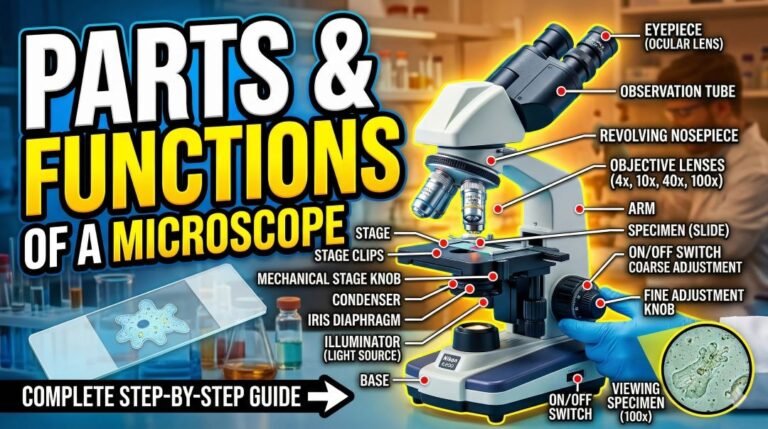
Today in this article we will discuss about the Parts and Functions of a Microscope PPT and PDF Download so, whether you are a student studying for a biology exam, a researcher setting up your first laboratory, or simply curious about how these fascinating instruments work, understanding the parts and functions of a microscope is an essential foundation in science. From the basic light microscope to advanced models like the confocal microscope, the Olympus FV3000, or the Leica Stellaris, all microscopes share core components that work together to reveal the invisible world around us.
This comprehensive guide covers the 14 parts of a microscope, their individual functions, and how different microscope types including compound microscopes, digital microscopes, electron microscopes, fluorescence microscopes, and confocal systems build upon these basics. By the end, you will have a clear picture suitable for a worksheet, a quiz, a school presentation (PPT), or professional reference.
What Is a Microscope and Why Does It Matter?
A microscope is a precision optical or electronic instrument designed to produce magnified images of objects too small to be seen clearly with the naked eye. The word itself comes from the Greek words mikros (small) and skopein (to look). The function of a microscope goes far beyond simple magnification. It enables scientists, educators, doctors, and engineers to study cells, bacteria, materials, and nano-scale structures with extraordinary clarity.
Today, microscopy imaging spans a vast range of technologies. You can choose from a basic upright microscope for routine lab work, an inverted light microscope for cell culture imaging, a laser scanning microscope for three-dimensional tissue analysis, or a benchtop SEM (scanning electron microscope) for high-resolution surface imaging. Each type builds on the same foundational parts described below.
Parts and Functions of a Microscope PPT and PDF Download (.PPTX)
The 14 Parts of a Microscope and Their Functions
Most standard compound microscopes have between 12 and 14 main parts. The exact number can vary depending on the model, but the core components are consistent. Below is a complete microscope parts diagram in text form, followed by a detailed parts and functions table.
Microscope Parts and Functions Table
| Part Name | Location | Function |
| Eyepiece (Ocular Lens) | Top of the microscope | Magnifies the image (usually 10x); this is where you look through |
| Body Tube | Between eyepiece and objective | Holds the eyepiece and connects it to the objective lenses |
| Arm | Structural support column | Connects the body to the base; used to carry the microscope |
| Nosepiece (Revolving) | Below the body tube | Holds and rotates between multiple objective lenses |
| Objective Lenses | On the nosepiece | Provide primary magnification (4x, 10x, 40x, 100x) |
| Stage | Flat platform below lenses | Holds and supports the glass slide specimen |
| Stage Clips | On the stage | Secure the glass slide in position on the stage |
| Diaphragm (Iris) | Below the stage | Regulates the amount of light passing through the specimen |
| Condenser | Below the stage | Focuses and concentrates light onto the specimen |
| Light Source (Illuminator) | Base of the microscope | Provides the light needed to illuminate the specimen |
| Coarse Adjustment Knob | On the arm | Makes large focus adjustments by moving the stage up or down |
| Fine Adjustment Knob | On the arm (smaller knob) | Makes small, precise focus adjustments for sharp imaging |
| Base | Bottom of the microscope | Provides stability and support for the entire instrument |
#1. Eyepiece (Ocular Lens)
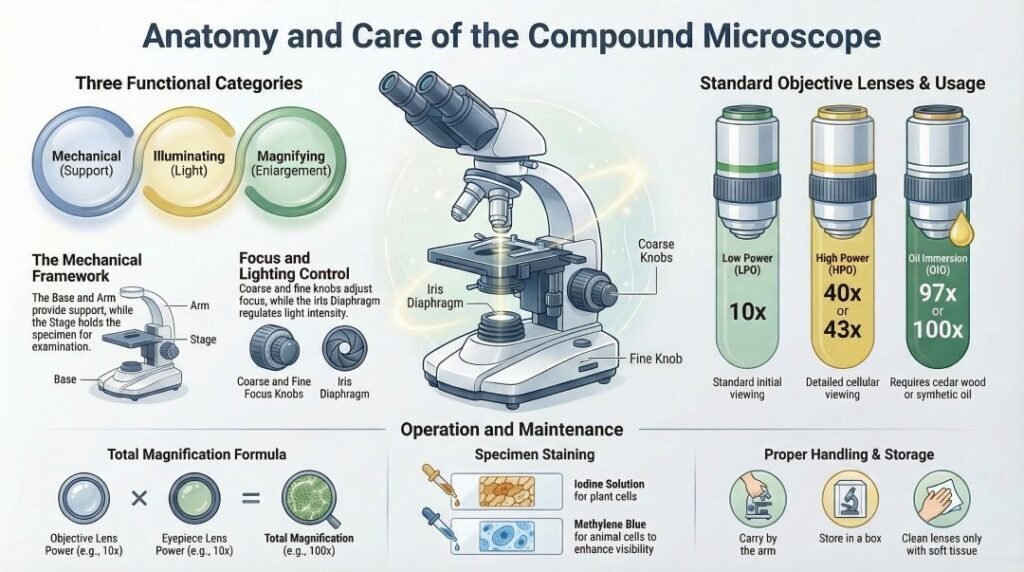
The eyepiece lens is located at the very top of the microscope. This is the component you look through. It usually provides 10x magnification, though 15x and 20x eyepieces also exist. In binocular microscopes, there are two eyepieces. The eyepiece works in combination with the objective lens to determine the total magnification of the microscope. For example, a 10x eyepiece combined with a 40x objective lens gives 400x total magnification.
#2. Body Tube
The body tube, sometimes called the draw tube, connects the eyepiece at the top to the nosepiece and objective lenses at the bottom. It maintains the correct distance between these optical components for accurate image formation. In modern finite-corrected optical systems, this distance is usually 160 mm.
#3. Arm
The arm is the curved or angled structural support that connects the body tube to the base. It is the part you hold when carrying the microscope. Always use one hand on the arm and one hand supporting the base to avoid damaging the instrument.
#4. Nosepiece (Revolving Turret)
The revolving nosepiece holds three to five objective lenses. By rotating it, you switch between different magnifications. Good-quality nosepieces are parfocal, meaning that when you switch from one objective lens to another, the specimen stays approximately in focus, requiring only minor adjustment.
#5. Objective Lenses
The objective lens is the most optically complex part of the microscope and is central to its performance. Standard compound microscopes come with four objectives:
- 4x (Scanning) – For locating the specimen on the slide
- 10x (Low Power) – For general overview
- 40x (High Dry) – For detailed cell structure
- 100x (Oil Immersion) – For bacteria and fine cellular detail
The objective lens microscope function is to gather light from the specimen and create a magnified, real intermediate image. Professional-grade objectives from brands like Olympus, Nikon, Leica, and Zeiss are precision-engineered for minimal chromatic and spherical aberration.
#6. Stage
The stage is the flat, horizontal platform where glass slides are placed. Mechanical stages allow precise X-Y movement of the slide using calibrated controls, which is critical for systematic scanning. The stage has a central hole (aperture) that allows light to pass through from below.
#7. Stage Clips
Stage clips are spring-loaded metal clips that hold the glass slide in place on a plain stage. Microscopes with mechanical stages do not need clips since the slide is held by the mechanical slide holder.
#8. Diaphragm (Iris Diaphragm)
Located just below the stage, the iris diaphragm controls the diameter of the light cone that reaches the specimen. Adjusting it changes both brightness and contrast. Closing the diaphragm increases contrast but reduces resolution; opening it increases brightness and resolution. Proper diaphragm adjustment is a skill often overlooked by beginners but is critical for high-quality microscopy imaging.
#9. Condenser
The condenser is a lens system positioned below the stage. Its role is to collect and focus the light from the illuminator onto the specimen plane, ensuring even and bright illumination. The Abbe condenser is the most common type. High-NA (numerical aperture) condensers are used in advanced setups like epi-fluorescence and confocal fluorescence microscopy to achieve maximum resolution.
#10. Light Source (Illuminator)
Modern microscopes use built-in LED or halogen illuminators in the base. Older models used a mirror to reflect external light. The light source in fluorescence microscopes is more complex, often using mercury arc lamps, xenon lamps, or LEDs with specific excitation wavelengths. Laser scanning microscopes use focused laser beams as their light source.
#11. Coarse Adjustment Knob
The coarse adjustment knob produces large movements of the stage or body tube to bring the specimen into the approximate focal plane. It is used when starting with a new slide or switching to a lower magnification objective.
#12. Fine Adjustment Knob
The fine adjustment knob makes small, precise movements to sharpen the image. It is essential when using high-magnification objective lenses (40x and above) where depth of field microscope tolerance is very narrow. In z-stack microscopy, fine motorized focus steps capture multiple image planes through the specimen.
#13. Base
The base is the heavy bottom platform of the microscope. It provides stability to prevent tipping and often houses the illuminator and its power controls.
#14. Substage Condenser Adjustment Knob
This control moves the condenser up or down to correctly align it with the objective lens, following Kohler illumination protocol for optimal image quality.
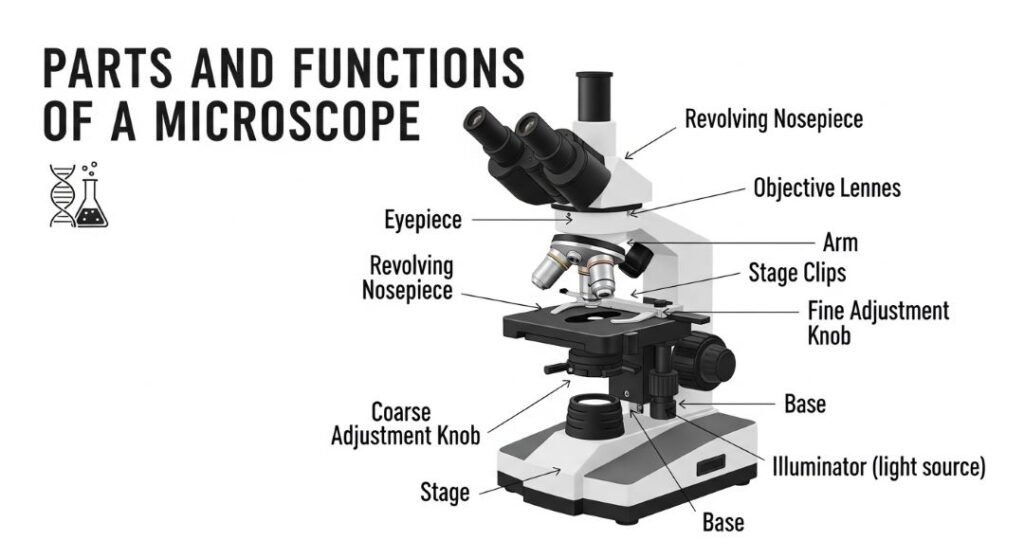
Parts and Functions of a Compound Microscope
The compound microscope is the most widely used type in schools, colleges, and research labs. Its name comes from the use of two or more lens systems: the objective lens and the eyepiece. Together they produce higher magnification than a single lens alone.
Key features of a compound microscope include:
- Magnification range: 40x to 1000x
- Uses transmitted light passing through thin, transparent specimens
- Standard configuration is upright microscope design
- Brands like AmScope microscope, Olympus BX60, Olympus BX61, and Nikon offer excellent compound models
- The Olympus BX61 and Olympus BX60 are popular research-grade upright compound microscopes
- Ideal for stained tissue sections, blood smears, and microbiology
Parts and Functions of a Light Microscope
The light microscope (also called the optical microscope) uses visible light and lenses to magnify specimens. It is broadly divided into:
- Upright microscope – Standard design; light passes from below upward through the specimen
- Inverted light microscope – Objectives are below the stage; used for living cells in dishes and flasks (for example, the Leica DMI8)
The inverted light microscope is particularly important in cell biology because cells cultured in multi-well plates or Petri dishes cannot be placed on a conventional upright stage. Models like the Leica DMI8 combine transmitted light with epi-fluorescence for versatile live-cell imaging.
Digital Microscope: Modern Technology Meets Classic Design
A digital microscope replaces or supplements the traditional eyepiece with a high-resolution camera sensor that displays images on a monitor. This eliminates eye strain during long imaging sessions and allows real-time image capture and analysis.
Key advantages of digital microscopes include:
- Live image display on a screen for group viewing
- Built-in measurement and annotation tools
- Easy documentation and sharing of microscopy images
- Models like the Keyence BZ-X800 combine bright-field, phase contrast, and fluorescence in one digital platform
- The EVOS microscope series from Thermo Fisher is another widely used digital fluorescence platform for cell biology
- The Echo Rebel microscope and Echo microscope range offer compact digital solutions for labs and classrooms
Fluorescence Microscopy: Seeing the Invisible in Color
Fluorescence microscopy is one of the most powerful techniques in modern biology. Instead of using transmitted white light, it uses specific wavelengths of excitation light to cause fluorescently labeled molecules to emit light of a different (longer) wavelength.
Core concepts in fluorescence microscopy:
- Epi-fluorescence (epi-illumination): The excitation light and emitted fluorescence travel through the same objective lens, using a dichroic mirror to separate them
- Fluorescent dyes (fluorophores) or fluorescent proteins (like GFP) label specific cellular structures
- Filter cubes select the excitation and emission wavelengths for each fluorophore
- The inverted fluorescence microscope is the standard platform for cell culture work
- Brands offering excellent fluorescence systems include Leica fluorescence microscope, Nikon confocal, Olympus confocal microscope, and Zeiss confocal microscope
Confocal Microscopy: Optical Sectioning for 3D Imaging
Confocal microscopy revolutionized biological imaging by eliminating out-of-focus blur from thick specimens. A pinhole aperture in the detection path rejects light from planes above and below the focal plane, producing optically sectioned images of exceptional clarity.
How a Laser Scanning Microscope Works
In a laser scanning microscope (LSM), one or more laser beams scan across the specimen point by point. The emitted fluorescence from each point is detected, and the system assembles the full image digitally. This is the basis of confocal fluorescence microscopy.
Leading confocal systems in current research:
- Leica SP5 and Leica SP8 – Spectral detection systems with tunable emission windows; the Leica SP5 was a landmark system in its generation
- Leica Stellaris – The latest generation Leica confocal platform with a highly sensitive WhiteLight Laser and FALCON lifetime imaging module
- Leica Confocal (DMi8 based) – Inverted confocal with flexibility for live-cell imaging
- Olympus FV3000 – High-sensitivity confocal with TruSpectral detection; excellent signal-to-noise ratio for live imaging
- Zeiss LSM (Zeiss Confocal Microscope) – Includes the LSM 800, LSM 900, and LSM 980 series; widely used in research institutions
- Nikon confocal (A1/AX series) – The Nikon confocal microscope range provides fast resonant scanning for dynamic live-cell work
- Olympus confocal microscope (including Olympus FV3000) – Renowned for sensitivity and ease of use
Z-Stack Microscopy
One of the key applications of confocal and widefield fluorescence systems is z-stack microscopy. By capturing a series of images at different focal depths (z-planes) through a specimen, a complete three-dimensional reconstruction can be assembled. This is essential for imaging thick tissues, whole embryos, organoids, and biofilms. The depth of field microscope parameter determines how many z-steps are needed for complete coverage.
Electron Microscope: Beyond the Limits of Light
The electron microscope uses a beam of electrons instead of light to form images. Because electrons have much shorter wavelengths than visible light, electron microscopes achieve far higher resolution, down to the sub-nanometer level.
The two main types are:
- Scanning Electron Microscope (SEM) – Scans the surface of specimens with an electron beam and produces detailed 3D-looking surface images. The Zeiss SEM (including Zeiss Gemini series) is industry-leading. Benchtop SEM instruments make electron microscopy accessible without a dedicated room. The Zeiss SEM range includes the SIGMA, MERLIN, and GeminiSEM platforms.
- Transmission Electron Microscope (TEM) – Passes electrons through ultra-thin specimen sections to reveal internal ultrastructure at atomic resolution
Specialized Microscopes and Brands You Should Know
Olympus Microscope
Olympus is one of the world’s leading microscope manufacturers. Their product range covers the full spectrum of microscopy, from educational compound microscopes to cutting-edge research platforms. Notable models include the Olympus BX61 (upright research microscope), Olympus BX60 (its predecessor), Olympus SZ40 (stereomicroscope for low-magnification work), Olympus FV3000 (confocal), and Olympus IX-series inverted microscopes. The Olympus Objective Finder tool helps researchers select the ideal objective for their application.
Leica Microscope
Leica Microsystems (part of Danaher Corporation) produces some of the most respected research-grade instruments in microscopy. The Leica confocal lineup (SP5, SP8, Stellaris) is known for spectral flexibility and sensitivity. The Leica SP5 introduced many labs to tunable spectral confocal imaging. The Leica Stellaris represents the state of the art with an extended wavelength range and advanced FLIM capabilities. Leica fluorescence microscope systems span widefield, confocal, STED, and THUNDER technologies.
Nikon Microscope
Nikon is synonymous with precision optics. The Nikon confocal microscope (A1 and AX series) delivers high-speed scanning with superb sensitivity. Nikon’s Ti-series inverted microscopes are popular platforms for cell biology and super-resolution microscopy.
Zeiss SEM and Confocal Systems
Carl Zeiss AG is a global leader in optical systems. Their Zeiss confocal microscope (LSM series) and Zeiss SEM instruments set industry benchmarks. The Zeiss SEM range (including benchtop models) makes high-resolution electron microscopy available to more labs. Zeiss also produces the Axio series of light microscopes widely used in pathology and materials science.
Keyence Microscope
Keyence produces the BZ-X series of all-in-one fluorescence microscopes. The Keyence BZ-X800 is particularly notable for combining multiple imaging modes (bright-field, phase contrast, fluorescence) with automated image stitching and analysis software, making it popular in pharmaceutical research and quality control.
AmScope Microscope
AmScope microscopes offer accessible, good-value optical instruments for students, hobbyists, and entry-level research labs. They produce a wide range of compound, stereo, and digital microscopes, making microscopy accessible to a broader audience.
EVOS Microscope
The EVOS microscope (Thermo Fisher Scientific) is a modular digital fluorescence imaging system widely used in cell biology labs. EVOS systems offer multiple LED light cubes for different fluorophores, an intuitive touchscreen interface, and easy image capture without traditional eyepieces.
Microscope Parts Diagram: Key Terminology for Reference
When studying a microscope parts diagram, whether for a class worksheet, a quiz, or a Quizlet study set, the following terminology is essential to know:
- Parfocal – Objectives designed so that changing magnification requires minimal refocusing
- Numerical Aperture (NA) – A measure of the objective lens’s ability to gather light and resolve detail
- Working Distance – The distance between the front lens of the objective and the specimen when in focus
- Depth of Field – The thickness of the specimen plane that appears in focus at one time (decreases as magnification increases)
- Resolution – The smallest distance between two points that can be distinguished as separate
- Magnification – Total magnification = objective lens magnification x eyepiece magnification
- Fluorophore – A fluorescent chemical compound that can re-emit light after excitation
- Z-Stack – A series of images taken at sequential focal depths for 3D reconstruction
- Confocal – Imaging mode using a pinhole to reject out-of-focus light
How to Use a Microscope: Step-by-Step
Understanding the parts and functions of a microscope only becomes truly useful when you know how to use the instrument correctly. Here is a simple protocol for a compound light microscope:
- Step 1: Place the microscope on a stable surface and plug in the power cord
- Step 2: Turn on the illuminator and set brightness to a medium level
- Step 3: Rotate the nosepiece to the lowest power objective (4x)
- Step 4: Place your prepared glass slide on the stage and secure with stage clips or the mechanical slide holder
- Step 5: Look through the eyepiece and use the coarse adjustment knob to bring the specimen into rough focus
- Step 6: Use the fine adjustment knob to sharpen the image
- Step 7: Adjust the diaphragm to optimize contrast
- Step 8: Once focused at 4x, rotate to the 10x objective and refocus using only the fine knob
- Step 9: Continue increasing magnification as needed, using only fine adjustment above 10x
- Step 10: When finished, return to the lowest power objective, remove the slide, and clean the lenses with lens paper
Confocal vs. Widefield Fluorescence: Which Should You Choose?
A common question in microscopy imaging is whether to use a widefield fluorescence system or invest in a confocal fluorescence microscopy setup. Here is a practical comparison:
| Feature | Widefield Fluorescence | Confocal Fluorescence |
| Speed | Fast | Slower (point scanning) |
| Out-of-focus blur | Present in thick samples | Eliminated by pinhole |
| 3D imaging | Requires deconvolution | Native optical sectioning |
| Phototoxicity | Higher | Lower (scanned area only) |
| Cost | Lower | Higher |
| Best for | Thin samples, live cells | Thick tissues, 3D reconstruction |
| Example systems | Leica DMI8, EVOS, Keyence BZ-X800 | Leica Stellaris, Olympus FV3000, Zeiss LSM |
Objective Lens Microscope Function: A Deeper Look
The objective lens is arguably the single most important component of any microscope. Its quality directly determines image resolution, contrast, and color accuracy. When shopping for or evaluating a microscope, the objective specifications are the primary performance indicators.
Key objective lens parameters:
- Magnification (e.g., 4x, 10x, 20x, 40x, 60x, 100x)
- Numerical Aperture (NA) – Higher NA means better resolution
- Correction class – Plan (flat field), Plan-Apo (apochromat, color corrected), Plan-Fluor (fluorescence optimized)
- Immersion medium – Dry, water, glycerol, or oil immersion
- Working distance – Critical for live imaging with coverslips
Leading manufacturers produce objectives under the names Olympus UPlanSApo, Nikon Plan Apo Lambda, Leica HC PL Apo, and Zeiss Plan-Apochromat. The Olympus Objective Finder is an online resource to match objective specifications to your experimental requirements.
Tips for Students: Preparing for Your Microscope Quiz or Worksheet
If you are preparing for a microscope parts quiz, a Quizlet review session, or need to complete a worksheet on the parts and functions of a microscope, here are the most commonly tested points:
- Know all 14 parts of a microscope and their functions by name
- Understand the difference between coarse and fine adjustment knobs
- Be able to calculate total magnification (objective x eyepiece)
- Know what the diaphragm and condenser do to light quality
- Understand why oil immersion is used with 100x objectives
- Be able to compare a compound microscope with a light microscope, electron microscope, and digital microscope
- For Class 12 Biology: Know the difference between light microscopes and electron microscopes in terms of resolution, magnification, and specimen preparation
Also read: HPV Vaccine PDF and PPT Slides Download
FAQ:
What are the 12 parts of a microscope?
The 12 most commonly listed parts are: eyepiece, body tube, arm, revolving nosepiece, objective lenses, stage, stage clips, diaphragm, condenser, light source, coarse adjustment knob, and fine adjustment knob. When the base and the substage condenser adjustment are added, you reach the full 14 parts of a microscope.
What is the most important part of a microscope?
The objective lens is generally considered the most important component because it determines the fundamental resolution and magnification of the image. However, the condenser is equally important for image quality; many beginners neglect proper condenser alignment, which significantly degrades image sharpness.
What is the difference between a compound microscope and a light microscope?
Technically, a compound microscope is a type of light microscope. The term light microscope describes any microscope using visible light, while compound refers specifically to the use of two or more lens systems. All compound microscopes are light microscopes, but not all light microscopes are compound (for example, a simple magnifying glass uses only one lens system).
What is confocal microscopy used for?
Confocal microscopy is used for imaging fluorescently labeled cells and tissues with high resolution and optical sectioning. It is particularly valuable for three-dimensional reconstruction of thick specimens, co-localization studies of multiple fluorescent labels, live-cell imaging with temporal z-stacks, and FRAP (fluorescence recovery after photobleaching) experiments.
What is a benchtop SEM?
A benchtop SEM (scanning electron microscope) is a compact version of a full-sized SEM that can sit on a laboratory bench without requiring a dedicated room, extensive vibration isolation, or high-voltage infrastructure. They offer high-resolution surface imaging at significantly reduced cost and complexity compared to conventional SEMs. They are popular in materials science, quality control, and educational settings.
Conclusion: The Microscope as a Gateway to Discovery
From the basic 14 parts of a compound light microscope to the sophisticated laser optics of the Leica Stellaris confocal system or the electron optics of the Zeiss SEM, all microscopes share a common purpose: to extend human vision into the realm of the very small. Understanding the parts and functions of a microscope is the first step toward mastering this powerful technology.
Whether you are preparing a worksheet for class, building a PPT presentation on the parts and functions of a microscope, studying for a quiz, looking for a PDF reference guide, or selecting your next research instrument, the knowledge of how each component works and why it matters will serve you throughout your scientific career.
The microscope has been called the most important invention in the history of biology. It revealed the cell, the bacterium, and the virus. Today, advances in confocal fluorescence microscopy, z-stack microscopy, digital microscopy, and electron microscopy continue to transform our understanding of life at the molecular level. The journey always begins with a clear view through the eyepiece.