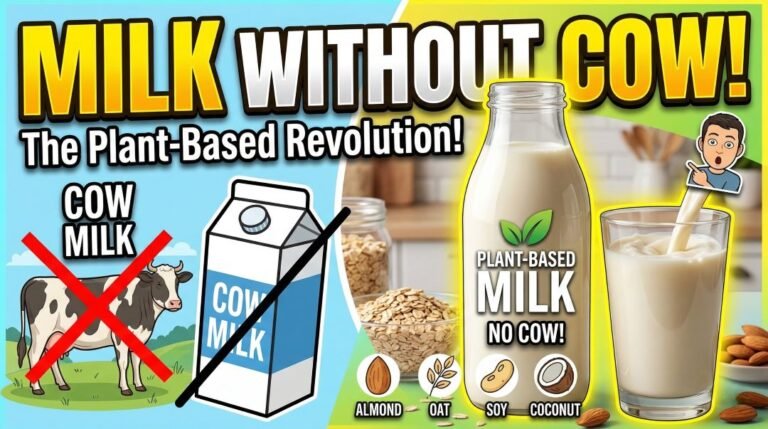
In this article we will discuss about the Milk Without Cow PDF and PPT Download, Precision Fermentation, Lab-Grown Milk, Dairy Innovation, Plant-Based Alternatives, Milk Without Cow: The Future of Dairy Is Already Here so, What if you could enjoy a cold glass of real dairy milk – the kind that melts cheese perfectly, froths into cappuccino foam, and tastes just like what you grew up with – but no cow was ever involved? That question, which once sounded like science fiction, is now the centrepiece of one of the most exciting food revolutions of the 21st century. Milk without a cow is no longer a concept. It is a product, a movement, and a rapidly growing industry.
Whether you are lactose intolerant, vegan, environmentally conscious, or simply curious about the world’s first milk without cow that scientists have created, this article will walk you through everything – from how making milk without cows actually works, to which milk without cow brands are leading the charge, what it costs, and why dairy milk without cows could transform the global food system.
What Exactly Is Milk Without a Cow?
Most of us grew up thinking milk = cow. But at a molecular level, milk is simply a collection of proteins (primarily casein and whey), fats, sugars (lactose), water, and minerals. The cow is just a biological factory that assembles those ingredients. So scientists asked a simple but radical question: what if we could produce those exact same proteins without the cow?
The answer came through a process called precision fermentation – and it is the basis of what is now called dairy milk without cows. Using genetically engineered microorganisms such as yeast or fungi (the same organisms used to brew beer and bake bread), scientists programme these microbes to produce milk proteins that are molecularly identical to what comes from a cow. The result: real dairy, made entirely animal-free.
This is fundamentally different from plant-based alternatives like almond milk, oat milk, or soy milk. Those products do not contain actual dairy proteins, which is why they behave differently when heated, melt poorly in cooking, and have a distinctly non-dairy taste. Cow milk without the cow produced through precision fermentation, however, contains the real proteins – which means it behaves like milk because it genuinely is milk, just brewed instead of milked.
Milk Without Cow PDF and PPT Download
Making Milk Without Cows: The Science Explained Simply
Here is a step-by-step breakdown of how making milk without cows actually works:
- Scientists identify the DNA sequence that codes for milk proteins – particularly beta-lactoglobulin (a primary whey protein) and casein.
- That DNA sequence is inserted into a microorganism – typically a strain of yeast like Trichoderma reesei.
- The programmed microbe is fed sugar and nutrients and placed in a fermentation tank – the same kind used to brew beer.
- As the yeast ferments, it secretes milk proteins that are chemically identical to those in cow milk.
- The proteins are then harvested, purified, and blended with water, plant-based or fermented fats, and minerals to create the final product – 100% animal-free and naturally free of cow milk without lactose complications.
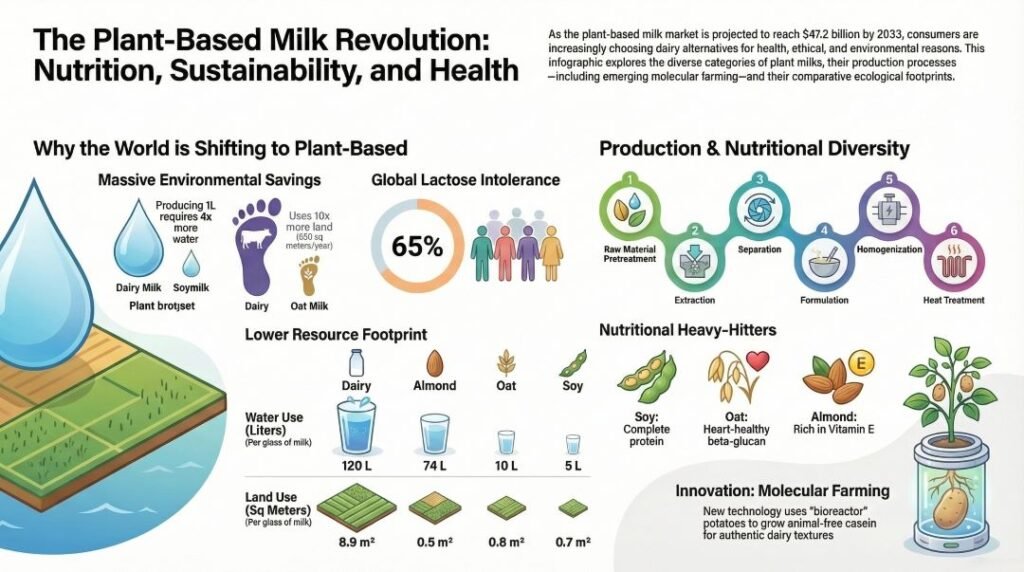
Because lactose – the sugar that causes digestive distress for an estimated 65 to 70 percent of the global population – is not produced by the yeast, this type of dairy milk without cows is inherently cow milk without lactose. It also contains none of the hormones or antibiotics that can be present in conventional dairy.
Milk Without Cows Milk Protein: Is It Nutritionally Complete?
The most common concern people raise is about nutrition. Does milk without cows milk protein actually compare to traditional dairy? The short answer is yes – and in several ways, it exceeds it.
Because the proteins produced are molecularly identical to those in cow milk, the nutritional profile is essentially the same. You receive the same amino acid profile, the same protein quality score, and the same functional benefits – without hormones, antibiotics, or saturated fats at traditional dairy levels.
It is also worth discussing milk without a2 protein in this context. A2 milk has become popular because it contains only the A2 beta-casein protein, which many people find easier to digest than standard A1 milk. Precision fermentation companies have the ability to produce specifically A2-type casein proteins, which means future versions of lab-grown milk could be tailored to be milk without A2 protein issues – essentially an ultra-digestible, animal-free dairy designed for sensitive stomachs.
Nutritional Comparison: Milk Types Per Cup (240ml)
| Milk Type | Calories | Protein (g) | Total Fat (g) | Calcium (mg) |
| Whole Cow Milk | 149 | 7.7–8.0 | 7.9 | 276–300 |
| Precision Fermentation Milk | ~149 | ~7.5–8.0 | ~7.0–8.0 | ~280 |
| Soy Milk | 80–105 | 6.5–8.0 | 3.5–4.0 | 300* |
| Oat Milk | 120–130 | 3.0–4.0 | 2.5–5.0 | 350* |
| Almond Milk | 30–40 | 1.0–1.5 | 2.5–3.0 | 450–480* |
| Pea Milk | 80–100 | 8.0 | 4.5 | 440* |
| Rice Milk | 115–120 | 0.5–1.0 | 2.5 | 300* |
*Fortified. Natural levels in plant sources are typically much lower.
As the table shows, precision fermentation milk matches cow milk almost exactly in protein and nutrition – far outperforming most plant-based alternatives in protein density. If you are choosing milk without cow protein for fitness or health purposes, fermentation-based dairy is the most nutritionally comparable option available.
Formula Milk Without Cow Protein and Baby Milk Without Cow Protein
For parents navigating cow milk protein allergy (CMPA) in infants, the need for formula milk without cow protein is urgent and deeply personal. Traditional hypoallergenic formulas use either extensively hydrolysed proteins or amino acid-based formulas, which are expensive, often unpalatable, and not always available.
Baby milk without cow protein derived from precision fermentation represents a potential breakthrough – proteins that are real dairy in structure but produced entirely without animals, and therefore without the allergenic triggers associated with bovine sources. While this application remains in research and development stages and has not yet received broad regulatory approval, several biotech companies are actively pursuing it. It could eventually offer a far superior alternative to current hypoallergenic formulas for the millions of infants who need dairy-free infant nutrition.
The World’s First Milk Without Cow: A Brief History
The world’s first milk without cow achieved through precision fermentation was produced by Perfect Day, a California-based food tech company founded in 2014. Their mission: create cow-free dairy that is molecularly indistinguishable from the real thing.
In 2020, Perfect Day partnered with Graeter’s Ice Cream to launch the first precision fermentation dairy product available to consumers – animal-free ice cream. The public response was extraordinary, with people genuinely surprised that something produced without a single animal could taste so completely authentic.
Since then, the field has exploded. What began as a niche biotech experiment is now a multi-billion-dollar global industry with hundreds of millions in investment and dozens of companies racing to bring dairy milk without cows to supermarket shelves worldwide.
Milk Without Cow Brands: Who Is Leading the Market?
The landscape of lab grown milk brands is growing rapidly. Here are the key players you should know:
1. Perfect Day (USA)
The pioneer of precision fermentation dairy. Perfect Day produces whey protein identical to that found in cow milk and is among the best-known milk without cow brands globally. Their proteins are now used as ingredients in ice cream, cream cheese, and other dairy foods by partner brands.
2. Remilk (Israel)
Remilk is one of the most talked-about names in the cow-free dairy space. They produce real dairy proteins without animals using precision fermentation – cholesterol-free, lactose-free, and hormone-free. Remilk has received US FDA clearance and is scaling up production aggressively. As production scales, the Remilk milk price is expected to fall significantly, eventually undercutting conventional dairy.
3. Zero Cow Factory (India)
Zero Cow Factory is an Indian startup working to produce precision fermentation dairy proteins indigenously – specifically A2 beta-casein, a protein associated with easier digestibility. Zero Cow Factory milk price is a critical topic for the Indian market, and their goal is to make lab-grown dairy accessible at a price point viable for India’s price-sensitive consumers. They represent the leading edge of lab-grown milk India development.
4. Change Foods, Inc. (USA/Australia)
Change Foods targets cheese production – creating mozzarella, cheddar, and other varieties using precision fermentation with authentic melt, stretch, and flavour. They are widely regarded as one of the most innovative milk without cow brands in the cheese segment.
5. LegenDairy Foods GmbH (Germany)
LegenDairy Foods is developing bioidentical dairy proteins for the European market, working toward EU regulatory clearance – an essential step for establishing lab grown milk brands in high-regulation environments.
6. The EVERY Company (USA)
Originally focused on egg proteins, The EVERY Company has expanded into dairy proteins using yeast-based fermentation. They supply functional proteins to food manufacturers, showing how precision fermentation is reshaping the entire animal-protein industry.
7. Imagindairy Ltd (Israel)
Imagindairy uses AI and machine learning alongside precision fermentation to optimise dairy protein production. They are one of the most technology-forward companies in the dairy milk without cows space, enabling faster iteration at lower cost.
8. Nourish Ingredients (Australia)
Nourish Ingredients focuses specifically on producing animal-free fats through fermentation – the lipids that give dairy its rich flavour and mouthfeel. Their animal-free dairy fats are the missing piece in producing truly complete milk made without cows, addressing the gap that most other precision fermentation companies leave by relying on plant-based lipids.
Lab-Grown Milk India: The World’s Biggest Dairy Market Is Paying Attention
India is the world’s largest producer and consumer of milk, contributing an estimated 32 percent of global dairy supply by 2026. It is also a country where dairy is woven deeply into culture, cuisine, religion, and economy. So where does lab-grown milk India stand today?
India’s participation in the dairy without cow’s milk revolution is growing. Zero Cow Factory is producing indigenous precision fermentation proteins including A2 beta-casein – proteins well-suited to Indian consumer preferences, since A2 milk is already widely accepted in the Indian market. Several Indian-origin researchers are also active in the global precision fermentation race, and the Indian government has shown increasing interest in alternative proteins as part of its food security strategy.
For a country that depends so heavily on livestock farming, the transition to making milk without cows will be gradual and requires thoughtful policy support. But the seeds are clearly planted, and India’s robust biotech infrastructure makes it well-positioned to become both a major consumer and producer of precision fermentation dairy.
Milk Without Cow Price: What Does It Cost Today?
Milk without cow price is currently a genuine barrier for mass adoption. Precision fermentation products cost more to produce than conventional dairy because the technology is still maturing and production is not yet at commodity scale. Consumer products using precision fermentation proteins – specialty ice creams, premium cheeses – are available in the United States at a significant price premium.
However, the economics are improving rapidly. Industry projections suggest that as fermentation capacity scales and technology becomes more efficient, precision fermentation dairy could reach cost parity with conventional dairy within five to ten years. The Remilk milk price trajectory, for example, is explicitly designed to undercut conventional dairy at scale. Zero Cow Factory milk price in the Indian market is being engineered with local cost structures in mind, targeting accessibility rather than premium positioning.
Cow Milk Without Cow vs. Plant-Based Alternatives: What Is the Difference?
It is important to distinguish between two very different categories that both fall under the broad label of ‘dairy milk without cows’:
- Plant-based beverages (soy, oat, almond, coconut, rice, pea, hemp): These are made by blending plant sources with water and straining out the solids. They contain no actual dairy proteins. Nutritional profiles vary widely – soy and pea milk come closest to cow milk in protein content, while almond milk is lowest in calories. These are dairy-free beverages, not dairy alternatives in a strict scientific sense.
- Animal-free dairy (precision fermentation): This produces real milk proteins – casein and whey – using microbes instead of cows. The end product is molecularly real dairy, just made without an animal. It behaves identically to dairy in cooking, baking, frothing, and taste.
For most health and culinary purposes, cow milk without cow produced through precision fermentation is the superior choice if you need the real dairy experience without the animal. Plant-based milks remain excellent alternatives for consumers whose priority is affordability, wider availability, or avoiding all fermentation-based processes.
Is Dairy Milk Without Cows Better for the Environment?
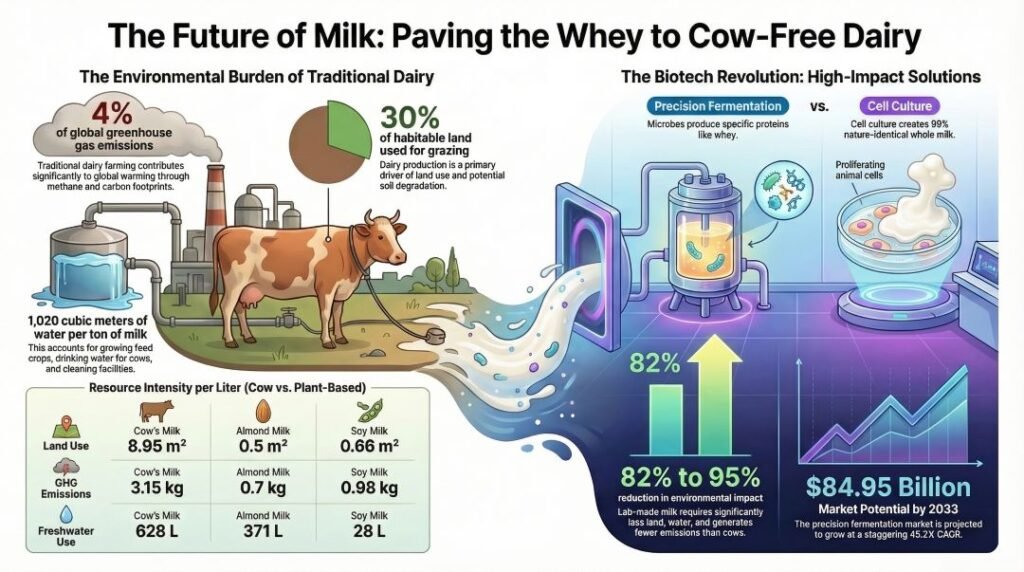
The environmental case for milk made without cows is compelling. Conventional dairy farming is a significant contributor to greenhouse gas emissions, land use, and water consumption. Early lifecycle assessments suggest that producing dairy proteins via fermentation emits up to 91 percent fewer greenhouse gases, uses up to 99 percent less land, and requires up to 98 percent less water compared to conventional dairy farming.
For environmentally conscious consumers who have been reluctantly giving up cheese and yogurt in the name of sustainability, dairy without cow’s milk produced through fermentation offers an exciting prospect: keeping the foods you love while dramatically shrinking your environmental footprint.
The Future of Milk: Dairy 4.0 and What Comes Next (2025–2050)
The future of milk is shifting from a standard commodity toward a high-value, personalised product shaped by biotechnology and digital automation. Industry analysts project that by 2030 to 2050, the global dairy industry will be a mix of traditional dairy, plant-based alternatives, and animal-free dairy created via fermentation or lab-grown cells. Here are the key trends redefining the industry:
- Precision Fermentation Dominance: Technology for making milk without cows uses genetically engineered microbes to brew milk proteins. Major global players like Nestle and Danone are already integrating these proteins into products like animal-free whey isolates.
- Hyper-Personalisation: By 2050, milk may move from a ‘nutrient-dense commodity’ to a ‘personalised health solution,’ with bioactives tailored to individual wellness needs through data-driven research and development.
- India’s Pivotal Role: As the world’s largest producer, India is expected to contribute 32 percent of global supply by 2026. Future focus here will include UHT sachet milk for shelf stability and automation to reduce the 30 percent waste due to poor refrigeration infrastructure.
- Smart Farming (Dairy 4.0): Traditional farms are adopting IoT sensors, drones, and AI to monitor cattle health and milk quality in real-time – improving efficiency even within conventional dairy.
Challenges and Controversies: Real Hurdles Ahead
Milk without cow technology faces several real challenges:
- Regulatory approval: Most countries require safety assessments before precision fermentation products can be sold. The US FDA has cleared several products, but the EU, Asia, and other markets are still developing their frameworks.
- Consumer acceptance: Some people are sceptical of fermentation-produced dairy. Even scientifically sound and ethically superior products face a trust barrier that companies must address through transparency and education.
- Farmer livelihoods: Dairy farming supports millions of livelihoods globally, particularly in countries like India. A rapid shift to dairy milk without cows could have serious economic consequences for farming communities unless carefully managed.
- Scale and cost: Moving from lab to mass production while maintaining quality and reducing milk without cow price is a significant engineering challenge the industry is actively solving.
Who Should Be Most Excited About Milk Without a Cow?
This technology has something tangible to offer a wide range of people:
- Lactose-intolerant individuals: Fermentation-based dairy is cow milk without lactose by nature – enjoy dairy without digestive consequences.
- People sensitive to A1 proteins: Future products could offer milk without a2 protein complications, with specifically A2-type casein produced by fermentation.
- Vegans: No animals are harmed in precision fermentation. The product is animal-free while remaining real dairy.
- Parents of allergic infants: Research into baby milk without cow protein and formula milk without cow protein could eventually produce better infant formula alternatives.
- Climate-conscious consumers: Dramatically lower carbon, land, and water footprint compared to conventional dairy.
- Food tech enthusiasts: One of the most tangible, everyday examples of biotechnology improving human life.
The Cow-Free Creamery: How Yeast is Re-Engineering the Future of Milk?
Imagine a dairy farmer standing in a sterile, climate-controlled room. Outside, a long line of customers waits for fresh milk, and the farmer provides it by the hundreds of liters. In the adjacent paddock, his cow looks on with a sense of profound biological confusion. She hasn’t been milked all day, yet the “dairy” is flowing.This isn’t a sleight of hand; it is the biological decoupling of the product from the producer. We are witnessing a shift from traditional animal husbandry toward cellular agriculture, a revolution sparked by the need to solve age-old human health barriers like lactose intolerance. This is the dawn of “Milk without the Cow,” a transition that promises to move dairy from the barnyard to the laboratory.
#1. Yeast: The New “Hero” of the Dairy Industry
The protagonist of this story isn’t a bovine, but a fungus: Saccharomyces cerevisiae , famously known as “Baker’s Yeast.” For millennia, we have relied on this microscopic organism to leaven our bread and ferment our spirits. Today, however, scientists have cast it in a far more complex role: a microscopic factory.The process centers on fermentation, which is scientifically defined as a process that converts complex substances into simpler or higher-value products using microorganisms. In the context of the new dairy industry, it is a streamlined “A to B” transformation.The Efficiency of Micro-Factories Traditional dairy production is inherently inefficient. To produce milk, we must raise a 1,500-pound “bio-processor”-the cow-which requires massive inputs of land, water, and feed just to maintain its own biological overhead. By using yeast, we bypass the animal entirely. We provide the yeast with a nutrient-rich environment, and it produces specific milk components with a fraction of the environmental footprint and none of the livestock maintenance.
#2. The Genetic “Software” Update: Recombinant DNA
To transform yeast into a milk-producing powerhouse, scientists utilize “Precision Fermentation” via Recombinant DNA Technology. The technical “hero” of this molecular edit is the Plasmid . Unlike the primary DNA found in the nucleus, a plasmid is a small, circular, and extra-nuclear piece of DNA. Because it sits outside the main genetic headquarters, scientists can “cut and paste” new instructions into it without killing the host cell.In this realm of bio-engineering, the relationship between DNA and the organism is best understood through a computing lens:
- Software (DNA): The instructional code that dictates how an organism looks, functions, and produces substances.
- Hardware (The Organism): The biological machinery-in this case, the yeast cell-that executes that code.By identifying the specific gene in a cow’s DNA responsible for producing Casein (the primary protein that gives milk its structure), scientists can splice that “software” into the yeast’s plasmid. Once the update is complete, the yeast ceases its traditional work of making CO2 for bread and begins churning out bio-identical bovine casein protein.
#3. A Solution for Lactose Intolerance (With a Vital Caveat)
One of the most profound advantages of “designing” milk from the molecular level is the ability to solve the global epidemic of lactose intolerance. During the re-programming phase, scientists simply “de-select” the instructions for producing lactose, replacing the milk sugar with more easily digestible sweeteners like sucrose.The “Chunnu vs. Munnu” Analogy To understand why this matters, consider two consumers, Chunnu and Munnu:
- Chunnu possesses the biological “hammer”-the enzyme lactase. When he drinks milk, his hammer breaks the lactose into glucose and galactose for easy digestion.
- Munnu lacks this “hammer.” When he consumes traditional dairy, the lactose remains unbroken, traveling to his large intestine where bacteria attack it. The result is the “gurgling,” gas, and distress associated with lactose intolerance.By omitting the lactose “software” in the lab, we create a product Munnu can enjoy without pain. However, a critical safety distinction must be made: this is a solution for lactose intolerance, not necessarily for milk allergies. Because the yeast is producing bio-identical Casein proteins, those with a true cow’s milk protein allergy must still approach these products with extreme caution and medical advice.
#4. The Environmental “Methane” Bonus
Beyond human digestion, the transition to precision fermentation offers a massive ecological reprieve. Traditional cattle farming is a primary driver of methane emissions. According to the Global Methane Report , the dairy industry is a significant source of this potent greenhouse gas, which has a much higher heat-trapping potency than carbon dioxide.Precision fermentation acts as a “greener” alternative by:
- Drastically reducing the land and water footprint required for a single liter of milk.
- Eliminating the methane-producing biological processes of livestock.
#5. From Pilot Projects to Your Dinner Table
This technology has already migrated from the realm of science fiction into the global marketplace. Several key players are currently scaling these bio-identical dairy products:
- Zero Cow Factory (India): A regional pioneer in cellular dairy, leading the charge in South Asia.
- Remilk (Israel): A world-famous innovator that has become a global face for cow-free protein.
- New Culture (USA/Canada): An industry leader that has already cleared the significant hurdle of FDA approval.The Ghee Hurdle While this milk is excellent for making yogurt (Dahi) and cheese (Paneer) due to its high casein content, it faces a unique limitation: Ghee . Because the fats in cow-free milk are typically added separately-often from vegetable sources-they lack the specific aromatic and complex chemical properties of 100% animal-derived butterfat. Replicating the “soul” of animal Ghee remains a significant challenge for cellular agriculture.
#6. The Dawn of the Designer Era
We are entering a “Designer Era” of nutrition. Just as the concept of “Designer Babies” explores the ethical frontier of combining the best genetic traits in humans, we are now doing the same with our food. We can take the protein-producing excellence of a cow and the efficiency of a fungus to create a superior, optimized product.As we move toward a world where our dairy is “brewed” in a precision facility rather than harvested from an animal, we must ask ourselves: are we ready to trade the “natural” for the “optimized”? In an age of environmental crisis and digestive sensitivity, the shift toward a scientifically perfected glass of milk may not just be a choice, but a necessity.
Also read: Thorne Creatine Monohydrate Supplement (POWDER) (.PPTX)
Final Thoughts: Would You Drink Milk Brewed in a Lab?
The question is no longer whether milk without a cow is scientifically possible. It clearly is. The question is whether you are ready to embrace it – and whether the industry can bring it to your doorstep at a price that makes sense.
From Remilk in Israel to Zero Cow Factory in India, from Perfect Day in California to LegenDairy in Germany – the world’s most innovative food scientists are working together on a single audacious goal: dairy milk without cows, for a world that increasingly needs better options.
Making milk without cows is not a fringe idea. It is a measurable, funded, regulatory-approved, and commercially available reality that is rapidly moving from the lab to your local shop shelf. It is cow milk without lactose, without hormones, without the environmental cost – and according to everyone who has tasted it, without any compromise on flavour. And if that future comes with better taste, lower cost, and a cleaner planet? Well, that sounds like dairy worth drinking.