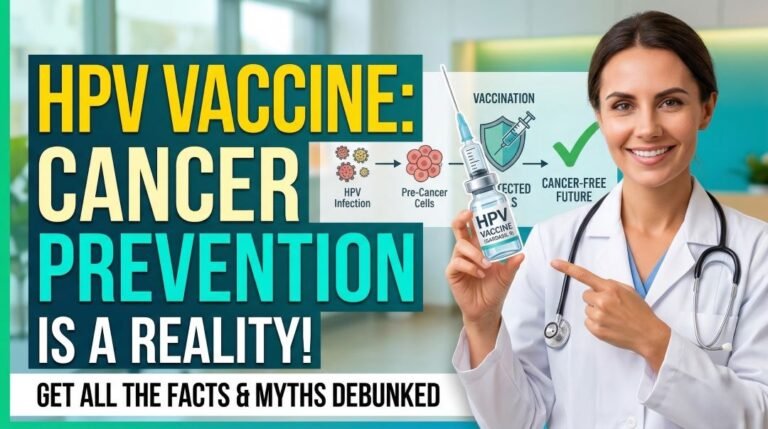
In this article we will get info about the HPV Vaccine, HPV Vaccine PDF and PPT Slides Download and Complete Guide with Side Effects, Price, Benefits, Age, Schedule, and Uses, Everything you need to know about the HPV vaccine – what it is, HPV vaccine side effects, price in India, benefits for males and females, age limit, schedule, uses, and whether it is safe for kids, women, and men so, Cervical cancer is the fourth most common cancer in women worldwide – and one of the most preventable. The HPV vaccine is the single most powerful tool we have to stop it before it starts. Yet despite being available for nearly two decades, millions of families still have questions: Is it safe? Who should get it? What are the side effects? How much does it cost in India?
This complete guide answers every important question about the HPV vaccine – covering its full form, uses, benefits for males and females, side effects in kids and adults, price in government and private hospitals, age limit, schedule, and much more.
Whether you are a parent, a young adult, or someone who simply wants to make an informed health decision, this is the only HPV vaccine guide you will need.
HPV Vaccine PDF and PPT Slides Download (.PPTX)
HPV Vaccine Full Form and Meaning – What Is HPV?
HPV vaccine full form: Human Papillomavirus Vaccine.
The Human Papillomavirus (HPV) is one of the most common sexually transmitted infections in the world. It is so widespread that nearly every sexually active person will be exposed to at least one type of HPV during their lifetime. There are over 200 strains of HPV, of which roughly 40 affect the genital area. High-risk strains – particularly HPV 16 and HPV 18 – are responsible for the vast majority of cervical cancers, as well as cancers of the throat, mouth, anus, penis, vagina, and vulva.
HPV vaccine kya hota hai? In simple terms: it is a vaccine that prevents infection from high-risk strains of the Human Papillomavirus, significantly reducing the risk of cervical cancer, genital warts, and several other HPV-related cancers.
Key facts about HPV:
- HPV causes over 90% of cervical cancers worldwide
- HPV also causes genital warts in both men and women
- Most HPV infections show no symptoms and go undetected
- HPV spreads through skin-to-skin sexual contact, not just intercourse
- The HPV vaccine is the only proven prevention available against high-risk HPV strains
HPV Vaccine Name – Which Vaccines Are Available?
When people search for HPV vaccine name, they are typically looking for the brand names of approved vaccines. Here are the main ones available globally and in India:
- Gardasil 9 (Merck): Protects against 9 strains of HPV (HPV 6, 11, 16, 18, 31, 33, 45, 52, 58). This is the most widely used HPV vaccine globally.
- Cervarix (GSK): Bivalent vaccine protecting against HPV 16 and HPV 18. Available in some countries.
- Cervavac (Serum Institute of India): India’s own indigenously developed HPV vaccine – a quadrivalent vaccine protecting against HPV 6, 11, 16, and 18. Approved by DCGI for use in India.
The HPV vaccine protects against the strains that cause the most cancers and genital warts, making it one of the most effective cancer prevention tools available today.
HPV Vaccine Age and Age Limit – When Should You Get It?
One of the most common questions people ask is about HPV vaccine age – specifically, who should get it and when. The answer depends on your age group.
Recommended Age Groups
- Ages 9 to 14 (Ideal Age): The vaccine is most effective when given before any exposure to HPV. Just 2 doses are required, given 6 to 12 months apart. This is the best window for vaccination.
- Ages 15 to 26: Three doses are required over six months (0, 1-2, and 6 months). The vaccine is still highly beneficial and strongly recommended.
- Ages 27 to 45 (HPV Vaccine Age Limit): Adults in this range may benefit from vaccination after discussing with a doctor. It is not routinely recommended but is approved for use.
Why Is HPV Vaccine Not Recommended After 26?
Many people wonder: why is HPV vaccine not recommended after 26? The reason is not that the vaccine stops working – it is that by age 27 and above, most sexually active people have already been exposed to HPV. The vaccine prevents new infections; it does not treat existing ones. After 26, the benefit-to-cost ratio diminishes for general population recommendations. However, individuals who have not been previously vaccinated may still benefit – your doctor is the best person to advise.
HPV Vaccine Schedule – How Many Doses Are Needed?
Here is the complete HPV vaccine schedule based on age:
- 2-Dose Schedule (Ages 9 to 14): Dose 1 at chosen date; Dose 2 at 6 to 12 months after Dose 1
- 3-Dose Schedule (Ages 15 to 45): Dose 1 at chosen date; Dose 2 at 1 to 2 months later; Dose 3 at 6 months after Dose 1
- Immunocompromised individuals (regardless of age) always require 3 doses
Note: The vaccine is given as an intramuscular injection, typically in the upper arm or thigh. It is not recommended during pregnancy, though it is considered safe for breastfeeding mothers.
HPV Vaccine Price in India – Cost in Government and Private Hospitals
HPV vaccine price is a major concern for many families, especially in India. Here is a transparent breakdown of HPV vaccine cost:
HPV Vaccine Price in Government Hospitals
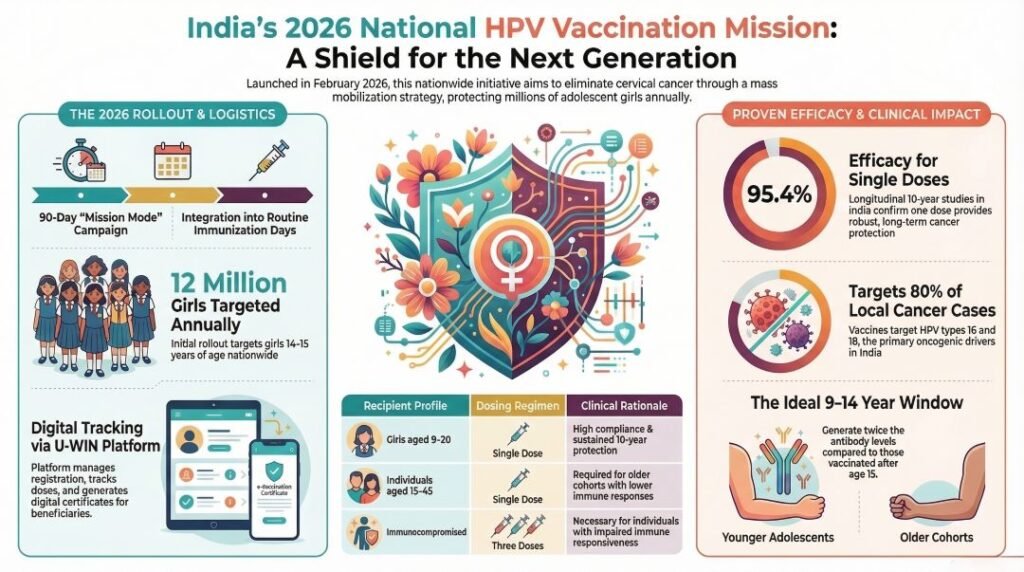
The Government of India introduced the HPV vaccine in its Universal Immunisation Programme (UIP) in 2023, targeting girls aged 9 to 14 years. Under government campaigns – such as those recently launched in Maharashtra and Andhra Pradesh – the HPV vaccine is available free of charge or at heavily subsidised rates in government hospitals and health centres.
HPV vaccine price in government hospital: Free (under national vaccination drives) or at a nominal cost of approximately Rs. 200 to Rs. 400 per dose under some state programmes.
HPV Vaccine Price in Private Hospitals
- Gardasil 9 (Merck): Approximately Rs. 2,800 to Rs. 3,500 per dose (total 3 doses = Rs. 8,400 to Rs. 10,500)
- Cervarix (GSK): Approximately Rs. 2,000 to Rs. 2,500 per dose
- Cervavac (Serum Institute of India): Approximately Rs. 200 to Rs. 400 per dose – making it the most affordable option in India
Tip: If you are looking for an HPV vaccine near me, check your nearest government health centre first – free vaccination is increasingly available through state and national programmes for eligible age groups.
HPV Vaccine Uses – What Does the HPV Vaccine Protect Against?
HPV vaccine uses go far beyond just cervical cancer prevention. The vaccine protects against:
- Cervical cancer (the primary target – caused predominantly by HPV 16 and 18)
- Genital warts (caused by HPV 6 and 11)
- Vaginal and vulvar cancers
- Anal cancer
- Throat and mouth cancer (oropharyngeal cancer) – particularly relevant for men
- Penile cancer
- Recurrent respiratory papillomatosis (rare condition caused by HPV in the airway)
In short, the HPV vaccine prevents which cancers? It prevents cervical, vaginal, vulvar, anal, penile, and oropharyngeal cancers – up to six types of cancer from a single vaccine.
HPV Vaccine Benefits – For Males, Females, Girls, and Boys
What benefits does the HPV vaccine have? The benefits are significant and well-documented across all genders and age groups.
HPV Vaccine Benefits for Females (Girls and Women)
- Up to 93-100% effective at preventing infection from the HPV strains it targets
- Dramatically reduces the risk of cervical cancer – the second most common cancer in Indian women
- Prevents precancerous cervical lesions that would otherwise require painful treatment
- Reduces risk of vaginal and vulvar cancers
- Prevents genital warts, which are uncomfortable and can recur if left untreated
HPV Vaccine Benefits for Males (Boys and Men)
HPV vaccine for men is equally important, though this fact is underappreciated. A global study shows that one in three men carry HPV. Excluding boys from vaccination keeps the infection circulating and poses a broader public health risk.
- HPV vaccine benefits for males include protection against penile cancer
- Protects against anal cancer – a growing concern, especially in men who have sex with men
- Prevents throat and mouth cancer (oropharyngeal cancer) – HPV is now the leading cause of throat cancer in men
- Prevents genital warts
- Contributes to herd immunity, protecting unvaccinated partners and community members
HPV Vaccine Benefits for Boys Specifically
Oncologists increasingly advocate for HPV vaccination to include boys too – and the evidence supports this strongly. HPV vaccine benefits for boys include prevention of mouth, throat, and anal cancers, which are rising rapidly among young men. The Maharashtra government and other Indian states are beginning to include boys in their HPV vaccination campaigns.
HPV Vaccine Side Effects – What to Expect
Understanding HPV vaccine side effects is crucial for informed consent. The reassuring truth is that the vast majority of side effects are mild and temporary.
Common (Mild) Side Effects
- Pain, redness, or swelling at the injection site (most common)
- Headache
- Mild fever
- Fatigue or tiredness
- Dizziness or fainting (usually right after injection – sitting or lying down for 15 minutes after vaccination is recommended)
- Nausea (less common)
HPV Vaccine Side Effects in Kids
HPV vaccine side effects in kids are similar to those in adults – mostly soreness at the injection site and mild fever. These are a sign that the immune system is responding. Serious reactions are extremely rare. Children should be observed for 15 minutes post-vaccination to monitor for fainting.
HPV Vaccine Side Effects in Women
HPV vaccine side effects in women are generally the same as the common list above. Some women report temporary arm soreness lasting 1 to 3 days. The vaccine is not recommended during pregnancy, though no harmful effects on the baby have been documented in accidental cases.
HPV Vaccine Side Effects for Men
HPV vaccine side effects for men mirror those for women – injection site reactions, mild headache, and occasional dizziness are the most reported experiences. Long-term side effects have not been established in large, credible studies.
HPV Vaccine Side Effects Long Term – What the Research Says
Many parents and adults worry about HPV vaccine side effects long term. Here is what the evidence shows: Gardasil 9 has been used since 2006 and has been administered to hundreds of millions of people in over 160 countries. Long-term safety monitoring has not identified any serious long-term adverse effects.
What about Gardasil side effects 10 years later? Studies tracking vaccinated populations over 10+ years show no increased risk of chronic illness, autoimmune disorders, or fertility problems compared to unvaccinated groups.
HPV Vaccine Side Effects in Adults – How Many Days Do They Last?
HPV vaccine side effects in adults typically resolve within 1 to 3 days. HPV vaccine side effects – how many days? Injection site discomfort usually peaks within 24 hours and subsides within 2 to 3 days. Fever and headache, if they occur, typically resolve within 24 to 48 hours.
Is HPV Vaccine Safe? Addressing Common Concerns
Is HPV vaccine safe? Yes – and the evidence is overwhelming. The HPV vaccine has been approved by the World Health Organization (WHO), the US Centers for Disease Control and Prevention (CDC), India’s DCGI, and regulatory bodies in over 100 countries.
What about doctors against HPV vaccine? A minority of medical practitioners have raised concerns, largely about the speed of initial approval or specific rare side effects. However, the overwhelming scientific and medical consensus – supported by WHO, CDC, ACOG, and the Indian Academy of Pediatrics – affirms that the HPV vaccine is safe and effective.
Key safety statistics:
- Over 500 million doses administered globally since 2006
- 93 to 100% effective at preventing infection from targeted HPV strains
- Used in over 160 countries as of 2026
- No proven serious long-term adverse effects
- Countries with high vaccination rates have seen dramatic reductions in cervical cancer cases
HPV Vaccine for Men – Why Boys and Men Need It Too
HPV vaccine for men is not just beneficial – it is essential. Despite common misconceptions, HPV is not a disease that only affects women. Men carry HPV silently, often without symptoms, and can pass it to partners. They are also at direct risk of HPV-related cancers.
Why HPV vaccine for men matters:
- HPV causes 70% of all oropharyngeal (throat and mouth) cancers – a rate rising faster in men than in women
- One in three men globally carry HPV at any given time
- Vaccinating boys creates herd immunity, reducing transmission to women and other men
- The HPV vaccine is equally safe and effective in males as in females
HPV Vaccine in Hindi – HPV Vaccine Benefits and Side Effects in Hindi (संक्षिप्त जानकारी)
HPV vaccine kya hota hai – Hindi mein samjhein:
HPV (Human Papillomavirus) ek bahut hi aam sexually transmitted infection hai. Yeh virus cervical cancer, genital warts, aur throat cancer ka mukhya karan hai. HPV vaccine ek suraksha kawach hai jo is virus ke high-risk strains se bachata hai.
HPV vaccine ke fayde (benefits in Hindi):
- Cervical cancer se bachav – mahilaon ke liye sabse bada fayda
- Purushon mein gale aur muh ke cancer se suraksha
- Genital warts ki roktham
- Ladkiyon aur ladkon dono ke liye surakshit aur prabhavi
HPV vaccine ke side effects (Hindi mein):
- Tikakaran wali jagah par dard ya sujan (1-3 din mein theek ho jaata hai)
- Halka bukhaar ya sir dard
- Chakkar aana – tika lagwane ke baad 15 minute baithe rahein
HPV Vaccine in India – Latest News and Government Programmes
HPV vaccine in India has gained significant momentum. Here are the latest developments:
- The Maharashtra Health Department recently rolled out a free HPV vaccination campaign for girls on Women’s Day, targeting school-going girls aged 9 to 14
- Andhra Pradesh’s Prakasam district launched a free HPV vaccination drive reaching thousands of eligible girls
- Cervavac, India’s first indigenous HPV vaccine by the Serum Institute of India, has made vaccination affordable at approximately Rs. 200-400 per dose
- The Government of India introduced HPV vaccination in its Universal Immunisation Programme in 2023
- Medical experts are calling for HPV vaccine programmes to include boys as well, given rising rates of throat and mouth cancer in men
HPV Vaccine Prevents Which Cancers – A Complete List
The HPV vaccine protects against multiple types of cancer. Here is the full list of cancers the HPV vaccine prevents:
- Cervical Cancer – The primary target. HPV causes over 90% of all cervical cancers.
- Vaginal Cancer – Caused by high-risk HPV strains.
- Vulvar Cancer – HPV is a leading cause.
- Anal Cancer – Affects both men and women.
- Penile Cancer – Affects men; HPV is responsible for a significant proportion.
- Oropharyngeal Cancer (Throat and Mouth Cancer) – HPV is now the leading cause in many countries, surpassing tobacco as a risk factor.
Also read: Cave Theory by Plato PDF and PPT Download
The Spongy Rasgulla Virus: Why India is Betting Big on the New HPV Vaccination Mission
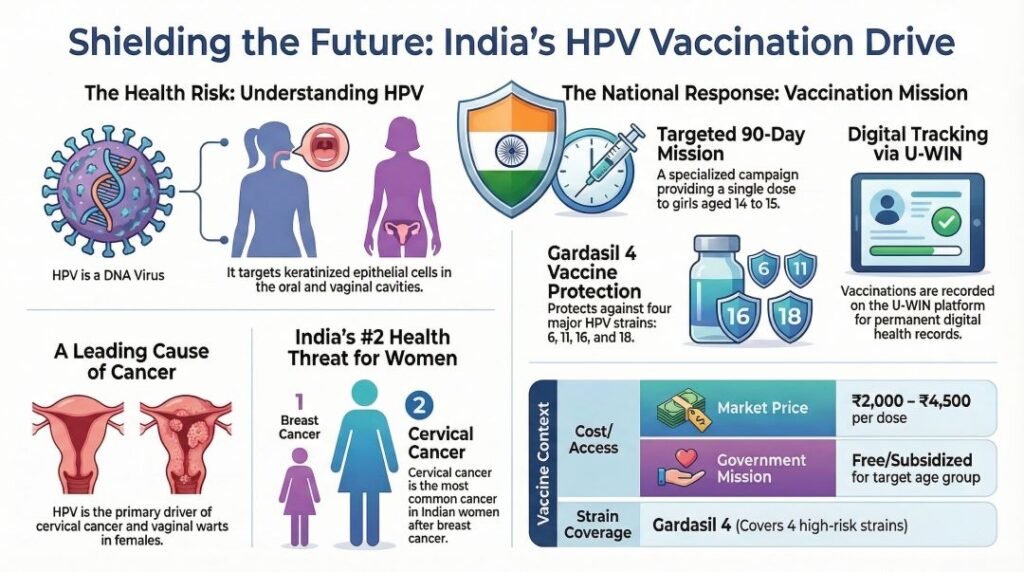
Public health in India just took a massive leap forward, and it started in the historic city of Ajmer. Recently, Prime Minister Narendra Modi inaugurated a campaign that seeks to transform the landscape of women’s health: the national HPV (Human Papillomavirus) vaccination drive. For years, the shield against cervical cancer was a luxury reserved for the few, with private market prices ranging from ₹2,000 to ₹4,500 per dose. By turning this into a government mission, India is moving from an era of expensive medical options to one of large-scale, accessible protection.
The DNA Glutton: Why HPV is Not Like COVID
To understand the urgency of this mission, we have to look at the biology of the enemy. We’ve spent the last few years learning about RNA viruses like Corona and HIV, which are often wrapped in a fragile lipid (fat) layer. HPV is a different beast entirely. It is a DNA virus, consisting of a genetic core protected by a rugged protein-only capsule. Because it lacks that lipid layer, it is structurally simpler but significantly “sturdier” than the viruses we’ve grown used to. But what truly defines HPV is its “dietary preference.” This virus is a specialized glutton for keratinized epithelial cells-the soft, layered cells found in the oral cavity and the vaginal area. To explain this to his students, biology expert Dharmendra Sir uses a quintessentially Indian metaphor: “Its favorite food is keratinized cells… it loves to eat spongy rasgulla. “Think of the texture of your inner cheek or the lining of the cervix-soft, layered, and “spongy.” These are the exact cells HPV targets, making those areas the primary frontlines in the fight against infection.
The Stress Sabotage: How Our Lifestyle Impacts DNA Repair
A common fear is that an HPV infection is an automatic death sentence for cells. In reality, our bodies are built for maintenance. The real danger isn’t just the virus; it’s the failure of our internal “cleanup crew. “Consider the story of two girls, Chunni and Munni. Both are exposed to HPV. Chunni prioritizes her DNA repair: she exercises, meditates, and manages her stress. Munni, however, lives a high-stress lifestyle with poor sleep and a diet of processed foods. While stress doesn’t cause the DNA damage, it drastically lowers the “DNA repair rate. “Think of your body like a computer. If you have five programs running and you simply switch off the monitor, the PC hasn’t actually shut down; the background tasks are still draining resources. Our brains and bodies work the same way. We need a “cooldown” period-at least one hour of screen-free time before sleep-to truly “shut down” and allow DNA repair to take place. When we skip this, we leave the door open for HPV-induced damage to turn into something much more permanent: cancer.
Why 14 is the Magic Number: Targeted Protection
The current government campaign, which officially kicked off its first major phase on February 28th, is a surgical strike. It specifically targets girls who have reached their 14th birthday but are not yet 15. This “pre-exposure” window is critical for ensuring the vaccine provides maximum efficacy before any potential contact with the virus. This isn’t a long, drawn-out process; it is a focused 90-day mission aiming toward a broader goal in 2026. The vaccine is administered as a single dose in the left upper arm. Crucially, unlike the urgent mandates seen during the pandemic, this campaign operates on the principle of explicit consent, ensuring parents and guardians are fully informed and involved in the decision.
The Strategic Choice: Gardasil 4 vs. 9
The government is utilizing Gardasil 4, produced by the American pharmaceutical giant Merck (MSD). While a newer “Gardasil 9” exists, the choice of Gardasil 4 is a calculated, strategic move for the Indian population. There are over 1,174 known types of HPV, but they generally fall into two categories: “High Risk” (cancer-causing) and “Low Risk” (causing vaginal warts). Scientific surveys show that four specific strains- 6, 11, 16, and 18 -account for the vast majority of cervical cancer and vaginal wart cases in India. Gardasil 4 targets exactly these four. By focusing on the most prominent local threats, the government is providing the most cost-effective and impactful protection possible for the nation’s daughters.
The Digital Backbone: Entering the ‘U-Win’ Era
To prevent the logistical chaos of the past, the campaign is powered by the U-Win (Universal Immunization Window) platform. This is the digital evolution of the Mission Indradhanush framework. U-Win allows parents to register via a mobile number and, more importantly, schedule appointments. This means no more waiting in long, uncertain lines; you can schedule a slot for 12:00 PM and get the vaccination done immediately. The platform maintains a permanent digital health record, ensuring that even as this HPV mission eventually integrates into the broader Universal Immunization Program (UIP), every child’s record remains accessible and secure.
A Surprising Warning: The “Cat vs. Dog” Factor
While the campaign focuses on human-to-human transmission, the science behind these viruses offers a surprising lesson in hygiene. Many people fear a dog’s bite, but in the world of saliva-borne viruses, a cat’s lick can be more deceptive. Because cats groom their entire bodies constantly, their saliva-and any viruses within it-is spread across their entire coat. Petting a cat and then touching your mouth or eyes can be a transmission route. It is a vital reminder: in the age of viral awareness, washing your hands after playing with any animal isn’t just good manners-it’s essential science.
Conclusion: Beyond the Injection
Cervical cancer is the second most prominent cancer among women in India, trailing only breast cancer. Yet, unlike many other forms of the disease, we now have a clear roadmap for its elimination. By combining the latest science of DNA repair with the strategic rollout of the Gardasil 4 vaccine and the digital efficiency of U-Win, India is attempting to write a new ending to a tragic story. We are transitioning from a world where health was a luxury to one where protection is a right. Are we ready to trade 90 days of effort for a lifetime of protection?
(FAQs)
Q: What is the HPV vaccine full form?
A: HPV vaccine full form is Human Papillomavirus Vaccine. It prevents infection from the Human Papillomavirus, which causes cervical cancer, genital warts, and several other cancers.
Q: What is the HPV vaccine age limit?
A: The HPV vaccine is routinely recommended for ages 9 to 26. It can be given up to age 45 after a doctor consultation. The ideal age is 9 to 14, when the fewest doses are needed and the immune response is strongest.
Q: What is the HPV vaccine price in India?
A: HPV vaccine price in India varies from free (under government programmes) to Rs. 200-400 per dose for Cervavac to Rs. 2,800-3,500 per dose for Gardasil 9 in private hospitals.
Q: What are the HPV vaccine side effects in kids?
A: HPV vaccine side effects in kids include mild soreness, redness at the injection site, low-grade fever, and occasional dizziness. These resolve within 1 to 3 days. Serious reactions are extremely rare.
Q: Does the HPV vaccine benefit males?
A: Yes. HPV vaccine benefits for males include protection against penile cancer, anal cancer, throat and mouth cancer, and genital warts. Vaccinating men also helps reduce community transmission.
Q: Why is HPV vaccine not recommended after 26?
A: By age 27 and above, most people have already been exposed to HPV, reducing the vaccine’s preventive benefit. It does not treat existing infections. However, adults aged 27-45 may still benefit after consulting their doctor.
Q: Is the HPV vaccine safe for long-term use?
A: Yes. Long-term studies tracking vaccinated individuals for over 10 years show no serious long-term side effects. The Gardasil 9 vaccine has been used globally since 2006 with an exceptional safety record.
Conclusion – Should You Get the HPV Vaccine?
The answer, based on overwhelming scientific evidence, is yes – for both girls and boys, women and men.
The HPV vaccine is one of the safest, most effective, and most impactful vaccines ever developed. It has the potential to eliminate cervical cancer as a public health threat within a generation. With government programmes making it increasingly affordable in India, and with the availability of Cervavac at a fraction of the cost of international brands, there has never been a better time to vaccinate.
The mild, short-term side effects – a sore arm, a brief headache – are a small price to pay for protection against six types of cancer. The decision to vaccinate is not just personal – it is a contribution to public health, herd immunity, and a cancer-free future.
Speak to your doctor today. If you are in India, check with your nearest government health centre about free or subsidised HPV vaccination options in your area.
Medical Disclaimer:
This article is for informational and educational purposes only. It is not a substitute for professional medical advice, diagnosis, or treatment. Always consult a qualified healthcare provider for personalised medical guidance regarding the HPV vaccine or any other health decision.