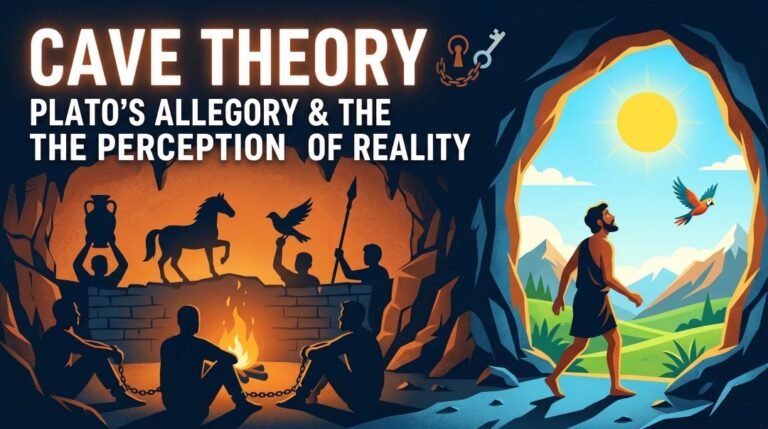
Today in this article we will disucss about the Cave Theory by Plato PDF and PPT Download, Cave Theory by Plato: The Complete Guide to Plato’s Allegory of the Cave and a complete summary, meaning, interpretation, symbolism, psychology, and real-life examples of Plato’s allegory of the cave explained simply so, Have you ever wondered whether everything you see and believe is actually real? That is the central question at the heart of cave theory – one of the most powerful philosophical ideas ever conceived. Developed by the ancient Greek philosopher Plato, cave theory (formally known as Plato’s Allegory of the Cave) challenges us to examine the nature of knowledge, perception, and reality itself.
Whether you are a philosophy student, a curious mind, or someone trying to understand life’s deeper truths, this complete guide to cave theory by Plato will walk you through everything – from a simple cave theory summary to its meaning, symbolism, psychology, and real-world applications.
What Is Cave Theory? (Cave Theory Concept Explained)
Cave theory refers to Plato’s famous philosophical thought experiment known as the Allegory of the Cave. It was presented by Plato in his renowned work, The Republic (Book VII), written around 375 BCE. The allegory uses the vivid image of prisoners trapped in a cave as a metaphor for the human condition – specifically, how people mistake incomplete perceptions for the whole truth.
In simple terms, cave theory by Plato is a concept devised by the philosopher to examine the nature of belief versus knowledge. It asks: Are we seeing reality as it truly is, or are we like prisoners watching shadows on a wall, mistaking illusions for truth?
Key terms associated with cave theory:
- Plato’s cave allegory
- Allegory of the cave theory
- Cave theory concept
- Plato theory of cave
- Plato’s cave analogy explained
Cave Theory by Plato PDF and PPT Download (.PPTX)
Cave Theory Summary: The Story of the Cave
Here is a straightforward cave theory summary to help you understand the allegory at its core.
The Setup: Prisoners in the Cave
Socrates asks Glaucon to imagine a group of people held captive in a cave since childhood, chained so that they cannot move their heads. They can only look straight ahead at a stone wall. Behind them burns a fire, and between the fire and the prisoners, other people walk carrying objects – statues of animals, plants, and other things. The fire casts shadows of these objects onto the wall in front of the prisoners.
Because they have never seen anything else, the prisoners believe the shadows are reality. They name the shadows, study them, and consider those who are best at predicting the shadow movements to be the wisest among them.
The Liberation: Stepping Into the Light
Now imagine one prisoner is freed. At first, the light is blinding and painful. He struggles to accept the new reality. But gradually, he adjusts. He sees the objects that cast the shadows, then the sky, and ultimately – the Sun itself. He realises that the Sun is the source of all light and truth.
The Return: Back to the Cave
When the freed prisoner returns to the cave to enlighten others, his eyes are now adjusted to the light – he can barely see in the darkness. The other prisoners mock him and refuse to believe his claims. They prefer their familiar shadows. Plato suggests that such an enlightened person – like a philosopher – would even be killed if he tried to free the others by force.
Summary of Plato’s cave in four points:
- People mistake limited perceptions for absolute reality.
- True knowledge requires effort and the courage to face discomfort.
- Enlightened thinkers are often rejected by those still in ignorance.
- The philosopher’s duty is to seek truth and guide others toward it.
Plato’s Allegory of the Cave: Meaning and Interpretation
So what does cave theory by Plato actually mean? The meaning operates on multiple levels.
1. Epistemological Meaning (Theory of Knowledge)
Plato’s allegory of the cave meaning, at its most fundamental level, is about the difference between opinion (doxa) and true knowledge (episteme). Most people live in the world of appearances – the shadows. Philosophers, through reason and education, ascend toward genuine understanding.
2. Political Meaning (The Role of the Philosopher-King)
Plato believed that only those who had seen the ‘Sun’ – that is, those who understood the Form of the Good – were truly fit to govern. This is the foundation of his concept of the philosopher-king: a ruler guided by wisdom, not desire or power.
3. Metaphysical Meaning (The Theory of Forms)
The shadows represent the physical world – imperfect copies of higher truths. The objects casting the shadows represent the world of Forms. The Sun represents the Form of the Good – the ultimate source of truth and existence. This is Plato’s allegory of the cave meaning and interpretation at its deepest level.
Allegory of the Cave Symbolism
Understanding allegory of the cave symbolism helps unlock the full depth of Plato’s message. Here is what each element represents:
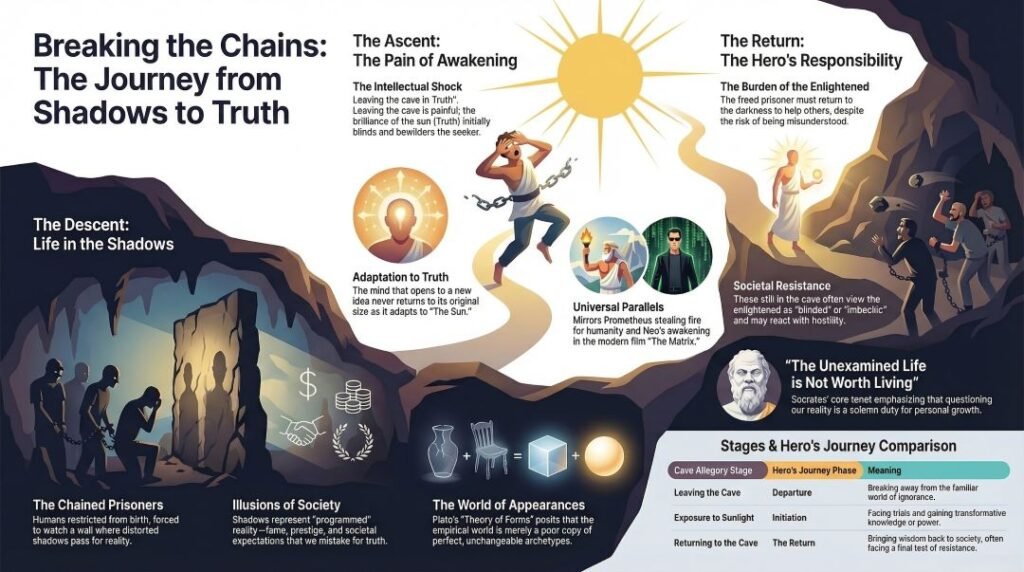
- The Cave – The physical world; the realm of sensory experience and illusion
- The Chains – The mental and social constraints that bind people to ignorance
- The Shadows – False perceptions; what most people believe to be truth
- The Fire – Artificial light; a lower level of understanding (e.g., opinion, religion, or tradition)
- The Objects Behind the Fire – Physical things in the real world
- The Journey Outside – The painful but necessary process of education and enlightenment
- The Sun – The Form of the Good; ultimate truth, reason, and enlightenment
- The Return to the Cave – The philosopher’s duty to educate and govern society
What Is the Main Message of the Allegory of the Cave?
The main message of the allegory of the cave can be summarised in one powerful statement: Most people confuse appearances with reality, and true wisdom requires the courage to step beyond what is comfortable and familiar.
More specifically, the core messages are:
- Knowledge requires active effort – it does not come from passive observation alone
- Education is transformative, not merely informative
- Society often punishes those who challenge the status quo
- The pursuit of truth is a moral and intellectual responsibility
- True leadership must be grounded in wisdom, not in popularity or power
Cave Theory Philosophy: Where Does It Fit?
Cave theory philosophy sits at the intersection of three major branches of philosophy:
- Epistemology (Theory of Knowledge) – What can we truly know, and how?
- Metaphysics – What is the nature of reality?
- Political Philosophy – How should society be organised and who should lead?
Within Plato’s broader philosophical system, cave theory is directly linked to his Theory of Forms. Plato argued that the physical world is a shadow or imperfect copy of a higher realm of perfect, eternal, unchanging Forms. Ordinary people see only the physical copies; philosophers strive to understand the Forms themselves.
This makes cave theory philosophy one of the most ambitious philosophical frameworks ever constructed – linking education, governance, metaphysics, and ethics into a single unified vision.
Cave Theory Psychology: The Modern Interpretation
Beyond philosophy, cave theory psychology has become increasingly relevant in modern times. Psychologists and thinkers have drawn striking parallels between Plato’s allegory and contemporary psychological phenomena.
Cognitive Biases and Confirmation Bias
Just like the cave prisoners who only see shadows, humans are subject to confirmation bias – the tendency to favour information that confirms existing beliefs. Cave theory psychology reminds us that the ‘shadows’ we see are often filtered through our preconceived notions.
The Echo Chamber Effect
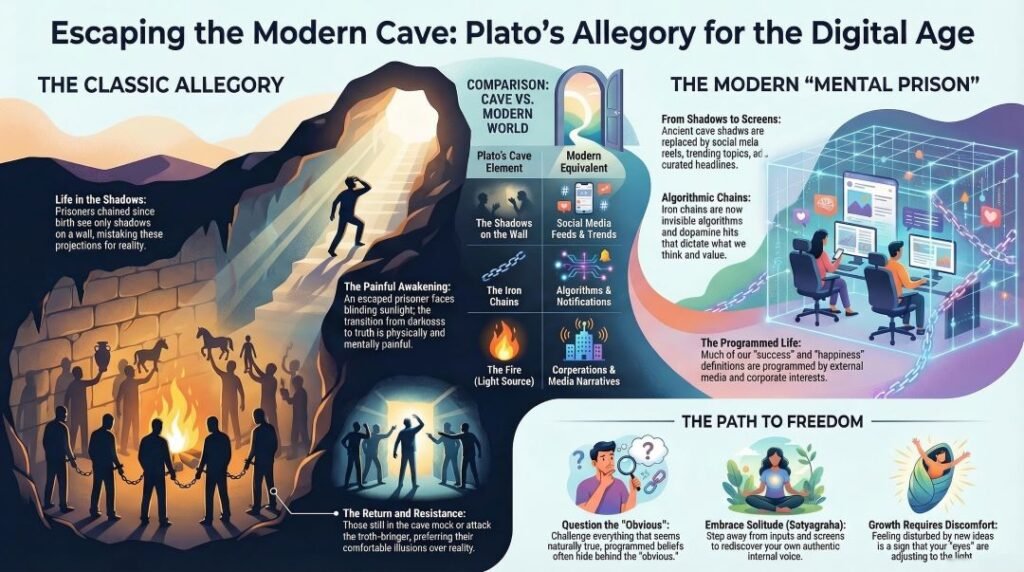
In the age of social media, the cave has become digital. Algorithms create echo chambers where people only see information that reinforces their existing worldview – a modern parallel to the prisoners watching shadows on the wall.
Learned Helplessness
The prisoners in the cave do not try to escape – they have become conditioned to their limited reality. This mirrors the psychological concept of learned helplessness, where people stop trying to change their situation because they believe it is hopeless.
The Pain of Growth
In cave theory psychology, the blinding pain the freed prisoner feels when he first steps into the sunlight is a powerful metaphor for the discomfort of personal growth and paradigm shifts. Real intellectual and emotional growth often feels painful before it becomes liberating.
Cave Theory of Learning: Education Through the Lens of Plato
The cave theory of learning is one of its most practical and enduring legacies. Plato believed that education is not about filling an empty vessel with information – it is about turning the mind toward truth.
Key principles of the cave theory of learning:
- Education must be active, not passive – students must be guided to question and discover, not just memorise
- True learning involves discomfort – just like the prisoner stepping into blinding sunlight, real learning challenges our assumptions
- Teachers are guides, not information dispensers – the role of an educator is to help students ‘turn their minds’ toward truth
- Critical thinking is the highest form of learning – moving from shadow-watching to sun-seeing
- Lifelong learning is essential – the journey out of the cave is never truly complete
In modern educational theory, the cave theory of learning aligns closely with constructivism (Vygotsky, Piaget) and experiential learning (Kolb) – philosophies that emphasise active, inquiry-driven education over rote memorisation.
Plato’s Cave Allegory Examples: Real-World Applications
One of the most remarkable aspects of cave theory is how relevant it remains today. Here are compelling Plato’s cave allegory examples from modern life:
1. Social Media and Filter Bubbles
Social media platforms use algorithms to show users content they already agree with, creating a ‘digital cave’ where people only see shadows of reality – carefully curated versions of the world that reinforce existing beliefs.
2. Propaganda and Media Manipulation
State propaganda is perhaps the most direct modern equivalent of the cave. When governments or media outlets control the ‘shadows’ – the information people receive – they control what people believe to be real.
3. Scientific Discovery
Throughout history, scientists who challenged prevailing beliefs – Galileo, Copernicus, Darwin – were met with ridicule and even persecution. Like the returning prisoner, they had ‘seen the sun’ and were punished for it.
4. Cultural and Religious Conditioning
People raised in strict cultural or religious environments may accept certain worldviews simply because they have never encountered anything else – much like prisoners who have only ever seen shadows.
5. Virtual Reality and the Metaverse
As technology advances, virtual and augmented realities increasingly blur the line between illusion and reality. Cave theory examples from the digital age are becoming more tangible than Plato could have ever imagined.
What Is the Problem with Plato’s Allegory of the Cave?
No philosophical idea is without criticism. So what is the problem with Plato’s allegory of the cave? Here are the main critiques:
- Elitism: The allegory implies that only a select few (philosophers) can grasp true knowledge, which many critics find arrogant and anti-democratic.
- The Problem of Who Decides Truth: If the philosopher has ‘seen the sun,’ who verifies that? How do we know the freed prisoner is not simply experiencing a different set of illusions?
- Authoritarianism Risk: Plato’s philosopher-king model, if misapplied, could justify authoritarian rule – leaders who believe they alone know the truth.
- Dismissal of Sensory Knowledge: Modern empiricism (e.g., John Locke, David Hume) argues that sensory experience is actually a valid and important source of knowledge – something Plato largely dismisses.
- Cultural Bias: The allegory reflects ancient Greek values that may not universally apply across all cultures and societies.
Cave Theory Explained: Step-by-Step Breakdown
For those who want cave theory explained in a clear, step-by-step manner, here is the allegory broken down into its five stages:
- Stage 1 – Ignorance (The Cave): The prisoners accept shadows as reality. This represents the unexamined life – ordinary people accepting common opinions without question.
- Stage 2 – Awakening (Breaking Free): A prisoner is freed and first sees the fire and objects. This is the beginning of intellectual awakening – painful and confusing at first.
- Stage 3 – The Ascent (Education): The prisoner climbs out of the cave. This represents the rigorous process of philosophical education and self-discipline.
- Stage 4 – Enlightenment (Seeing the Sun): The prisoner sees the Sun – ultimate truth and goodness. This is the peak of philosophical understanding.
- Stage 5 – Return (The Duty to Lead): The philosopher returns to the cave. Despite mockery and danger, it is the moral duty of the enlightened to guide others.
Cave Theory in Hindi – Overview
For readers searching for cave theory in Hindi (cave theory kya hai), here is a brief overview:
Plato ki ‘Gufa Ki Kahani’ (Cave Theory) ek prasiddh darshanik vichar hai jisme yeh bataya gaya hai ki adhikansh log andheri gufa mein zinjeeron se jakde hue hain aur sirf deewar par bani parchchhaiyaan (shadows) dekhte hain. Unhe lagta hai ki yahi sachhai hai. Lekin jo vyakti gufa se bahar nikalkar dhoop mein aata hai, usse asli duniya dikhti hai. Yeh kahani humein sikhati hai ki sachchi jaankaari (true knowledge) ke liye andheron se bahar aana zaroori hai – apni soch, apne poorvagraheeon (biases), aur simit vicharonn se mukti paana hi asli shiksha hai.
In summary: Cave theory kya hai – it is Plato’s allegory teaching us that true knowledge requires stepping beyond our limited, conditioned perceptions into the light of reason and truth.
Cave Theory and Dharmendra: A Unique Connection?
Search trends show that some users look for cave theory Dharmendra – possibly referring to educational content, lectures, or commentary on cave theory by an educator or speaker named Dharmendra. If you have come across a specific discussion or lecture on Plato’s cave theory by Dharmendra (possibly a philosophy teacher or YouTube educator popular in India), the core concepts they discuss will align with everything covered in this article.
The growing interest in cave theory Dharmendra reflects the increasing popularity of philosophy education in India, especially Plato’s ideas as taught through Hindi and English medium instruction.
The Digital Cave: Why We’re All Chasing Shadows (and How to Break Free)
The Frustration of the Unheard Truth
Imagine the blue light of a smartphone reflecting in the eyes of a 58-year-old homemaker. She stays silent during dinner, paralyzed by the knowledge that speaking the truth to her family will only trigger an explosion of anger. Nearby, a retired senior citizen, displaced and living with his grandchildren, watches his family’s stability unravel. When he offers a word of seasoned caution, he is treated not as a mentor, but as a criminal.These are not merely “generational gaps” or family squabbles. We are witnessing a systemic collapse of shared reality. As a cultural psychologist, I see this as a modern pandemic of the intellect. To understand why your logic fails to reach those you love, we must look back 2,400 years to Plato’s “Allegory of the Cave”-a philosophical autopsy of the human mind that has never been more relevant than it is in the age of the algorithm.
Takeaway 1: We Are Living in Plato’s Allegory (2,400 Years Later)
In The Republic , Plato describes prisoners chained in a cave since birth. They face a wall, unable to turn their heads. Behind them, a fire burns, and between that fire and the prisoners, “captors” carry objects across a raised path.The source context reveals a crucial, sinister detail: this is a deliberate deception. The captors might hold up a wooden horse while mimicking the sound of a rooster. To the prisoners, reality is a flickering shadow of a horse that crows. Because they have never seen the sun, they mistake these curated illusions for the absolute truth.”These prisoners become ‘intelligent’ at predicting which shadow will appear next. Eventually, they make the ‘biggest fool’-the one most adept at identifying these illusions-their leader.”In our modern “cave,” we don’t just watch shadows; we celebrate those who are best at interpreting them, oblivious to the fact that the entire display is a fabrication.
Takeaway 2: The Algorithm is the New Chain
The stone walls of the cave have been replaced by the glowing screens of WhatsApp, Instagram, and YouTube. These platforms utilize algorithms that function as digital chains, pinning our attention to a singular, narrow perspective. If you search for a specific bias once, the algorithm ensures your feed is “rained on” by that same ideology until it becomes your entire atmosphere.This leads to a state of Passive Consumption . When you scroll mindlessly, your brain enters a state of biological regression. You cease to be a logical human and begin to resemble a buffalo or a cow staring blankly at a screen as the images change.The psychological impact is devastating:
- The “Plume of Thoughts” (Guibar): We are surrounded by a collective cloud of unverified, non-logical ideas.
- Mirror Neurons: Our biology betrays us. These neurons force us to copy the negativity and irrationality we see on screen, creating a self-sustaining cycle of bias.
- Repetition Theory: We are victims of the “1,000 Lies” rule. When a lie is repeated a thousand times via a digital feed, the brain eventually registers it as an objective fact.Consider the cost: a single video of a girl dancing or a boy swearing can garner 20 to 50 million views. If each person watches for just one minute, that single “useless” video consumes over 30 years of human time-stripping the country of its GDP and intellectual potential in exchange for passivity.
Takeaway 3: Why Logic Fails When Ego is at Stake
When a prisoner finally breaks his chains and steps into the sunlight, the experience is not immediately joyful-it is painful. The light burns his eyes. He is confused because his “old truth” has been shattered. He eventually sees the grass, the colors, and the real horse, realizing that a horse does not crow and it certainly isn’t a black shadow on a wall.However, the “Collision of Ego and Logic” occurs when he returns to the cave. Because his eyes have adjusted to the light, he can no longer see the shadows in the dark. He stumbles and falls. The remaining prisoners don’t see a liberated man; they see a fool who has “ruined his eyes.” They use his physical disadvantage as proof that the outside world is dangerous.This irony is why truth-tellers are often mocked or even “poisoned” (as Socrates was). For those with high levels of ideological or religious bias, the ego acts as a shield against the sun. Admitting the truth would mean admitting their entire life was spent worshipping shadows-a psychological death they will fight to avoid.
Takeaway 4: Identifying the “Cave Dwellers” (The Four Red Flags)
When you find yourself in a stalemate of logic, check for these four psychological indicators that a person is “chained” to an echo chamber:
- Identity Tied to Titles: They lead with their degrees, social status, or job selections unprompted (“As a PhD holder…” or “Since I was selected for…”). Their status has replaced their humanity.
- Inflated Ego: They treat factual corrections as personal assaults.
- “I” over Logic: They rely on personal authority (“Because I said so”) rather than evidence.
- Toxicity toward Truth-Tellers: They view anyone with a different reality as a mortal enemy rather than a fellow human.The advice from the ancients is clear: “Don’t call a blind man blind.” If you see these flags, direct logic will only lead to your own “injury.” Instead, share knowledge gently and gradually, hoping their “eyes” might one day adjust on their own.
Takeaway 5: The Economic Conspiracy of the Cave
Why are these echo chambers allowed to flourish? The answer lies in the “Economic Conspiracy” of consumerism, a concept rooted in the theories of Gramsci.There is a direct correlation between the breakdown of social bonds and corporate profit. When we are “chained” in our individual caves, we are easier to manipulate. When the bond between a grandparent and grandchild is severed, or when brothers and spouses are driven apart by ideological “shadows,” families fracture.The math is simple: One household of six people consumes as a single unit. But when that family breaks into four separate, isolated households due to conflict, they become four separate consumers. They need four fridges, four subscriptions, and four times the “digital feed.” Breaking the family isn’t just a social byproduct; it is a business model designed to turn us into predictable, passive consumers.
The Wisdom of Knowing You Don’t Know
Breaking free from the cave requires the rarest form of courage: intellectual humility. We must recognize that our own digital feeds are curated shadows, designed to make us feel “intelligent” while keeping us in the dark. The philosopher Socrates, who ultimately faced the “poison” of the cave dwellers, left us with the only true starting point for growth: “I know that I do not know. “By acknowledging the limits of our own perspective, we begin to unchain ourselves. We stop mirroring the negativity of the “plume” and start looking for the sun. Final Thought: Look at your digital feed right now. Ask yourself: Is this the world as it truly is, or is it just the shadow of a horse that crows?
Plato’s Cave Allegory Summary: Key Takeaways
Here is your complete Plato’s cave allegory summary at a glance:
- Cave Theory / Plato’s Allegory of the Cave: A philosophical thought experiment from The Republic (c. 375 BCE)
- Core Concept: Most people mistake appearances (shadows) for reality
- Main Message: True knowledge requires education, courage, and the willingness to question the familiar
- The Sun = The Form of the Good; the ultimate source of truth
- The Cave = The world of sensory illusion and ignorance
- Philosophical Branches: Epistemology, Metaphysics, Political Philosophy
- Modern Relevance: Social media bubbles, propaganda, cognitive biases, educational theory
- Criticisms: Elitism, authoritarianism risk, dismissal of empirical knowledge
Also read: Milk Without Cow PDF and PPT Download
(FAQs)
Q: What is cave theory by Plato?
A: Cave theory by Plato, also known as the Allegory of the Cave, is a philosophical thought experiment from The Republic in which prisoners in a cave mistake shadows for reality, symbolising how people confuse appearances with truth.
Q: What is the main message of the allegory of the cave?
A: The main message of the allegory of the cave is that most people live in ignorance, mistaking limited sensory experience for absolute reality. True knowledge comes through philosophical reasoning, education, and the courage to question assumptions.
Q: What are some cave theory examples in real life?
A: Real-life cave theory examples include social media echo chambers, government propaganda, cultural conditioning, religious dogma, and virtual reality environments that blur the boundary between illusion and reality.
Q: What does cave theory mean in psychology?
A: In cave theory psychology, the allegory relates to cognitive biases, confirmation bias, echo chambers, learned helplessness, and the discomfort of personal growth – all situations where people mistake their limited perspective for objective reality.
Q: What is the problem with Plato’s allegory of the cave?
A: The main criticisms include its intellectual elitism, the risk of justifying authoritarian rule, the dismissal of sensory experience as a source of knowledge, and the question of who determines what counts as ‘true’ knowledge.
Also read: Milk Without Cow PDF and PPT Download
Conclusion: Why Cave Theory Still Matters Today
More than 2,400 years after Plato wrote The Republic, cave theory remains one of the most thought-provoking and widely relevant philosophical ideas in human history. Whether you apply it to education, psychology, politics, or your own personal growth, the allegory offers a timeless challenge:
Are you watching shadows – or seeking the Sun?
In a world flooded with information, misinformation, social media bubbles, and rapid change, the wisdom of Plato’s cave allegory is more urgent than ever. The journey out of the cave – the willingness to question, learn, and grow – is the essence of a well-lived, examined life.
Start your ascent today.
Related Keywords Covered in This Article:
cave theory | cave theory by plato | plato’s allegory of the cave | allegory of the cave summary | cave theory summary | cave theory explained | cave theory concept | cave theory philosophy | cave theory psychology | cave theory of learning | cave theory examples | plato’s cave allegory | plato’s cave allegory examples | plato’s cave allegory summary | allegory of the cave theory | cave theory plato | plato theory of cave | plato’s allegory of the cave explained | plato’s cave analogy explained | plato’s theory of the cave | summary of plato’s cave | plato’s cave summary | allegory of the cave symbolism | allegory of the cave meaning and interpretation | what is the main message of the allegory of the cave | what is the problem with plato’s allegory of the cave | cave theory dharmendra | cave theory in hindi | cave theory kya hai