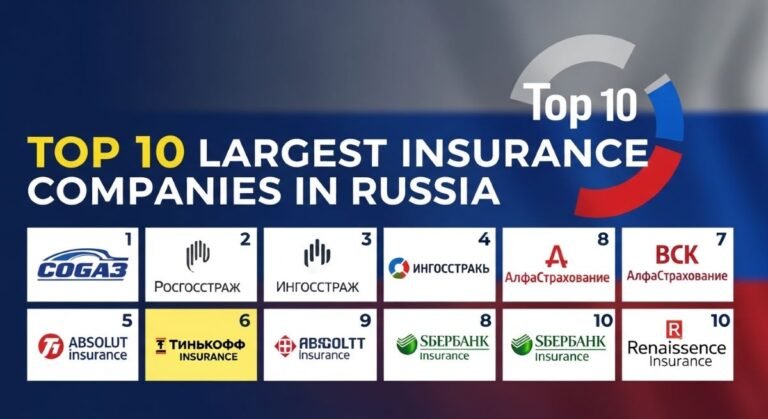
Today is this article we will discuss about the Top 10 Largest Insurance Companies in Russia 2026 with PDF, PPT and Infographic so, Russia’s insurance industry is one of the most concentrated in the world. According to recent data from the Bank of Russia, the top 10 largest insurance companies in Russia account for approximately 85% of all property insurance premiums and 90% of life insurance premiums. The market surged by 6.2% in 2024, reaching 3.7 trillion rubles in total gross written premiums – a milestone that reflects both rising consumer awareness and increasing mandatory insurance requirements.
Understanding who leads this market is essential for consumers choosing a reliable insurer, businesses seeking corporate coverage, investors analyzing the Russian financial sector, and professionals tracking industry consolidation trends. In this in-depth guide, we profile each of the top 10 largest insurance companies in Russia using the most current 2024 and early 2025 data available (REASON: TENSION BETWEN NATIONS).
Russian Insurance Market Snapshot: 2024–2025
The Russian insurance sector entered 2025 with strong momentum. Despite international sanctions, which have significantly limited access to global reinsurance markets and forced domestic players to rely more heavily on the Russian National Reinsurance Company (RNRC), the overall premium volume has continued to grow. Several key trends define the current market:
The bancassurance model has proven dominant. Sberbank’s combined life and non-life insurance operations now control roughly one-third of the entire Russian insurance market – an extraordinary concentration for a single financial group. Life insurance and savings-linked products have seen the highest growth, as Russian consumers increasingly seek alternatives to traditional bank deposits in an environment of high interest rates and economic uncertainty.
Digital transformation is accelerating. T-Insurance (formerly Tinkoff Insurance) has broken into the top 10 for the first time, driven entirely by app-based distribution. Renaissance Insurance, listed on the Moscow Exchange, is also gaining ground through its digital-first model. Meanwhile, legacy players like SOGAZ and Ingosstrakh are investing heavily in technology to defend their market positions.
Market concentration is increasing. The top 20 insurers now control approximately 90% of all premiums, and consolidation continues as smaller and undercapitalized companies exit the market or have their licenses revoked by the Bank of Russia.
Top 10 Insurance Groups in Russia by Gross Written Premiums (2024)
The following table provides a comparative overview of the top 10 largest insurance companies in Russia based on 2024 year-end performance and early 2025 market positioning. All figures are expressed in Russian Rubles (RUB).
| Rank | Company Name | Primary Focus | Market Share | Key Financial Indicator |
| 1 | Sberbank Life Insurance | Life / Investment | ~20% | Over RUB 1.10 Trillion GWP |
| 2 | SOGAZ Insurance Group | Corporate / Property | ~8% | Leader in Industrial Risks |
| 3 | AlfaStrakhovanie Group | Universal / Life | ~5% | RUB 295.0 Billion (Life div.) |
| 4 | Ingosstrakh | Motor / Marine / Property | ~7.5% | Top-rated for Solvency |
| 5 | RESO-Garantia | Motor / Health | ~6% | Largest Agent Network |
| 6 | VSK Insurance House | Universal / Retail | ~5% | Over 500 Regional Offices |
| 7 | Rosgosstrakh | Retail Property | ~4% | RUB 93 Billion (2024 GWP) |
| 8 | Renaissance Insurance | Digital / Universal | ~3.5% | Listed on Moscow Exchange |
| 9 | Sberbank Insurance (Non-Life) | Property / Credit | ~3% | Fastest Growth in H1 2025 |
| 10 | T-Insurance (Tinkoff) | Digital / Motor | ~2.5% | 100% Digital Service Model |
Top 10 Largest Insurance Companies in Russia (2026) (.PPTX)
Detailed Profiles: Top 10 Largest Insurance Companies in Russia (2025-2026)
#1. Sberbank Life Insurance – Russia’s Overall Market Leader
Sberbank Life Insurance is the overall market leader by a wide margin, recording over RUB 1.10 trillion in premiums for 2024. It holds a double-digit market share exceeding 20% of the entire Russian insurance sector – a dominance that no single insurer in any comparable large market enjoys. This extraordinary position is the direct result of the bancassurance strategy pursued by Sberbank, Russia’s largest bank with over 14,000 branches and more than 110 million individual clients.
Sberbank Life Insurance focuses primarily on life insurance and investment-linked products. Its growth has been turbocharged by the popularity of investment life insurance (ILI) and endowment life insurance (NLI) products, which many Russian consumers have adopted as structured savings vehicles. The seamless integration with SberOnline, Sberbank’s digital banking platform, allows customers to purchase and manage policies entirely online without visiting a branch.
When combined with Sberbank Insurance (Non-Life), which ranks 9th separately on this list, Sberbank’s total insurance footprint accounts for roughly one-third of the entire Russian market. This makes Sberbank’s insurance ecosystem the single most important force in Russian insurance today. Its state backing through the Russian government, which is the majority shareholder of Sberbank, adds an additional layer of financial stability and consumer trust.
#2. SOGAZ Insurance Group – Corporate Russia’s Preferred Insurer
SOGAZ Insurance Group is traditionally the largest in corporate and property insurance, and while it now ranks second overall due to Sberbank Life’s extraordinary premium volume, it remains the top provider for large-scale industrial risks. SOGAZ recorded a total market volume of RUB 260.39 billion in 2024, maintaining its position as the undisputed leader in the corporate insurance segment.
When it comes to SOGAZ ownership, the group is majority-controlled by Rossiya Bank, a St. Petersburg-based financial institution with close ties to influential figures in the Russian government. This connection has secured SOGAZ’s position as the preferred insurer for Russia’s largest state-owned enterprises, including Gazprom, Rosneft, and Transneft. These energy and infrastructure giants generate enormous insurance premiums for property, liability, and employee health coverage.
SOGAZ offers more than 100 insurance programs covering all kinds of property, personal, and liability insurance. Its healthcare subsidiary, Medicina, operates its own network of private clinics, making it a vertically integrated health and insurance provider. For any business operating in Russia’s energy, defense, or heavy industry sectors, SOGAZ is almost certainly their insurer of choice.
#3. AlfaStrakhovanie Group – The Private Sector Powerhouse
AlfaStrakhovanie is a dominant force in life insurance, ranking second in that segment overall with RUB 295.0 billion in its life insurance division alone. As part of the Alfa Group consortium, one of Russia’s largest privately owned financial and industrial conglomerates, AlfaStrakhovanie benefits from strong cross-selling opportunities with Alfa-Bank, one of Russia’s largest private banks, and other Alfa Group companies.
AlfaStrakhovanie Group operates as a truly universal insurer, offering motor insurance (OSAGO and KASKO), voluntary medical insurance (VMI), life insurance, property and casualty insurance, and travel insurance. The company is particularly renowned for its corporate health insurance segment, providing voluntary medical insurance as an employee benefit to thousands of Russian and international corporations.
The company’s success in life insurance reflects a broader strategic pivot toward savings and protection products that offer both insurance coverage and investment returns. With strong brand recognition, a large agent force, and growing digital capabilities, AlfaStrakhovanie is well-positioned to capitalize on the continued growth of life insurance in Russia.
#4. Ingosstrakh Insurance Company – Russia’s International Insurance Pioneer
The Ingosstrakh Insurance Company is a leader in non-life insurance with strong positions in OSAGO (compulsory motor liability), KASKO, and corporate property. The company holds roughly 7.5% of the total market, making it one of the most financially robust insurers in Russia. Ingosstrakh is particularly notable for being top-rated for solvency by Russian rating agencies, a distinction that reflects its conservative financial management and strong capital base.
Founded in 1947 during the Soviet era, Ingosstrakh was originally created to handle the insurance needs of Soviet foreign trade and diplomatic activities. This heritage gave it unique expertise in complex international risk categories such as aviation, marine, space, and cargo insurance – capabilities that most domestic competitors lack. Today, Ingosstrakh maintains partnerships with leading global reinsurers and has representative offices and subsidiaries in several countries.
One of the oldest and most internationally recognized insurers in Russia, Ingosstrakh consistently ranks at the top for corporate clients who need sophisticated risk management solutions. Its consistent financial strength, international expertise, and diversified product portfolio make it one of the most respected names in the Russian insurance market.
#5. RESO-Garantia – The Agent Network Champion
RESO-Garantia is noted for its massive agent network, making it a primary player in the motor and voluntary health insurance (VHI) segments. With approximately 6% of total market share, RESO-Garantia has built its business on the strength of one of the largest independent agent forces in the Russian insurance industry, which spans thousands of brokers and agents across all major Russian cities and regions.
The company is majority-owned by the AXA Group, one of the world’s largest insurance conglomerates, bringing international standards of risk management, actuarial expertise, and customer service to the Russian market. RESO-Garantia is best known for KASKO (comprehensive auto insurance), where it has consistently ranked among the top three providers. Its strong presence in voluntary health insurance makes it a major employer benefit provider as well.
Despite international sanctions limiting some foreign-ownership dynamics, RESO-Garantia continues to benefit from its well-established agent network and brand recognition, particularly among middle-class urban Russian consumers who value personal service and professional claims handling.
#6. VSK Insurance House – The Regional Network Giant
VSK Insurance House is a top-tier universal insurer that has heavily digitalized its claims process, leading in mobile-based remote settlements. With over 500 regional offices spread across Russia, VSK has one of the most extensive physical distribution networks in the country – a significant competitive advantage in a geographically vast nation where many consumers still prefer face-to-face service.
Originally founded to serve the insurance needs of Russia’s military and defense sector (VSK stands for Voenno-Strakhovaya Kompaniya, or Military Insurance Company), the company has long since transformed into a fully commercial universal insurer. It provides motor insurance, health insurance, property insurance, life insurance, liability coverage, and travel insurance to both individual and corporate clients.
VSK’s investment in mobile claims technology has been a standout development. By enabling clients to file and track claims entirely through a smartphone app, the company has reduced claims processing times and improved customer satisfaction, positioning itself as a technology-forward insurer despite its traditional roots.
#7. Rosgosstrakh – A Soviet Legacy Brand in Recovery
Rosgosstrakh is an established giant with a strong focus on retail property. Despite high claim pressures from regional flooding in 2024, the company reported RUB 93 billion in premiums for 2024. Rosgosstrakh is one of the most historically significant insurance companies in Russia – its name translates to Russian State Insurance, and it served as the sole insurer in the Soviet Union for most of the 20th century.
After significant financial difficulties in the late 2010s that led to a costly government-assisted restructuring, Rosgosstrakh has stabilized under new ownership. The company’s brand remains one of the most recognized in Russian insurance, particularly among older generations and in rural areas where it has maintained a physical presence for decades. In some parts of Russia, Rosgosstrakh’s local office is the only insurance provider residents have ever known.
The company’s recovery strategy focuses on its core strengths in retail property insurance and motor insurance, where its nationwide branch network provides a distribution advantage that purely digital insurers cannot replicate. Recent credit rating upgrades reflect improving financial health, though the company still faces challenges in rebuilding profitability and competitive positioning relative to the market leaders.
#8. Renaissance Insurance – The Digital Challenger on the Moscow Exchange
Renaissance Insurance Group is a significant player in the digital and property insurance space, holding roughly 3.5% of the life insurance market share. The company made history as one of the few Russian insurance companies to be publicly listed on the Moscow Exchange, giving it a higher profile among institutional investors and retail shareholders than most of its privately held competitors.
Renaissance Insurance has built its competitive identity around digital innovation. The company offers term life, whole life, health, accident, and property insurance products through a digital-first distribution model that appeals to younger, tech-savvy Russian consumers. Its online platform and mobile application allow customers to get quotes, purchase policies, and file claims without any paper-based processes.
The company’s listing on the Moscow Exchange has also imposed a higher level of transparency and corporate governance discipline, making it one of the more openly reporting insurance companies in Russia. This transparency is increasingly valued by consumers and corporate clients who want insight into the financial health and business practices of their insurer.
#9. Sberbank Insurance (Non-Life) – The Fastest-Growing Non-Life Insurer of 2025
Sberbank Insurance (Non-Life) is distinct from Sberbank Life Insurance and focuses on property insurance, credit insurance, accident coverage, and liability products. The company saw rapid growth with RUB 53.1 billion in premiums in the first half of 2025 alone, making it the fastest-growing non-life insurer in Russia at the time of this analysis.
Its growth is driven by the same bancassurance advantage that has made Sberbank Life dominant in the life segment. By integrating insurance products directly into Sberbank’s digital banking flows – for example, automatically offering home insurance when a customer applies for a mortgage, or travel insurance when booking tickets through the SberTravel platform – Sberbank Insurance (Non-Life) benefits from an essentially unmatched distribution ecosystem.
Together with Sberbank Life Insurance, the combined Sberbank insurance operations represent the most dominant single-group presence in the Russian insurance market. Their combined market share demonstrates that Russia’s insurance sector has become, in many ways, a natural extension of the country’s banking system.
#10. T-Insurance (Tinkoff) – The Digital-Native New Entrant
T-Insurance, formerly known as Tinkoff Insurance and now rebranded under the T-Bank umbrella, is the fastest-growing digital-first insurer in Russia. It has become firmly entrenched in the top 10 due to its seamless app-based distribution, operating a 100% digital service model with no physical branches. T-Insurance holds approximately 2.5% of total market share and is widely seen as the most disruptive force in Russian insurance today.
T-Insurance offers motor insurance, property insurance, life insurance, and travel insurance, all accessible through the T-Bank (formerly Tinkoff) super-app. Its target demographic is Russia’s digitally active urban population, particularly millennials and Gen Z consumers who expect every financial product to be as convenient and fast as a mobile banking app.
The company’s rapid ascent into the top 10 demonstrates how digital distribution can overcome the traditional barriers of branch networks and agent forces in the insurance industry. Several international insurers like Allianz and Zurich have recently exited or sold their Russian divisions to local management teams, leaving a gap that digital-native players like T-Insurance are well-positioned to fill.
The Legacy of Soviet Companies in Russian Insurance
It is impossible to discuss the largest insurance companies in Russia without acknowledging the profound influence of Soviet companies on the market’s structure and culture. During the Soviet era, insurance was a complete state monopoly divided between two entities: Gosstrakh (State Insurance) for all domestic personal and property insurance, and Ingosstrakh for international trade and diplomatic insurance.
When the Soviet Union dissolved in 1991, the privatization of these Soviet companies created an entirely new competitive landscape. Gosstrakh became Rosgosstrakh, which struggled through privatization, multiple ownership changes, and financial crises before stabilizing in recent years. Ingosstrakh adapted more successfully, leveraging its international expertise to remain one of Russia’s most respected insurers across three decades of market transformation.
The legacy of Soviet companies is still visible today in consumer behavior, regulatory culture, and market structure. Older Russian consumers who grew up with state insurance as the only option tend to trust established brands and state-affiliated companies – which partly explains why SOGAZ, with its Kremlin-linked ownership, and Rosgosstrakh, with its Soviet heritage brand, continue to attract significant customer bases despite fierce competition from private players.
Market Concentration: Why the Top 20 Insurers Control 90% of All Premiums
One of the most striking features of the Russian insurance market is its extraordinary concentration. The top 20 insurers now control approximately 90% of all premiums collected in Russia. This level of concentration is significantly higher than in Western European or North American insurance markets, where the top 20 players typically account for 50 to 70% of total premiums.
Several factors drive this concentration. First, the Bank of Russia has progressively tightened capital and solvency requirements, which has pushed smaller, undercapitalized insurers out of the market. Second, the bancassurance model has given bank-affiliated insurers – particularly in the Sberbank ecosystem – distribution advantages that independent insurers cannot match. Third, international sanctions have removed several foreign-backed insurers from the market, reducing competition and further concentrating the remaining premium pool among domestic players.
The Big Three concentration is particularly notable: Sberbank, SOGAZ, and AlfaStrakhovanie together account for more than half of the total Russian insurance market volume. This means that in a market of 3.7 trillion rubles in annual premiums, three companies alone collect approximately 1.85 trillion rubles.
Financial Stability and Credit Ratings of Russian Insurers
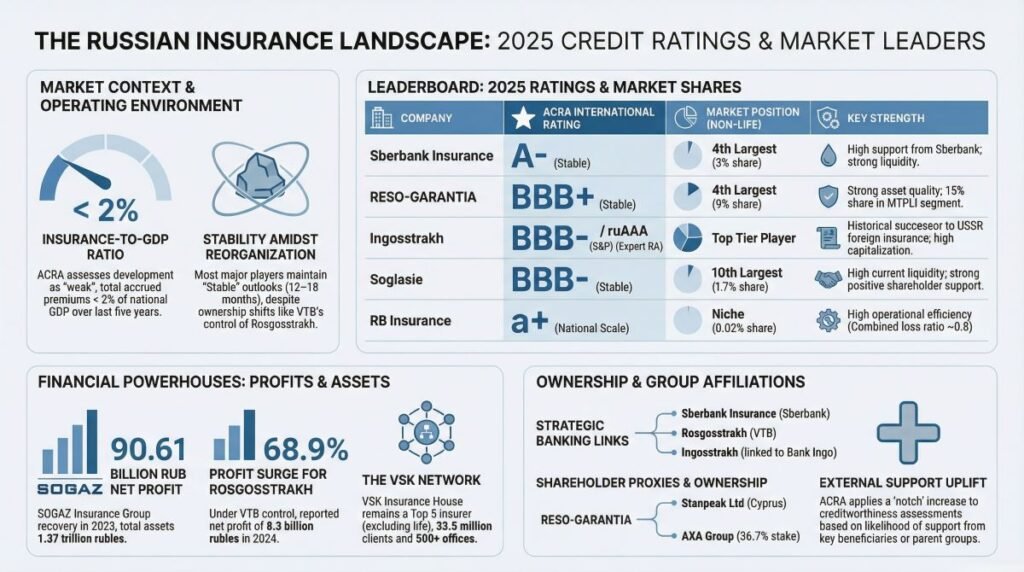
Most of the top 10 largest insurance companies in Russia hold the highest national credit ratings from Russian rating agencies such as Expert RA or ACRA (Analytical Credit Rating Agency). These agencies replaced the international ratings of S&P, Moody’s, and Fitch following 2022, when those agencies withdrew their Russian ratings.
Ratings of ruAAA or ruAA (from Expert RA) or AAA(RU) or AA(RU) (from ACRA) indicate the highest levels of financial strength and ability to meet policyholder obligations. Ingosstrakh is particularly noted for being top-rated for solvency, while SOGAZ and Sberbank’s insurance subsidiaries consistently maintain top ratings due to their state-connected ownership and strong capital bases.
For consumers and corporate buyers, these domestic ratings have become the primary reference point for evaluating insurer financial strength in the absence of international ratings. It is advisable to check an insurer’s current rating from Expert RA or ACRA before purchasing any long-term insurance product, particularly life insurance policies that may extend for 10, 20, or more years.
Impact of International Sanctions on the Russian Insurance Industry
International sanctions imposed following geopolitical events have had a significant and lasting impact on the Russian insurance industry. Many companies on this list, particularly SOGAZ and the Sberbank-affiliated entities, are under international sanctions, which limits their ability to provide international reinsurance or cover risks outside of Russia and internationally recognized jurisdictions.
The exit of major international reinsurers from the Russian market – including Lloyd’s of London syndicates, Munich Re, Swiss Re, and others – has forced Russian insurers to redirect their reinsurance needs entirely to the Russian National Reinsurance Company (RNRC) and other domestic or so-called friendly jurisdictions. This has reduced the capacity available for very large and complex risks, such as aviation, nuclear, and offshore energy insurance.
The withdrawal of international insurers like Allianz and Zurich from the Russian market has, paradoxically, benefited the remaining domestic players by eliminating competition and freeing up market share. T-Insurance and other growing domestic players have been among the primary beneficiaries of this competitive gap.
Future Outlook: What to Expect from Russia’s Insurance Giants in 2025 and Beyond
The Russian insurance market in 2025 is characterized by continued growth, deepening concentration, and accelerating digital transformation. The sector grew by over 60% in the last year in life insurance, driven primarily by investment-linked and savings-linked products as Russians sought alternatives to traditional bank deposits amid high interest rates.
The companies best positioned for future growth are those investing aggressively in digital infrastructure, expanding their product ranges into long-term savings and health products, and deepening customer relationships through data analytics and personalization. Sberbank Life, AlfaStrakhovanie, T-Insurance, and Renaissance Insurance are all pursuing these strategies with notable commitment.
Regulatory pressure from the Bank of Russia is expected to continue pushing market consolidation. Further license revocations for smaller, undercapitalized companies will concentrate the market even further among the top players. This is good news for the financial stability of the market overall, but raises questions about competition and consumer choice in the long term.
For corporate insurance buyers, the increasing dominance of a small number of very large insurers creates both opportunities and risks. On one hand, the largest insurers offer financial stability and comprehensive product ranges. On the other hand, reduced competition could limit innovation and put upward pressure on pricing over time.
How to Choose an Insurance Company in Russia: Key Considerations
When selecting among the largest insurance companies in Russia, individual and corporate clients should consider several key factors. Financial strength is paramount – check the insurer’s current rating from Expert RA or ACRA to ensure it meets the highest standards. A ruAAA or ruAA rating indicates strong ability to meet claims obligations.
Product fit matters enormously. Some insurers, like SOGAZ, specialize in large corporate risks. Others, like T-Insurance or Renaissance Insurance, are built for individual consumers who want a digital experience. RESO-Garantia and VSK Insurance House are particularly strong for motor insurance, while AlfaStrakhovanie and Sberbank Life dominate the life and health insurance segments.
Distribution and service accessibility should also be considered. If you value face-to-face service and local branch support, companies like VSK with 500+ regional offices or Rosgosstrakh with its nationwide network may be preferable. If you prefer managing everything digitally, T-Insurance or Sberbank Insurance through the SberOnline app offer seamless digital experiences.
Finally, consider the insurer’s claims handling reputation. An insurance policy is only as good as the company’s willingness and ability to pay valid claims promptly. Customer reviews, industry surveys, and media reports on claims disputes can provide valuable real-world insight beyond the financial metrics.
Also read: Top 10 Largest Insurance Companies in China 2026 (.PPTX)
Conclusion
The top 10 largest insurance companies in Russia in 2024 and 2025 represent a market defined by extraordinary concentration, rapid digital transformation, and the growing dominance of bank-affiliated insurance operations. From the market-leading Sberbank Life Insurance with over one trillion rubles in premiums, to the corporate insurance giant SOGAZ with its Kremlin-connected ownership, to the digital disruptor T-Insurance breaking into the top 10 for the first time, each company tells a different story about the forces shaping Russian insurance today.
The legacy of Soviet companies continues to echo through this market in ways both visible and subtle – in the brand heritage of Rosgosstrakh, in the international DNA of the Ingosstrakh Insurance Company, and in the deeply ingrained consumer preference for established, well-known brands. Meanwhile, the new generation of digital insurers is rapidly redefining what Russians expect from their insurance providers.
Whether you are a consumer seeking the best insurer for your personal or business needs, an investor tracking the evolution of Russia’s financial sector, or a professional monitoring market consolidation trends, the top 10 largest insurance companies in Russia are the institutions that matter most. Their strategies, financial strength, and market positions will determine the direction of this 3.7-trillion-ruble industry for years to come.
Disclaimer: All financial figures are based on 2024 year-end reports and early 2025 market data from the Bank of Russia and publicly available industry reports. This article is for informational purposes only and does not constitute financial or insurance advice. Always consult a licensed professional before making financial decisions.