Today in this article we will discuss about the Top 10 Biggest and Largest Indian Empires with (.PPTX & .PDF and infographics), Top 10 largest empires of india or India’s 10 Largest Empires: A Historical Journey Through Ancient Power so, If asked to name India’s largest empire, most people might struggle to answer with certainty. The Indian subcontinent has witnessed the rise and fall of numerous powerful empires over millennia, each leaving indelible marks on culture, architecture, governance, and civilization. From the Buddhist kingdoms of the east to the maritime powers of the south, from the defenders of the Deccan to the unifiers of the entire subcontinent, these empires collectively demonstrate that India’s political unity and cultural identity existed long before colonial intervention.
This comprehensive analysis examines the ten largest empires that shaped the Indian subcontinent, ranked by territorial extent, duration of rule, and historical significance. These empires-spanning from the 3rd century BCE to the 18th century CE-collectively governed territories ranging from 500,000 to 5 million square kilometers, encompassing regions from Afghanistan to Southeast Asia, from the Himalayas to the Indian Ocean.
Note: This analysis is based on historical records, archaeological evidence, inscriptions, and scholarly research. Territorial extents represent maximum boundaries during peak periods and are subject to ongoing historical debate. Dates and geographical boundaries reflect current academic consensus.
Understanding Empire Building in the Indian Context
Before examining individual empires, it’s important to understand what made these political entities unique in the Indian historical context. Unlike European empires that often emphasized rigid centralization, Indian empires frequently employed flexible governance models accommodating regional diversity, multiple languages, varied religious practices, and local administrative traditions.
Key Characteristics of Indian Empires:
- Cultural Integration: Empires spread cultural practices, architectural styles, and administrative systems across vast territories
- Religious Patronage: Rulers often supported multiple faiths while maintaining their own beliefs, fostering religious synthesis
- Trade Networks: Control of trade routes-both land and maritime-provided economic foundation for expansion
- Administrative Innovation: Development of sophisticated bureaucratic systems, taxation methods, and provincial governance
These empires demonstrate conclusively that India existed as a unified political and cultural entity long before colonial rule-a fact that deserves emphasis given persistent misconceptions about the subcontinent’s pre-colonial fragmentation.
Top 10 Biggest and Largest Indian Empires (.PPTX) PPT SLIDES
Top 10 Largest Indian Empires: Ranked by Territorial Extent
#10. The Satavahana Empire: Guardians of the Deccan
The Satavahana Empire, also known as the Andhra dynasty, represented one of India’s most enduring political entities, ruling the Deccan region for nearly 400 years. This empire served as a crucial bridge between North and South India, facilitating cultural exchange while maintaining distinct Deccan identity.
Historical Profile:
- Period: Approximately 1st century BCE to 3rd century CE
- Duration: Nearly 400 years
- Capital: Pratishthana (modern Paithan, Maharashtra)
- Territory: Large parts of present-day Andhra Pradesh, Telangana, Maharashtra, and Madhya Pradesh
- Estimated extent: Approximately 500,000-700,000 square kilometers at peak
Cultural and Economic Significance: The Satavahanas controlled crucial trade routes connecting North India with South India and maritime trade networks linking India with Rome. They patronized Buddhism while supporting Brahmanical traditions, exemplifying the religious pluralism characteristic of Indian empires. Their administrative practices, particularly land grants to Buddhist monasteries and Brahmin scholars, influenced subsequent Deccan dynasties.
The empire’s longevity-nearly four centuries-demonstrates effective governance and administrative continuity. Their coinage system, featuring ship imagery, reflects the importance of maritime trade to their economy. The Satavahanas successfully resisted northern invasions while maintaining cultural connections with both North and South India.
#9. The Harshavardhana Empire: Unifier of Northern India
In the 7th century CE, following the decline of the Gupta Empire, northern India fragmented into numerous small kingdoms. King Harshavardhana emerged as a unifying force, creating the last great indigenous empire of North India before the medieval period.
Historical Profile:
- Period: 606-647 CE
- Duration: Approximately 41 years
- Capital: Initially Thanesar, later Kanauj
- Territory: United all of North India up to the Narmada River
- Extent: From Punjab to Bengal, Himalayas to Narmada River
Administrative Achievement: Harsha’s empire represented remarkable political consolidation achieved within a single lifetime. Starting as ruler of Thanesar, he systematically unified northern India through military campaigns and diplomatic alliances. His administration maintained efficient communication networks across his vast territory, with regular royal tours ensuring provincial loyalty.
Cultural Patronage: Harsha patronized Buddhism while supporting other religious traditions. Chinese traveler Xuanzang’s detailed accounts provide invaluable information about 7th-century India. Harsha himself was a playwright and poet, contributing to Sanskrit literature. His religious assemblies at Prayag (Allahabad) attracted scholars from across Asia. However, the empire fragmented shortly after his death, demonstrating the challenge of maintaining territorial unity without strong institutional structures.
#8. The Pala Empire: Buddhist Power of Eastern India
The Pala Empire represented one of the last major Buddhist dynasties in India, ruling Bengal and Bihar while extending influence into Nepal and modern Bangladesh. This empire played a crucial role in preserving and spreading Buddhist learning during a period when Buddhism was declining in other parts of India.
Historical Profile:
- Period: 8th to 12th century CE (approximately 750-1161 CE)
- Duration: Over 400 years
- Capitals: Gauda (Gaur), later Vikramashila and Somapura
- Core territory: Bengal and Bihar
- Extended influence: Parts of Assam, Odisha, Nepal, and modern Bangladesh
Buddhist Scholarship: The Palas established and patronized great Buddhist universities including Nalanda, Vikramashila, and Odantapuri. These institutions attracted scholars from across Asia-Tibet, China, Southeast Asia, and Central Asia-making the Pala Empire a center of international Buddhist learning. The Pala art school influenced Buddhist artistic traditions across Asia.
International Relations: The Palas maintained diplomatic relations with Southeast Asian kingdoms and the Tibetan Empire. They controlled the lucrative trade routes of the Ganges Delta, facilitating commerce between India and Southeast Asia. Their naval power enabled them to project influence across the Bay of Bengal. The Pala period represents Buddhism’s final flowering in its Indian homeland before the faith’s center shifted to Tibet and Southeast Asia.
#7. The Rashtrakuta Empire: Bridge Between North and South
The Rashtrakuta Empire emerged as one of medieval India’s most powerful dynasties, uniquely positioned to link North and South India. From their Deccan heartland, the Rashtrakutas extended their influence from the Gangetic plains to the southern tip of India, creating a political entity that genuinely spanned the subcontinent.
Historical Profile:
- Period: 8th to 10th century CE (approximately 753-982 CE)
- Duration: Over 200 years
- Capital: Manyakheta (modern Karnataka)
- Territory: From the Deccan to Ganga-Yamuna Doab, extending to Kanyakumari
- Extent: Controlled large parts of present-day Karnataka, Maharashtra, Gujarat, Madhya Pradesh
Architectural Legacy: The Rashtrakutas are renowned for the magnificent rock-cut Kailasa temple at Ellora-arguably the most impressive single monolithic structure in the world. This architectural marvel, carved from a single rock, demonstrates the empire’s wealth, engineering capability, and religious devotion. The temple represents the peak of Indian rock-cut architecture.
Military and Cultural Power: The Rashtrakutas successfully competed with contemporary powers including the Palas of Bengal and the Pratiharas of North India in the tripartite struggle for Kannauj. They maintained a powerful military that could project force from the Deccan into both North and South India. The empire patronized Kannada and Sanskrit literature, contributing to both regional and pan-Indian cultural development. Their administration balanced centralized authority with regional autonomy, a governance model that influenced subsequent Deccan dynasties.
#6. The Vijayanagara Empire: The Last Great Hindu Kingdom
The Vijayanagara Empire, with its magnificent capital at Hampi, represented the last great Hindu kingdom of South India. Founded in the 14th century, this empire stood as a bulwark against Islamic sultanates of the Deccan while fostering one of the most remarkable periods of South Indian culture, architecture, and economic prosperity.
Historical Profile:
- Period: 1336-1646 CE
- Duration: Over 300 years
- Capital: Hampi (Vijayanagara)
- Territory: Almost all of South India at peak
- Extent: Modern Karnataka, Andhra Pradesh, Tamil Nadu, parts of Maharashtra, Goa, Kerala
Economic Prosperity: Vijayanagara controlled the lucrative spice trade and maintained commercial relations with Portuguese, Arabs, and Southeast Asian merchants. Foreign travelers described Hampi as one of the world’s largest and wealthiest cities, rivaling contemporary European capitals. The empire’s irrigation systems, particularly tank networks, supported intensive agriculture. Revenue from trade and agriculture funded massive architectural projects and maintained powerful military forces.
Cultural Achievement: The empire patronized literature in Sanskrit, Kannada, Telugu, and Tamil, producing works that remain classics of South Indian literature. Temple architecture reached magnificent heights, with structures like the Vittala Temple at Hampi showcasing unprecedented artistic achievement. The Vijayanagara administrative system, particularly the nayankara system of military-feudal governance, maintained stability across diverse regions. The catastrophic defeat at Talikota (1565) led to gradual decline, though successor states persisted until the mid-17th century.
#5. The Chola Empire: Naval Power and Cultural Expansion
The Chola Empire, originating from the Kaveri delta region around Kaverippattinam (Poompuhar) and later centered at Thanjavur in Tamil Nadu, represents one of the longest-ruling dynasties in world history. More significantly, the Cholas established India’s greatest maritime empire, projecting power across the Bay of Bengal and Indian Ocean.
Historical Profile:
- Period: 9th to 13th century CE (Medieval Cholas; earlier Chola kingdoms date to 3rd century BCE)
- Duration: Over 400 years of imperial dominance
- Capital: Thanjavur (Tanjore)
- Territory: South India, Sri Lanka, Maldives, parts of Southeast Asia
- Naval dominance: Bay of Bengal and Indian Ocean trade routes
Maritime Empire: The Cholas established naval supremacy unprecedented in Indian history. They conquered Sri Lanka, controlled the Maldives, and launched successful expeditions to Southeast Asia, particularly against the Srivijaya Empire. Chola inscriptions have been found in Thailand, Malaysia, and Indonesia, demonstrating the extent of their influence. Their naval power protected Indian Ocean trade routes, facilitating commerce between India, Southeast Asia, China, and Arabia.
Cultural Export: The Cholas are credited with taking Indian culture-particularly Tamil Hindu traditions, temple architecture, and Sanskrit learning-to Southeast Asia. This cultural transmission profoundly influenced the development of Khmer, Thai, Javanese, and other Southeast Asian civilizations. Temple construction reached extraordinary heights, with the Brihadisvara Temple at Thanjavur representing the pinnacle of Dravidian architecture. The Chola administrative system, particularly village self-governance and sophisticated revenue management, demonstrated advanced governance capabilities. Bronze sculpture from the Chola period is considered among the finest artistic achievements in world history.
#4. The Kushan Empire: Linking India with Central Asia
The Kushan Empire represented a unique phenomenon in Indian history-a dynasty of Central Asian origin that became thoroughly Indianized while maintaining connections with Central Asia, China, and the Hellenistic world. The Kushans controlled the vital Silk Road trade routes, making them immensely wealthy and culturally cosmopolitan.
Historical Profile:
- Period: 1st to 3rd century CE
- Duration: Over 200 years of major influence
- Capitals: Peshawar (Purushapura) and Mathura
- Territory: Northwest India, Afghanistan, Pakistan, parts of Central Asia
- Extent: From Bactria to Varanasi, from Kashmir to Gujarat
Silk Road Dominance: The Kushans controlled critical sections of the Silk Road connecting India with China, Central Asia, and the Roman Empire. This strategic position generated enormous wealth from trade taxes and commercial activity. Goods, ideas, technologies, and religious beliefs flowed through Kushan territories, making their empire a crucial node in trans-Asian exchange networks.
Buddhist Patronage and Cultural Synthesis: Emperor Kanishka, the most famous Kushan ruler, convened the Fourth Buddhist Council and patronized Mahayana Buddhism. Under Kushan rule, Buddhism spread along Silk Road routes to Central Asia and eventually China. The Gandhara and Mathura art schools, blending Greco-Roman, Persian, Central Asian, and Indian artistic traditions, flourished under Kushan patronage. The famous standing Buddha images originated during this period, representing revolutionary iconographic developments. The Kushans issued bilingual coins featuring deities from Indian, Greek, Persian, and Central Asian pantheons, reflecting their cosmopolitan character.
#3. The Maratha Empire: Indigenous Resistance and Expansion
The Maratha Empire represents one of the most remarkable examples of indigenous resistance and state-building in Indian history. Emerging from the Deccan highlands under Chhatrapati Shivaji Maharaj’s leadership, the Marathas challenged Mughal supremacy and eventually became India’s dominant power in the 18th century.
Historical Profile:
- Period: 1674-1818 CE (Shivaji’s coronation to British conquest)
- Duration: Approximately 144 years
- Capitals: Raigad, later Satara; Peshwa capital at Pune
- Peak extent (circa 1760): Thanjavur to Peshawar, Cuttack to Gujarat border
- Territory: Approximately 2.5 million square kilometers at maximum extent
Military Innovation: The Marathas pioneered guerrilla warfare tactics (ganimi kava) that proved devastatingly effective against the numerically superior Mughal armies. Their light cavalry could cover vast distances rapidly, enabling hit-and-run tactics that frustrated conventional military responses. The development of a sophisticated intelligence network and strategic fortification systems in the Sahyadri mountains provided defensive depth.
Territorial Expansion: By 1760, Maratha influence extended from Thanjavur in the south to Peshawar in the northwest, from Cuttack in the east to the Gujarat coast in the west. This map represents a source of pride for Marathi people, demonstrating how a regional power from the Deccan could dominate the entire subcontinent. The Maratha Confederacy included powerful families like the Peshwas (Pune), Scindias (Gwalior), Holkars (Indore), Gaekwads (Baroda), and Bhonsles (Nagpur).
Administrative System: The Marathas developed an efficient administrative system based on the Ashta Pradhan (Council of Eight Ministers). They maintained detailed revenue records and implemented relatively equitable taxation systems. The decline began after the Third Battle of Panipat (1761), though Maratha power persisted until British conquest in the early 19th century through three Anglo-Maratha Wars.
#2. The Gupta Empire: The Golden Age of India
The Gupta Empire represents what historians universally recognize as the Golden Age of India-a period of unprecedented achievement in science, mathematics, astronomy, medicine, literature, art, and architecture. The Guptas created political conditions that enabled one of history’s most remarkable cultural flowerings.
Historical Profile:
- Period: Approximately 320-550 CE (major imperial phase)
- Duration: Over 200 years of imperial power
- Capital: Pataliputra (modern Patna)
- Territory: Most of North, Central, and parts of South India
- Extent: Approximately 3.5 million square kilometers at peak
Scientific and Mathematical Achievement: The Gupta period witnessed extraordinary intellectual achievements. Aryabhata calculated pi to four decimal places, proposed heliocentrism, and explained lunar eclipses scientifically. The decimal system and concept of zero-foundations of modern mathematics-were formalized during this period. Medical knowledge advanced significantly, with Sushruta and Charaka’s texts standardizing surgical and medical practices. Astronomical observations achieved remarkable precision without telescopes.
Literary and Artistic Excellence: Sanskrit literature reached its peak with Kalidasa, whose plays and poetry remain masterpieces of world literature. The iron pillar of Delhi, erected during Gupta times, demonstrates metallurgical expertise that continues to puzzle modern scientists-the pillar has not rusted despite exposure to elements for over 1,600 years. Cave temples at Ajanta and Ellora showcase artistic achievement of extraordinary refinement. The Gupta artistic style influenced Asian art from Afghanistan to Southeast Asia.
Cultural Influence: The Gupta period standardized many aspects of classical Hindu culture, from temple architecture to religious practices to social organization. Their administrative system balanced centralized authority with local autonomy, creating political stability that enabled cultural flourishing. Chinese traveler Faxian’s accounts describe prosperous, well-governed cities and religious tolerance. The decline began with Huna invasions in the late 5th century, though Gupta influence persisted for decades afterward.
#1. The Mauryan Empire Under Ashoka: India’s Largest Ancient Empire
The Mauryan Empire under Emperor Ashoka represents not only India’s largest pre-modern empire but also one of the most remarkable political entities in world history. Stretching approximately 5 million square kilometers at its peak, the Mauryan Empire unified the Indian subcontinent on a scale not achieved again until modern times.
Historical Profile:
- Period: 322-185 BCE (Mauryan dynasty); Ashoka’s reign 268-232 BCE
- Duration: Over 130 years total; 36 years under Ashoka
- Capital: Pataliputra (modern Patna)
- Territory: Afghanistan to Bengal, Kashmir to Tamil Nadu
- Extent: Approximately 5 million square kilometers
Unprecedented Unification: Chandragupta Maurya established the empire by unifying the Gangetic plains and conquering territories from the collapsing Nanda dynasty. He then expanded westward, acquiring territories from Seleucus Nicator (Alexander’s successor) that extended Mauryan control into Afghanistan. His grandson Ashoka expanded the empire to its maximum extent after conquering Kalinga (modern Odisha), though this brutal campaign led to his famous conversion to Buddhism and adoption of non-violent policies.
Administrative Sophistication: The Mauryan administrative system, detailed in Kautilya’s Arthashastra, demonstrated sophisticated governance including: organized bureaucracy, standardized weights and measures, extensive road networks, efficient postal systems, and comprehensive taxation. Ashoka’s rock and pillar edicts, inscribed across the empire in local scripts and languages, represent an early example of mass communication and governance by proclamation.
Buddhist Propagation: Following his conversion, Ashoka sent Buddhist missionaries across Asia-to Sri Lanka, Burma, Thailand, and Central Asia-fundamentally shaping Asian religious geography. He convened the Third Buddhist Council, which standardized Buddhist teachings. His dhamma (righteous living principles) combined Buddhist ethics with universal moral precepts, promoting religious tolerance, animal welfare, and social justice.
Historical Significance: The Mauryan Empire proves conclusively that India existed as a unified political entity long before colonial rule. Anyone claiming India didn’t exist before the British should examine Ashokan maps showing territorial control from Afghanistan to Bengal, Kashmir to Tamil Nadu. The empire’s administrative innovations, religious tolerance, and emphasis on dharma (righteous rule) influenced subsequent Indian political thought. While the empire declined after Ashoka’s death, fragmenting into regional kingdoms, the precedent of subcontinental unification remained a political ideal influencing later empires.
Also read: What is Kinesthetic Daydreaming in students?
Before the Taj: The Ancient Indian Empires That Shaped a Subcontinent
India’s story didn’t begin with the Mughals or the British Raj. Long before European ships reached the Malabar Coast, the subcontinent was home to empires that operated on a scale and sophistication that would astound modern administrators. These weren’t just regional kingdoms—they were global titans that anticipated Newtonian physics, developed the concept of zero, and mastered metallurgy that still puzzles scientists today.
At its peak, one ancient Indian state controlled territory 152% larger than modern India. Another defended the subcontinent from Arab expansion for 300 years. Yet another built hydraulic systems so advanced they sustained half-million-strong cities in semi-arid wastelands.
To truly understand India is to look beyond the marble dome of the Taj Mahal and into a past where science, philosophy, and engineering reached heights that wouldn’t be matched for centuries.
The 5 Imperial Giants
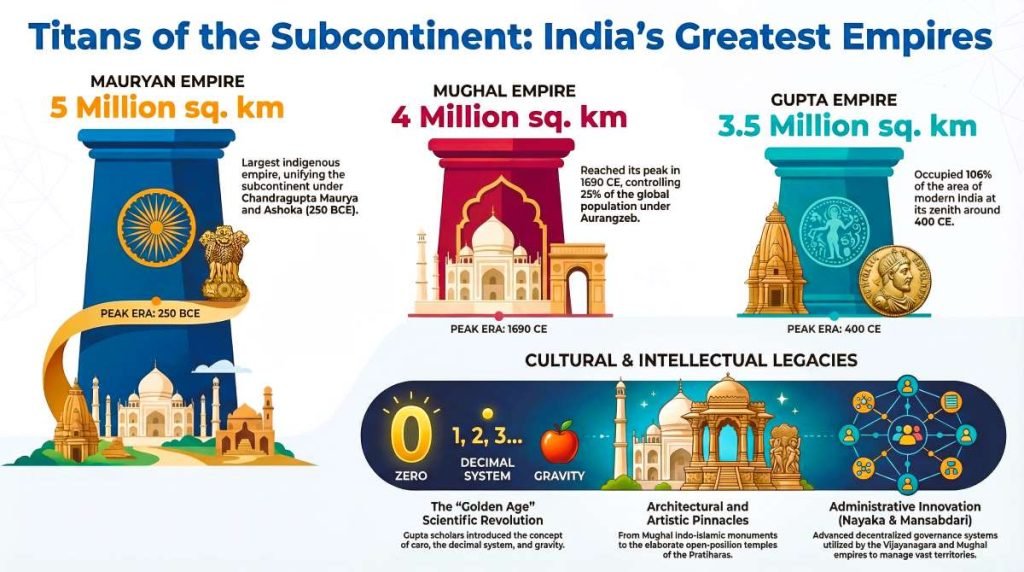
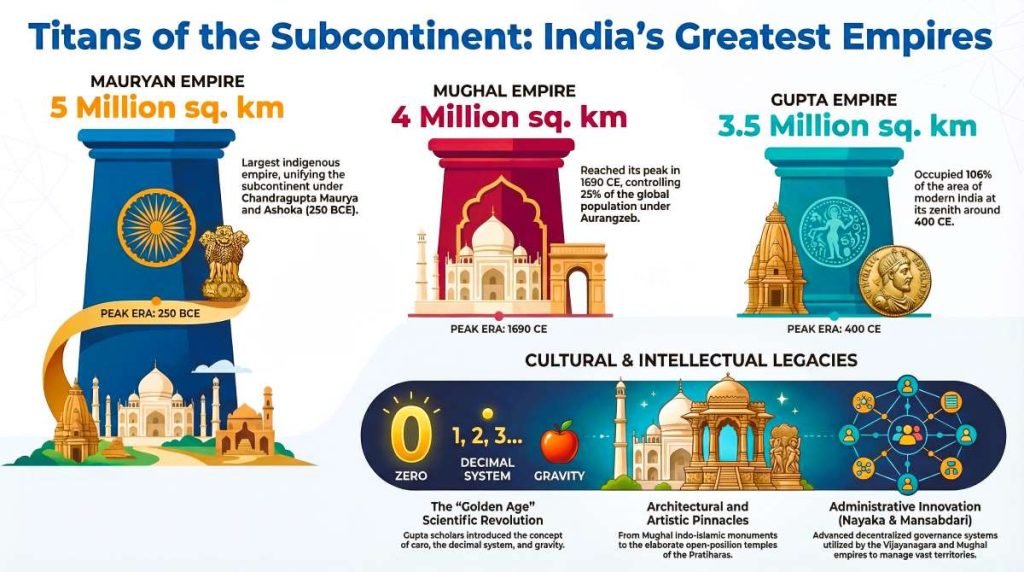
1. Mauryan Empire (322-185 BCE): Larger Than Modern India
Founded by Chandragupta Maurya, the Mauryan state achieved territorial dominance spanning 5 million square kilometers-approximately 152% of the current Republic of India. Stretching from Afghanistan to Bengal, this wasn’t a loose confederation but a sophisticated bureaucratic machine with extensive intelligence networks.
The empire’s most radical transformation came under Ashoka the Great. After the horrific bloodshed of the Kalinga War, Ashoka abandoned Digvijaya (conquest by arms) for Dhammavijaya-cultural and moral conquest. He transformed the empire from a military juggernaut into a vehicle for spreading Buddhism and ethical governance across Asia.
2. Gupta Empire (320-550 CE): The Scientific Revolution
While Europe navigated the early Middle Ages, Gupta scholars were revolutionizing human knowledge:
- Mathematical Breakthrough: Aryabhata refined the concept of zero and the decimal place-value system-the mathematical foundation of the modern world
- Astronomical Accuracy: Aryabhata proposed that Earth is a rotating sphere and correctly deduced that the Moon reflects sunlight-a millennium before Copernicus
- Metallurgical Mastery: The Iron Pillar of Delhi, made of 98% wrought iron, has stood for 1,600 years without rusting-a feat that still puzzles modern scientists
3. Gurjara-Pratihara Dynasty (730-1036 CE): The Shield of India
Often overlooked in history books, the Pratiharas served as India’s defensive bulwark for three centuries. They contained Arab expansion east of the Indus River, preserving the subcontinent’s cultural fabric during global Islamic expansion.
Their finest moment: the Battle of Rajasthan (738 CE), where they halted the Caliphate’s armies. An Arab chronicler wrote in 851 CE: “The ruler of Gurjara maintains numerous forces and no other Indian prince has so fine a cavalry… Among the princes of India there is no greater foe of the Islamic faith than he.”
4. Vijayanagara Empire (1336-1646 CE): The Hydraulic Marvel
The “City of Victory” represented urban splendor at its finest. Its capital, Hampi, was a global metropolis covering 25 square kilometers with a population exceeding 500,000-comparable to Rome or Constantinople.
The engineering feat? Sustaining this massive population in a semi-arid region through hydraulic infrastructure of staggering precision. Engineers utilized aqueducts, siphons, and gravity-fed pipelines to channel the Tungabhadra River into the city’s heart.
Under Krishna Deva Raya, the empire became a cosmopolitan superpower, integrating both Hindus and Muslims into the military and thriving on trade with Portuguese, Persians, and Chinese merchants.
5. Mughal Empire (1526-1857 CE): Gunpowder Wealth’s Double Edge
By 1690, the Mughals controlled 25% of the world’s population and funded iconic architecture from the Red Fort to the Taj Mahal. But this magnificence came at a cost: heavy taxation with little benefit to taxpayers created internal dissatisfaction. The empire was often most vulnerable when it appeared most magnificent-a paradox of marble grandeur and fiscal fragility.
Comparative Overview of India’s Imperial Giants
| Empire | Period | Territorial Extent | Key Achievement | Notable Legacy |
|---|---|---|---|---|
| Mauryan | 322-185 BCE | ~5 million km² (152% of modern India) | Ashoka’s moral transformation from military to ethical governance | Spread of Buddhism across Asia; concept of Dhammavijaya |
| Gupta | 320-550 CE | Northern & Central India | Scientific revolution: zero, decimal system, Earth’s rotation | Iron Pillar (1,600 years, no rust); mathematical foundation of modern world |
| Gurjara-Pratihara | 730-1036 CE | North & Western India | 300-year defense against Arab expansion | Battle of Rajasthan (738 CE); finest cavalry in ancient world |
| Vijayanagara | 1336-1646 CE | Southern India | Advanced hydraulic engineering in semi-arid region | Hampi ruins (25 km²); cosmopolitan governance under Krishna Deva Raya |
| Mughal | 1526-1857 CE | Peak: 4 million km² (25% world population) | Architectural grandeur; gunpowder empire dominance | Taj Mahal, Red Fort; fiscal fragility amid magnificence |
Scientific & Cultural Milestones
| Innovation | Empire/Period | Significance |
|---|---|---|
| Zero & Decimal System | Gupta (Aryabhata) | Mathematical foundation for modern computing and science |
| Heliocentric Insights | Gupta (Aryabhata) | Earth’s rotation & Moon’s reflected light-1,000 years before Copernicus |
| Rust-Proof Iron | Gupta | Iron Pillar of Delhi: 98% wrought iron, 1,600 years without corrosion |
| Advanced Surgery | Gupta (Sushruta Samhita) | Detailed surgical procedures and pharmaceutical use of mercury/iron |
| Hydraulic Engineering | Vijayanagara | Aqueducts, siphons, gravity-fed pipelines for 500,000+ population |
| Dhamma (Moral Governance) | Mauryan (Ashoka) | Cultural conquest replacing military expansion |
Military & Administrative Achievements
| Empire | Military Innovation | Administrative System |
|---|---|---|
| Mauryan | Extensive intelligence network (spies) | Sophisticated centralized bureaucracy across 5M km² |
| Gupta | Cosmopolitan synthesis of Indian & Hellenistic methods | Centers of learning (Nalanda, Takshila) |
| Gurjara-Pratihara | Finest cavalry in ancient world | Confederacy system that halted Caliphate expansion |
| Vijayanagara | Integration of Hindu & Muslim soldiers | Cosmopolitan governance; trade with Portuguese, Persians, Chinese |
| Mughal | Gunpowder technology dominance | Heavy taxation system (fiscal vulnerability) |
The Bottom Line
These empires aren’t dead relics-they’re the bedrock of modern Indian identity. From democratic pluralism echoing Ashoka’s Dhamma to the scientific spirit born with Aryabhata, their wisdom still resonates.
Standing before the rust-resistant Iron Pillar or walking through Hampi’s 25-square-kilometer ruins, one question lingers: If these ancient empires calculated Earth’s rotation and mastered metallurgy over a millennium ago, what other “lost” wisdom still waits to be rediscovered in the dust of the Deccan or the silence of the Gangetic plain?
The shadow of these giants is long. The marble of the Taj Mahal is magnificent, but it’s merely the latest chapter in a story that began with empires larger, wiser, and more scientifically advanced than most people realize.
Conclusion: The Legacy of India’s Great Empires
These ten empires-from the Satavahana guardians of the Deccan to Ashoka’s subcontinental Mauryan Empire-demonstrate conclusively that India possessed sophisticated political organization, territorial unity, and cultural continuity for over two millennia before colonial intervention. Each empire contributed uniquely to Indian civilization: the Satavahanas linked North and South, the Palas preserved Buddhist learning, the Rashtrakutas created architectural marvels, the Vijayanagara rulers patronized arts and commerce, the Cholas established maritime dominance and cultural export to Southeast Asia.
The Kushans connected India with Central Asia and the Silk Road networks. The Marathas demonstrated indigenous resistance and built an empire from regional origins. The Guptas created conditions for India’s Golden Age of scientific and cultural achievement. And the Mauryans under Ashoka unified the subcontinent on a scale matching any empire in contemporary world history.
Notably absent from this ranking are the Mughal emperors, despite their significant historical importance. This deliberate exclusion raises questions about how we categorize empires-should they be ranked purely by size, or should other factors like cultural impact, administrative innovation, or indigenous versus foreign origin influence classification? The Mughal Empire certainly controlled vast territories, but the video creator has indicated this topic deserves separate treatment, suggesting nuanced considerations beyond simple territorial extent.
What these empires collectively demonstrate is that India’s political unity, administrative sophistication, and civilizational continuity stretch back thousands of years. The persistent myth that India was merely a ‘geographical expression’ before British colonialism-that the subcontinent lacked political unity or common identity-is thoroughly refuted by examining these empires. From the 3rd century BCE Mauryan Empire to the 18th century Maratha Confederacy, Indian rulers created sophisticated political entities that governed hundreds of millions of people across millions of square kilometers.
The administrative systems developed by these empires-from Kautilya’s Arthashastra to the Maratha Ashta Pradhan council-demonstrated governance capabilities comparable to any contemporary civilization. The cultural achievements patronized by these rulers-from Gupta mathematics to Chola bronzes, from Mauryan rock edicts to Vijayanagara temples-represent peaks of human achievement that enriched world civilization.
Understanding these empires is essential for comprehending Indian history, identity, and civilization. They remind us that India’s story extends far beyond colonial narratives, encompassing millennia of political experimentation, cultural synthesis, scientific achievement, and territorial consolidation. The maps of these empires should instill pride not in territorial conquest per se, but in the sophisticated civilizations that created and sustained these political entities across centuries, contributing immeasurably to human knowledge, culture, and governance.
About This Analysis
This analysis synthesizes information from historical records, archaeological evidence, numismatic studies, epigraphic inscriptions, and scholarly research on ancient and medieval Indian history. Territorial extents represent scholarly consensus regarding maximum boundaries during peak periods and remain subject to ongoing historical debate. Dates follow current academic understanding but may vary slightly across different scholarly traditions.
Readers seeking detailed information should consult comprehensive histories of individual dynasties, archaeological reports from the Archaeological Survey of India, and academic works on Indian political history. The rankings presented reflect territorial extent primarily, though cultural impact, administrative achievement, and historical significance also factor into assessments. Understanding these empires requires engagement with primary sources including inscriptions, coins, literary works, and archaeological evidence alongside modern scholarly interpretations.